Excerpt From New York Women of Wit in the Twentieth Century
By Sabrina Fuchs Abrams
The question remains, why does women’s humor continue to be overlooked and undervalued? And why did these New York women of wit feel the need to mask their social critique through humor? The primary resistance to women’s humor goes back to false assumptions about feminine versus masculine behavior associated with the expression of intellect, aggression, and humor. Women were not supposed to “get” jokes, and they were certainly not expected to tell jokes.
Sarah Smith Tompkins Garnet: A Most Remarkable Suffragist
By Susan Goodier
Black women did not need white women to patronize, direct, organize, or financially support their efforts. They already had quite a few active suffragists, and several prominent leaders, including Sarah Garnet, and at least one organization in the city dedicated to women’s suffrage. In fact, virtually every Black women organization, established for whatever purpose—anti-lynching, racial uplift, integrated education, temperance—also supported women’s suffrage. It is the universality and intersectionality of Black women’s vision of equality and rights for women—as opposed to exclusion and limitation—that differentiates their suffrage activism from that of many white women’s organizations of the period.
Kazan’s efforts, combined with the power of the city’s labor movement and astute political alliance making, led to the building of 40,000 homes for working class New Yorkers. At a time when The Housing Question has rarely been more pressing than since Frederick Engels first raised it in 1872, recognising Kazan’s legacy is important. He successfully developed a model that worked: an alternative to the brutality of the housing market that, despite many challenges, has endured.
During her life, some members of the public drew connections between her antisemitism and her fervent anti-Zionism. But Woloch is right to separate these developments--there were Jews who rejected Zionism and many non-Jewish anti-Zionists who were not antisemitic. Gildersleeve pointed to her affection for Arab people and nations as the root of her anti-Zionism. This affection was, to be sure, inflected with Orientalism and the desire of some Progressives to remake Arab nations in the Protestant image. Still, she saw in Zionism the makings of bitter conflict in the Middle East. …Gildersleeve was active in the American Friends of the Middle East, a CIA-funded organization designed to cultivate closer ties between the U.S. and Middle East Arab nations… Digging deep into her controversial positions on Jews and Zionism, Woloch explains how the pieces of Gildersleeve’s worldview fit together.
Morganthau: Power, Privilege, and the Rise of An American Dynasty by Andrew Meier
Reviewed by David Huyssen
Henry wasn’t grateful. He hired Pinkerton agents to keep Lazarus away from his wedding. A talented, volcanically ambitious middle son, Henry had been nursing an Oedipal grudge for years. Lazarus had forced him to drop out of City College at fourteen to go to work, and the sting of this betrayal overshadowed the fact that it had also prompted a vital step on Henry’s journey to riches and repute: a job in a law firm run by one of Lazarus’s acquaintances, who initiated him into the world of property management.
Henry rejected his father but embraced his methods.
From roughly 1850 to 1950, Fulton Market would dominate wholesale fish provisioning in the United States and much of the country’s fish would pass through Fulton…As the market supplied itself from more distant locales, Fulton’s ecological impact widened. … wholesalers had to look further and further away and develop more and more complex means of preserving and moving fish. … the length and complexity of this process served to obscure the ecological impact of food—consumer appetites were, after all, destroying ecosystems a world away.
The Rise and Fall of Protestant Brooklyn: An American Story
Reviewed by Jon Butler
Between the Civil War and 1900, "old" Brooklyn both prospered and declined. Real estate developers and the new Brooklyn Bridge swelled Brooklyn's tony neighborhoods with middling and upper-class commuters to Manhattan….The New York Times may have been condescending when it labelled Brooklyn "that moral suburb" before the Brooklyn Bridge dedication, as Blumin and Altschuler put it. But it hadn't missed the Protestants' aim.
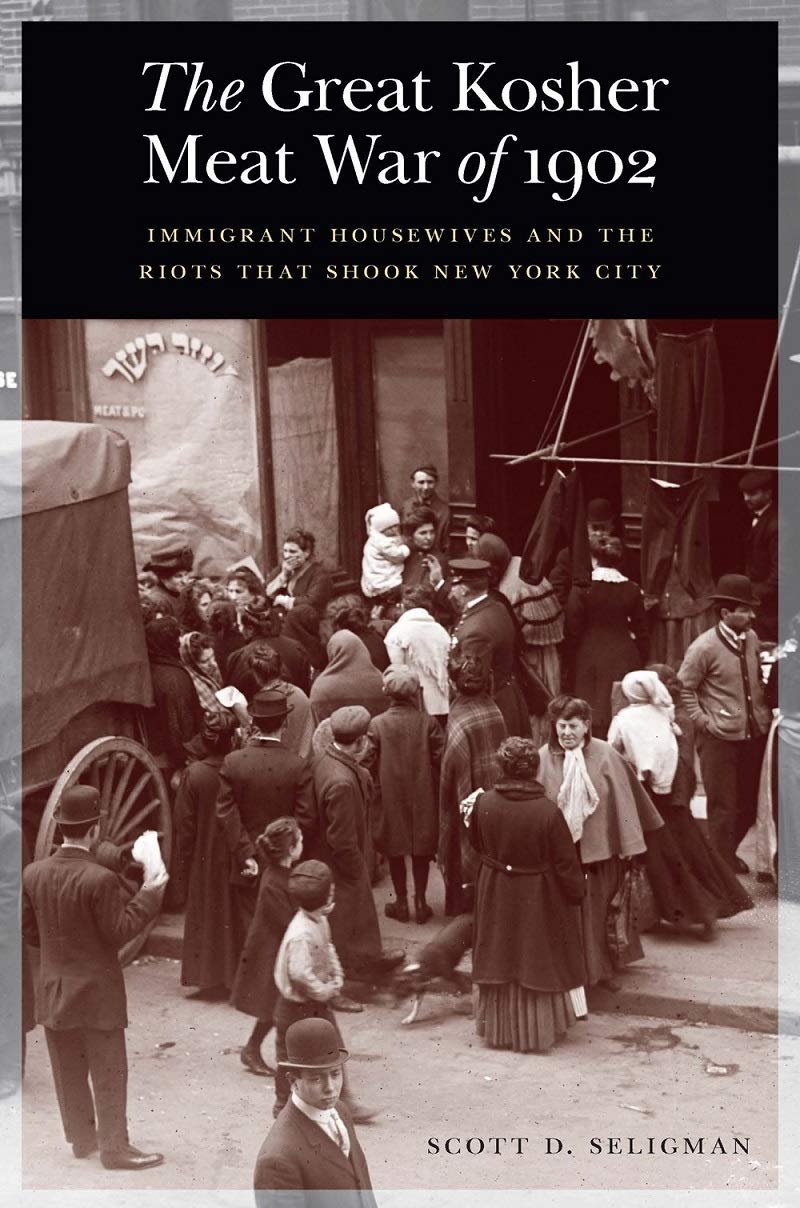
The Great Kosher Meat War of 1902: Immigrant Housewives and the Riots that Shook New York City
Reviewed by Aaron Welt
With The Great Kosher Meat War of 1902, Scott D. Seligman offers the first book-length treatment of the campaign of Jewish housewives against the “Beef Trust.” … Seligman provides a highly readable chronology of the events between May and June of 1902 that, at the time, earned the title of “a modern Jewish Boston Tea Party” and, later, the Kosher Meat Boycott. He succeeds in bringing to life the largely forgotten and primarily female leaders of the consumer campaign, their roles within the collective effort to bring down the price of kosher beef, the internal divisions that developed, and their significance for American Jews.
Henry Collins Brown and the Museum of the City of New York
By Claudia Keenan
Since at least the turn of the 20th century, New Yorkers raised the possibility of establishing a city museum. In 1904 when subway excavations at Bowling Green turned up a stone from the early 17th-century Fort George, a local author named Charles Hemstreet opposed giving it to the New-York Historical Society. “Once in the possession of the Society,” he told a reporter, “it would be as inaccessible to the general public as if it had been left in its underground resting place.” He urged the creation of a “municipal museum.”
Tong Kee Hang: A Chinese American Civil War Veteran Who Was Stripped of His Citizenship
By Kristin Choo
May is Asian American, Native Hawaiian, and Pacific Islander Heritage month, an appropriate time to recognize the Chinese Americans whose lives were disrupted, constricted or uprooted by the 1882 Chinese Exclusion Act and other racist laws and policies. Tong Kee Hang did not suffer the most egregious mistreatment meted out to Chinese immigrants during the late 19th and early 20th centuries. He was not beaten, lynched, or driven from his home like many others. But the loss of his citizenship and right to vote was a cruel blow for a man who had served his country in wartime and who took deep pride in being American.