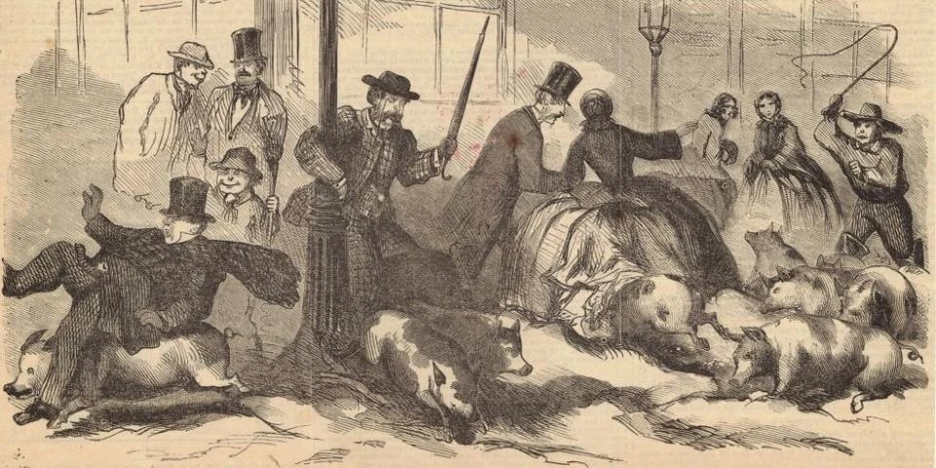
Unbeknownst to the Dutch colonists, their successors, the English occupiers, the politicians of Tammany Hall, and ultimately the Progressive Reformers, would all adopt variations of this warlike framing on pigs. The details of the various conflagrations with swine of interest, along with the broader impacts and effects of pig-control and pig-eradication policies, had significant and lasting consequences. Ultimately, pigs hold an important place in the history of domesticated animals in urban areas.
“The Chance Begins to Assume a Fair Prospect”: Marc Brunel and the Invention of the Steamboat — Part II
By Mark Kleinman
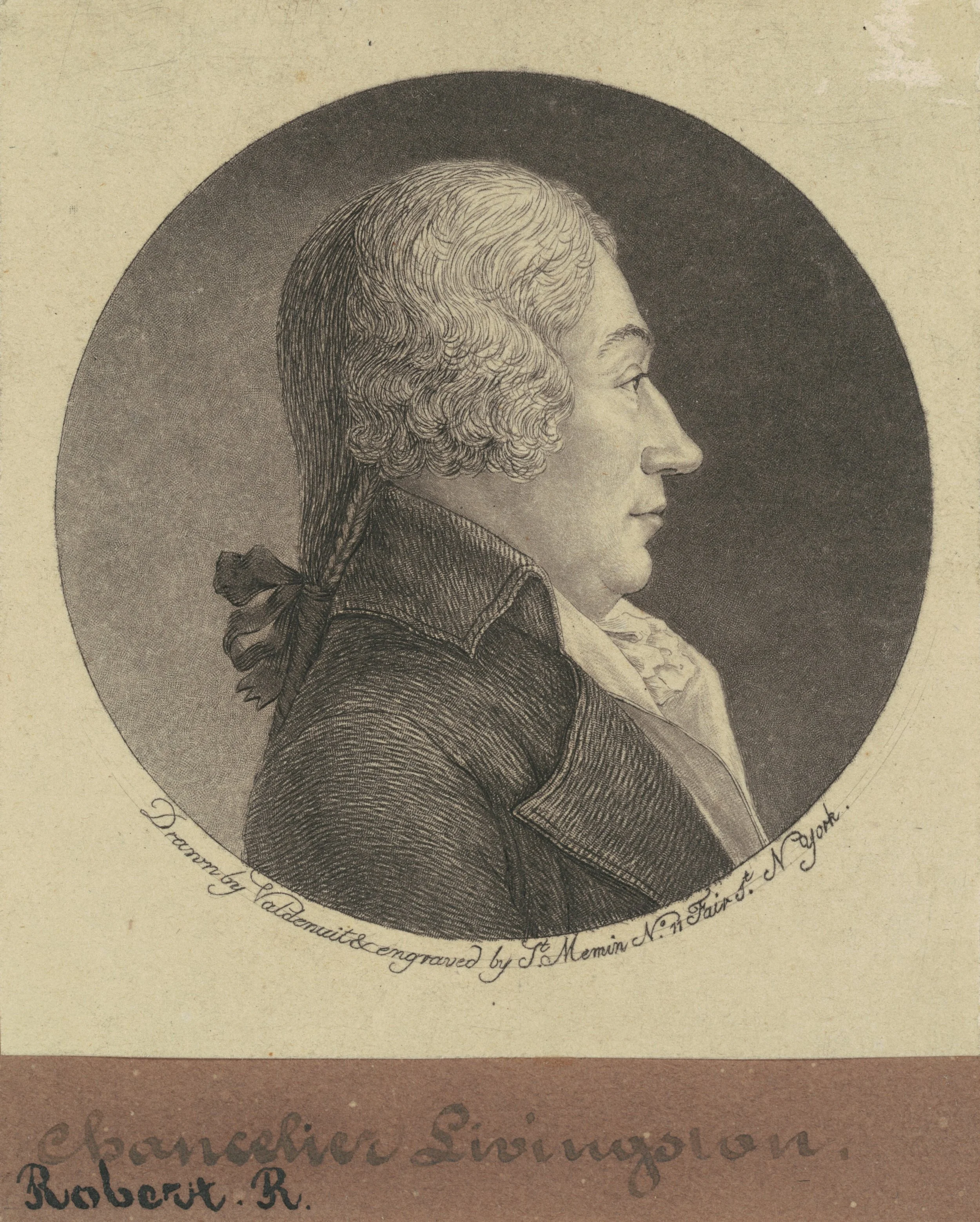
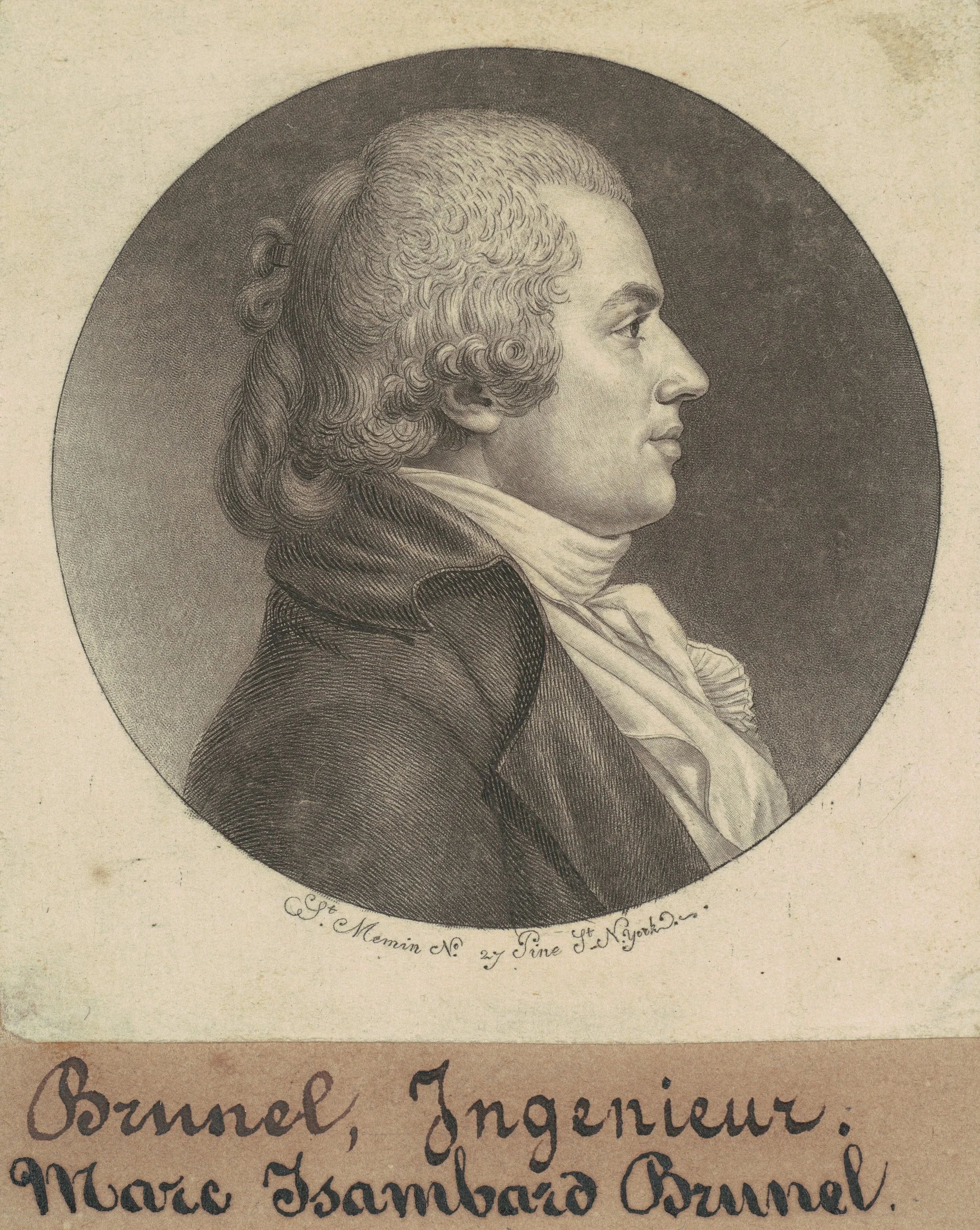
New York was still a very small city at that time. Its population doubled between 1790 and 1800, but was still only 60,000 at that date compared with 600,000 in Paris and 1 million in London. Brunel’s location first in Murray Street, then in George Street, placed him close to, among others, Nicholas Roosevelt, Alexander Hamilton and probably Robert Livingston’s town address. More generally, he was living and working in New York City just at the point when the still nascent city was beginning its rapid trajectory from local backwater to global metropolis.
“The Chance Begins to Assume a Fair Prospect”: Marc Brunel and the Invention of the Steamboat — Part I
By Mark Kleinman
The Colonel and the Chancellor now had the monopoly, the ideas and the enthusiasm. What they lacked, however, was an actual working steam engine. Here they had two options: they could import a suitable steam engine from England, preferably from the world-leading workshop of Matthew Boulton and James Watt in Soho, Birmingham. Or, they could build their own steam engine in the primitive engineering landscape of 1790s America, with a dearth of both suitable machinery and skilled engineers.
“Not only distressing but truly alarming”: New York City and the Embargo of 1807
By Harvey Strum
Regardless of these efforts, the embargo led to a deteriorating economy in the city. During the winter of 1808-09, “hundreds of…honest…and industrious citizens,” of New York City struggled “under the weight “of poverty and distress” produced by the embargo. In 1807, creditors imprisoned 298 people for debt; by 1808 that number had jumped to 1,317. By mid-February 1808, over 5,000 persons found shelter in the Alms House or received daily rations from it. More than a thousand laborers left the city seeking employment in the country, with hundreds of unemployed seamen similarly departing. On January 8th, in a truly radical response to their situation, 150 sailors turned their backs on their nation and accepted passage on British vessels headed for Halifax, Nova Scotia in search of employment in the British merchant marine. All considered, for New York the embargo ranked with the Great Depression as an economic nightmare that caused untold suffering on thousands of its inhabitants unable to find employment and dependent on public charity for subsistence.
Two-Hundred Fifty Years Of Organ-Building In the City: PART I — 18th-Century Imports and a Burgeoning 19th-Century Cottage Industry
By Bynum Petty
Thus, Henry Erben established himself as the greatest organ builder in the country, and with this instrument set new standards of construction and tonal quality by which all others were judged. Erben’s instruments simultaneously established New York City as the leading center of organ building, which it remained for the next nine decades.
Sojourner Truth: How the Enslaved Woman of a Dutch-New York Family Became an Icon of America’s Black Liberation Movement
By Jerome Dewulf
…[A]ssisting in the recruitment of Black troops for the Union Army… she had an audience with President Lincoln in 1864… in Washington, D.C., Truth challenged the de facto segregation in the city’s transportation system by insisting on her right to take a seat on streetcars. With her decision to use civil disobedience as a strategy to challenge segregation in public transportation, Truth anticipated Rosa Parks by almost a century. However, Truth could also be an uncomfortable voice within her own community. For instance, when Douglass defended the use of violence in the fight for racial justice at a meeting in 1852, she interrupted him with the words “Frederick, is God gone?” and, in 1867, she provocatively stated that “if colored men get their rights, and not colored women theirs... the colored men will be masters over the women, and it will be just as bad as it was before.”
The Rise and Fall of Protestant Brooklyn: An American Story
Reviewed by Jon Butler
Between the Civil War and 1900, "old" Brooklyn both prospered and declined. Real estate developers and the new Brooklyn Bridge swelled Brooklyn's tony neighborhoods with middling and upper-class commuters to Manhattan….The New York Times may have been condescending when it labelled Brooklyn "that moral suburb" before the Brooklyn Bridge dedication, as Blumin and Altschuler put it. But it hadn't missed the Protestants' aim.
David Grim’s Fairy Tale: The New York City Fire in Myth
By Benjamin L. Carp
On September 21, 1776, a fifth of New York City burned to the ground... But for almost 250 years, most New York City historians either ignored the Great Fire… or argued for its unimportance. They assumed that the fire was caused either by accident or by apolitical miscreants, and they chose to diminish the reports of outraged eyewitnesses who believed the fire was deliberate… most Americans never heard this story, then or since…
Dutch-American Stories: On the First Dutch Translation of the U.S. Constitution
By Michael Douma
There are a few topics that guarantee a historian an audience. Write a decent biography of Abraham Lincoln or James Madison, for example, and you are bound to have readers. Or, write something new and interesting about the Constitution and you might attract some attention.
Transatlantic Radicalism in Early National New York
By Sean Griffin
New York City has long been considered a hotbed of radical political ideas, as well as a cosmopolitan center of culture and commerce. But while the roots of the latter have been traced back to the city’s origins as a Dutch trading post with a decidedly commercial outlook and a polyglot population, fewer historians have explored the origins of the city’s radical political culture.