Melting Metropolis: An Interview with Daniel Cumming and Kara Murphy Schlichting
Interviewed By Rachel Pitkin
Public archives help create a record that highlights, or at least can suggest, the varied experiences of summer heat, even if one must learn to “read” the images with a critical eye. And while the archive itself is inherently selective — not everyone can or will upload their images of summer, of course — visual records that cross all five boroughs and span multiple generations reveal a rich tapestry of New York City life over many summer seasons.
Reel Freedom: Black Film Culture in Early Twentieth Century New York City
Review By Deena Ecker
Reel Freedom challenges the reader to think beyond the Harlem Renaissance and place film, an important piece of leisure in the 1920s and ‘30s, at the center of the Black cultural and intellectual transformation in New York and the nation. While much of the book focuses on the theaters in Harlem, Lopez reminds us that in the first decade of the 20th century, there were pockets of Black life all over the city. The ways that Black moviegoers, critics, projectionists, and producers engaged with film demonstrated a claim to physical, intellectual, and cultural space in early-twentieth-century New York. In real and significant ways, these claims to space were part of the larger Black struggle for equality.
The 1960s brought sweeping changes throughout America, and this included changes to women’s education. The Civil Rights Movement provoked a reassessment of the role of women in society. Many universities were reaching the conclusion that they could not, and should not, remain the restricted domains of male education. […] When Hunter College and Marymount Manhattan College became coeducational, Finch found itself competing with Barnard for the women-only market in the city.
Illustrating Your Ride: Fred Cooper and The Subway Sun
By Es-pranza Humphrey
When the Interborough Rapid Transit Company opened to the public in 1904, there was an active effort to beautify the underground stations and its metal vessels in order to ease the anxieties of riders who were hesitant to travel throughout the unknown. The initiative to beautify included the presence of a variety of posters presenting transportation etiquette and advertising products and services as a way to capitalize on the fact that passengers spent an average of fifteen minutes in a train car during their commute. Among the advertisements for Viceroy Cork Tipped Cigarettes, Rheingold Lager Beer, and Heinz Cream of Tomato Soup, were a series of in-car posters that helped riders navigate the subway to visit some of New York City’s most scenic wonders. This series was called The Subway Sun.
The Secret Man Behind the World’s Most Visible Building
By Jason M. Barr and Ann Berman
And yet almost all the stories about the origins of this New York landmark [the Empire State Building], online and in print, are inaccurate. They all omit the pivotal, behind-the-scenes role played by Louis Graveraet Kaufman (LGK) (1870-1942), the secret schemer, without whom the Empire State Building would not have been built. LGK’s hidden machinations irrevocably changed Gotham — and world — history, yet few today know his name.
The Hall of Fame for Great Americans: A Biography of Stanford White’s Forgotten Memorial
Review By Paul Ranogajec
The Hall of Fame for Great Americans, a group memorial and patriotic monument on the campus of the Bronx Community College, is a rich site for interrogating a range of cultural and political questions about American society from the 1890s to the present. Sheila Gerami’s book brings the now obscure monument to the attention of art historians and others who might want to approach New York’s memorial landscape from new angles.
Cultural Diversity, Ethnic Tensions, and Economic Marginality in an Early Bronx Settlement — Part 2
By Marian Swerdlow
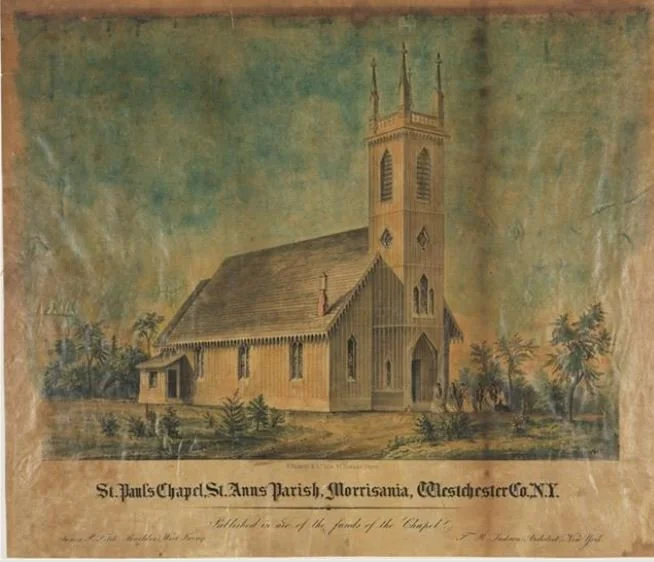
Only one church building from the time of the ancient Village still stands, the former Potts Memorial Church on Washington Avenue. As for the “successor” buildings these congregations moved into after the dissolution of the Village, three of them — the former St. John’s German Evangelical Lutheran Church on Fulton Avenue, the First Congregational Church of Morrisania on Forest Avenue, and St. Paul’s Episcopal Church on Washington Avenue — still stand, although just outside the borders of the ancient Village. The latter two retain their original congregations. Each of the three is a beautiful building in a very different style, and each well worth a visit. The demolitions of the magnificent third St. Augustine’s church (1895 - 2013), and of the historic former Centenary Methodist Episcopal Church (2019), are part of the story of an area that has been one of the poorest in New York City for over half a century.
Cultural Diversity, Ethnic Tensions, and Economic Marginality in an Early Bronx Settlement — Part 1
By Marian Swerdlow
The Village of Morrisania, founded in 1848, was the first area west of the Bronx River to be densely settled in what today is the Bronx. Despite this historic significance, almost nothing has been published about it in the past century, possibly because of the scarcity of resources in the community that is today in the ancient Village’s footprint.
Davida Siwisa James: Hamilton Heights and Sugar Hill
Interviewed by Rob Snyder
Davida Siwisa James explores two parts of Harlem in her book Hamilton Heights and Sugar Hill: Alexander Hamilton’s Old Harlem Neighborhood Through the Centuries, published by the Empire State Editions imprint of Fordham University Press. Exploring four centuries of life in a part of upper Manhattan that stretches from 135th Street to 165th Street and from Edgecombe Avenue to the Hudson River, James looks at the encounters between the Lenape and Dutch settlers, the rural village that was Harlem, and the Harlem Renaissance luminaries who lived in Hamilton Heights and Sugar Hill.
New York City’s borough of Staten Island has a long history of quarantines and public reactions to them. Just over five miles from Manhattan, Staten Island has faced numerous disease outbreaks, with quarantine measures playing a central role in containment efforts. In the nineteenth century, mass immigration and the spread of infectious diseases overwhelmed the city, leading to stricter quarantine enforcement.