
New York Sari: An Interview with Curator Salonee Bhaman
Interviewed By Dominique Jean-Louis
Today on the blog, Dominique Jean-Louis, Chief Historian at the Center for Brooklyn History, talks to Salonee Bhaman, co-curator of The New York Sari, an exhibition at The New York Historical’s Center for Women’s History that explores the sari’s presence in and impact on New York City history.
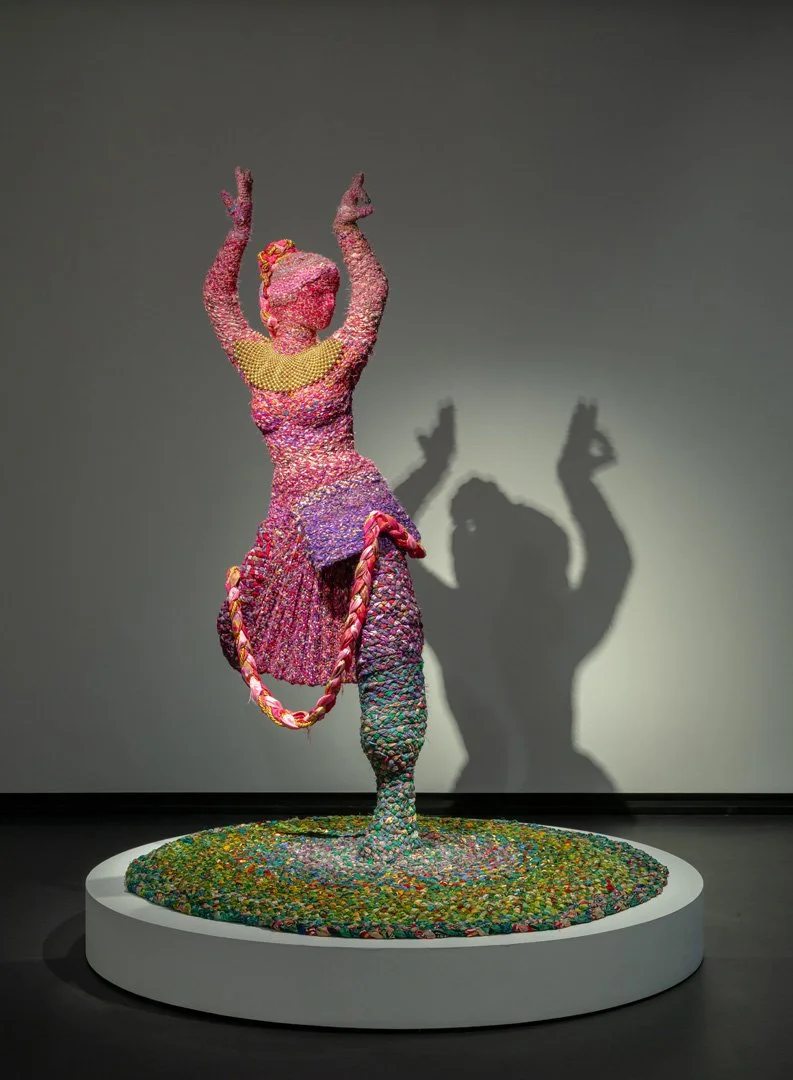
Suchitra Mattai (b. 1973), she arose (from a pool of tears), 2024. Worn saris (braided), beaded necklace, and gold cord. Courtesy of the artist and National Museum of Women in the Arts, Washington, DC / Photo Kevin Allen.
The beginning of the exhibition offers us encouragement to think about a sari as a symbol of movement, both as a consumer good that is moving through the circuits of global trade, but also as a garment worn by human people in motion. You give us a map of the sari’s scope and scale, juxtaposed next to that beautiful piece, she rose from a pool of tears, by Guyanese-American artist Suchitra Mattai, inspired by bharatanatyam dance. How did this particular sculpture come to be in the exhibition, and why was it so important to include this map of globalization and empire before you start diving into the New York City specificity and the historical sections of the exhibition?
There are a few different things that I want to touch on here that were really important to us about this piece. The first is Suchitra Mattai’s truly singular and beautiful work. Anna Danziger-Halperin (co-curator of this exhibit) and I had identified Mattai as someone we hoped to include from the very beginning of our process in part because of a gorgeous installation she had done in the Socrates Sculpture Park in Queens using the sari as this architectural object. All of Mattai’s pieces — tapestries, paintings, sculptures — evoke the materiality of history in the present day. They often depict scenes of colonial encounter or domesticity punctuated by found, fragmentary, and deeply intimate objects–scraps of sari fabric that had once belonged to family members or crowd-sourced by Mattai’s mother from friends; small trinkets; or even hair.
A common refrain at the New York Historical is that objects tell stories. As a body of work, Mattai’s art speaks to the way that history can be a ghost that animates the essence of everyday objects. The sculpture we have on display tells a very particular story: Mattai is a member of the Indo-Guyanese diaspora, and the saris of her ancestors are evidence of a story of forced migration and cultural belonging that felt really important to include in any show about South Asian life in New York City. Guyana is not in South Asia, but New York’s Indo-Caribbean community is emblematic of how these fabrics, styles, and stories have moved across time and space to find a home here. The dancer in the sculpture is engaged in a very traditional form of spiritual dance that shows up repeatedly through the exhibit as well.
I am obviously biased as the Chief Historian at the Center for Brooklyn History, but I was delighted to see so much Brooklyn and so many Brooklynites represented in this exhibition… and a little surprised that the history of the sari goes back that far in Brooklyn. Could you tell me a little more about the journey of researching the sari’s history in Coney Island specifically? Did you know about this history going in? What conclusions about the sari’s meaning in New York City specifically did it lead you to?
We were also surprised to see the history of the sari went that far back! When we first began researching this exhibition, I had anticipated that the biggest problem we would encounter would be finding traces of real-life women wearing the sari in New York. I had assumed that the Page Act, which explicitly restricted the entrance of Asian women into the United States, would foreclose all but the most elite diplomatic emissaries to the region. The story of the dancers who had come to New York to perform on stage and on Coney Island in the 1890s broke open for us when we discovered an excellent book called Sweating Saris by Priya Srinivasan. I won’t get into a deep summary of her research, but I highly recommend it to anyone who’s interested in learning more about this particular moment and the transnational encounter of South Asian dance in the early 20th century.
I had also heard rumors that P.T. Barnum had brought elephants from India to Brooklyn, but I certainly didn’t know what a big role performers from the subcontinent had played in the opening of Luna Park. That history underscored what a central role these real people — highly skilled dancers and performers — played in shaping American leisure culture in this moment. New Yorkers came to Luna Park to witness the spectacle of this kind of exotic performance. When I think about that fact in conversation with the work historians like Kathy Peiss and George Chauncey have done on the role of Coney Island as a space in the development of a leisure culture that featured cross-class socialization, same-sex intimacy, and a burgeoning working-class consumer culture, that feels really significant. Historians can be guilty of compartmentalizing our areas of study by geography or area; the story of the Coney Island dancers points to the ways that the idea of the exotic was part of constituting some very local notions of modernity, leisure, and being a New Yorker at the turn of the century.
We are obviously currently in the midst of having conversations about the outrages of 21st-century fast fashion, but you really establish here how much textiles have always been political–how they’re made, what they’re made of, who has access to them, what they symbolize. It also so happened that I visited this exhibition while I was in the midst of watching Ken Burns’ new documentary about the American Revolution, and his storytelling about American women’s resistance in the form of homespun cotton had so many echoes in the history you share about kala cotton in India. How does focusing on fabric (and by extension, gender) change the narrative about resistance, revolutions and freedom fighting?
Researching this exhibition showed me how the politics of textiles and fashion operates on multiple levels. The most obvious, perhaps, is the way that the choice of what to wear can be a kind of self-narration or self fashioning — an act of claiming or reinterpreting a particular identity in a new context. We certainly saw a lot of that among the people who boldly wear a sari on the streets of New York over the last two hundred years.
But we also found that the association between fashion, cloth, and the domain of women also allowed certain women to harness a kind of soft power that might have otherwise been lost to them. Homespun cotton offered women an entryway into a fairly masculine movement for independence that many had initially been closed off to them. One of the women we showcase in the exhibition, Kamladevi Chattopadhyay, is a great example. Kamaladevi was a child widow who defied many of the social conventions of her time to become a prolific activist. In one of her first trips abroad, she and a group of women ripped up their saris to use as a makeshift flag to represent India at an international conference in Berlin — because at the time there was no national flag. She is also often remembered as the “mother of the Indian handicrafts movement” because she dedicated much of her life after independence to studying, documenting, and preserving the various artisanal traditions of the rural people in different parts of India. For her, these traditions represented a form of resiliency against the ravages of industrial capitalism within a globalizing economy. Cloth — and the complex history of labor, land, gender relations, and class behind it — is the vernacular through which many women found that they were able to express powerful political opinions.
Peppered throughout the exhibition’s sections, we have these vignettes where various New Yorkers have loaned their own saris to be displayed: we have the sari that New York City’s first South Asian member of City Council Shahana Hanif wore to her swearing-in, a sari worn by Jeeno Joseph, founder of the Nadanam Dance Collective, for performances of the piece “Rachana,” a sari worn by Brooklyn-based designer, drag artist, and photographer RuAfza. These vignettes feel like the heart and soul of this exhibition—how all this tradition and history and craft and meaning actually shows up in the world, in people’s lives, on their very skin. How did you go about selecting saris and people to feature? What were people’s reactions? What were some of your favorite parts about the outreach process?
These vignettes are the heart of the exhibition! We knew as soon as we started thinking about this exhibition that there would be absolutely no way to represent all of the stories and experiences of New Yorkers who have a connection to the sari. We also knew that our own collections really lacked materials from New Yorkers of South Asian ancestry. These community stories offered us a way to connect with folks and allow them to speak in their own words about the way the sari showed up in their life. In some instances, we were also lucky enough to record oral histories with these individuals, so that our collections also reflect their experiences in detail for future historians to look at. We reached out to folks who had strong roots in their communities, with an eye towards capturing a diversity of experiences, backgrounds, and regional identities. We actually did not ask anyone for a specific type of sari — and I was surprised to see just how many beautiful Banarsi silks we got across the board.
The outreach process as a whole was the most precious part of this exhibition for me. Anna and I have met so many incredible people while curating this exhibit who have really dedicated their lives to uplifting their communities, taking care of their neighbors, and making incredible spaces for New Yorkers to gather. More often than not, they also introduced us to others who they worked with. RuAfza, for example, put us in touch with the incredible textile artist and fashion icon Nikita Shah who draped most of the saris in this exhibition and produced a fabulous “Get Ready With Me” video. I learned so much from every single person who featured in this show.
I guess I shouldn’t be surprised that an exhibition about saris at the New York Historical, a museum and research library, has so many books in it, but I was so struck by how many kinds of texts are on display as this exhibition explores sari-wearers in the South Asian diaspora. Comic books! Cookbooks! Novels! Handicraft books! Music albums! I was so struck by the argument that emerges about the intellectual contributions of South Asian women in particular, and how you can easily find them if you know where to look. Was it intentional to be offering saris as texts, alongside all these other kinds of published works?
Yes! I emerged from this process totally sari-pilled, but even beyond the metaphorical thought that saris tell stories — often, there are literal stories in the warp and weft of a woven textile like the sari — from the motifs that recur (flowers, or birds, or patterns) or the colors and the dyes that are used — that can speak to who made the sari, where they were working, and what materials they were using. For many sari wearers, these aren’t just incidental, they’re part of the message they’re sending when they put on an outfit. It’s very thoughtful. I am a historian, and I’ve typically been motivated and moved by more “traditional” texts — this exhibition really showed me how they might live alongside one another. I’ll also confess that I cannot resist the opportunity to put folks on to some cool stuff that they may not have known about — it’s my sincere hope that all the texts we had on display, from books, to cookbooks, to records, can inspire people to go seek out what they find themselves drawn to.
One of the ways that the New York framing adds value to this exhibition is how you address immigration and neighborhood segregation. You show how immigration policy, and city residential segregation, creates neighborhoods like Harlem. These dynamics play such important roles in establishing New York as a place where South Asian people, and their cultural traditions, permeate diverse populations in enclaves and patterns. It was a kind of mind-blowing moment to learn that Miles Davis’ sound evolves because of his exposure to the music played at a Harlem Indian restaurant, but you help us understand that it’s no coincidence that there are Indian restaurants in Harlem in the first place. What are you hoping that people come away with in terms of understanding how policy and legislation affects culture and cultural encounter?
Our social, material, and emotional worlds are shaped by history that is often far more complicated and varied than what we’re likely to learn in a classroom. I hope that people come away from this exhibition with a curiosity to learn more about how and why the things they love in this city — be it a beautiful and colorful fabric or a funky groove, or a tasty and transcendent meal — got to where they are and then follow that curiosity to learn more about the people that brought that thing, or food, or color palate into their lives. New York is a city of immigrants. It has been for a very long time. The themes of displacement, segregation, and persecution that often suffuse our stories of migration come to exist alongside a different set of narratives in this place: stories of community forged across differences of culture and experience. I hope that looking more closely at the myriad moments of cultural encounter we each experience daily in this city with an eye towards understanding the historical currents that lie beneath them will serve each of us.
“The New York Sari” is on view at The New York Historical until April 26, 2026. https://www.nyhistory.org/exhibitions/the-new-york-sari