
Russell Shorto, Taking Manhattan: The Extraordinary Events That Created New York and Shaped America
Reviewed By Dillon L. Streifeneder
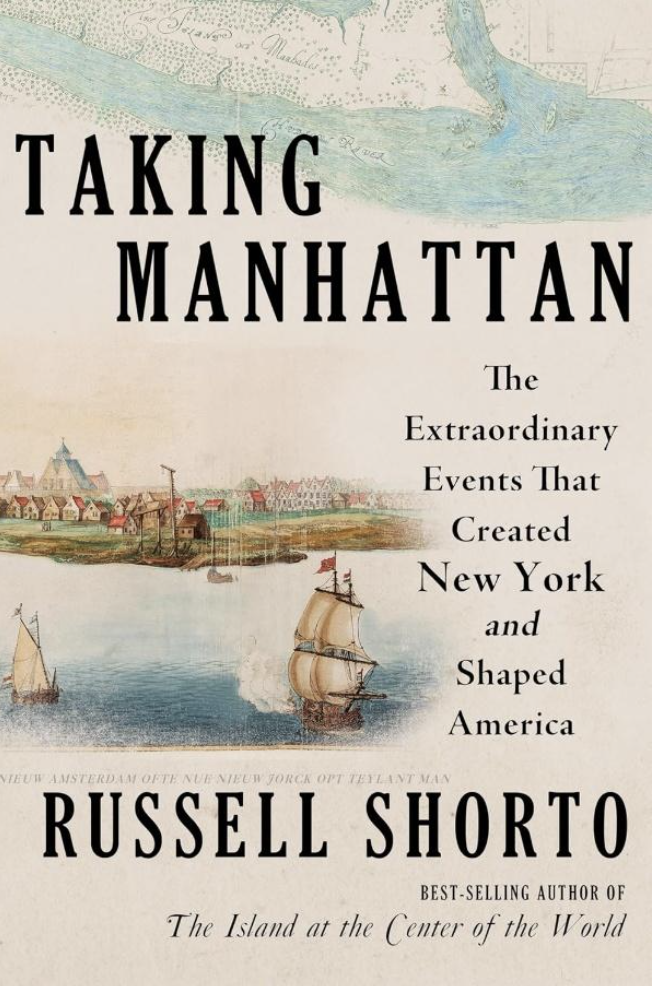
Taking Manhattan: The Extraordinary Events That Created New York and Shaped America
by Russell Shorto
W.W. Norton and Company
May 2025, 416 pp.
That the English took New Netherland from the Dutch in 1664 is well known. Why the English seized the Dutch colony, along with the circumstances of how they managed to achieve their conquest, however, remain largely forgotten to all but a small number of professional historians and archivists. Russell Shorto’s Taking Manhattan: The Extraordinary Events That Created New York and Shaped America, in what is surely the most comprehensive and accessible account of the English conquest, is therefore a welcome addition to scholarship on New York’s Dutch period and well-worth the read.
Taking Manhattan is indeed a sequel to Shorto’s 2004 bestselling story about the Dutch colonization of Manhattan, The Island at the Center of the World. While reading both in conjunction will certainly provide the reader with greater context, Taking Manhattan nevertheless stands well on its own. Structurally, Taking Manhattan is divided into four parts. After a brief prologue set in the twenty-first century, Part One, “Squaring Off,” focuses on events in 1664 in the days just prior to the English conquest of New Netherland. In two complementary chapters titled “The Invader” and “The Defender,” Shorto introduces his two antagonists: the English Richard Nicolls and the Dutch Petrus Stuyvesant. Beyond giving a sense of the character of both men, these chapters also provide a clear sketch of the make-up of the English invasion force, and the complex society Stuyvesant found himself governing.
More importantly though, these chapters highlight the contingent nature of the whole expedition. As Shorto demonstrates, the Dutch surrender was in no way guaranteed. Arriving in New England, Nicolls received a cold welcome from Puritan leaders in Boston who, as Shorto observes, “had become a rogue state” (p. 51). Adding to Nicolls’s list of worries, the New Englanders might have refused to assist with his mission against the Dutch. But the English expedition also received help from an unlikely agent: Stuyvesant. In Chapter 4, “Stuyvesant’s Error,” Shorto demonstrates that the aging yet redoubtable Stuyvesant made a series of miscalculations “in dealing with the impending English attack” (p. 59) that doomed New Netherland. In an intriguing “what if” moment, Shorto recounts an offer of cooperation between the Dutch and Native Americans proposed by “Quashawam, the daughter of a powerful Montaukett sachem” (p. 59). Could the Dutch, as Shorto seems to allude, have withstood the English invasion if they had joined forces with Native tribes, rather than dismissing them as Stuyvesant did? Likely not, but considering these paths not taken is instructive, and Shorto’s focus on the decision-making process of individual actors is thoughtful and compelling.
Jumping backward in time, Part Two, “Settlement and Exile” provides background on Nicolls and Stuyvesant and their respective homelands of England and the Dutch Republic. Chapters 5, 7, and 9 focus on Richard Nicolls, the English Civil War, and the Restoration of the Stuart Kings in 1660. Shorto’s narrative follows Nicoll’s life story, starting in “unassuming” Ampthill (p. 70) to highlight his connection to the royal family and his military service during the English Civil War. In Chapter 7, he traces his flight across the English Channel, exile in France and loyal service to the Stuarts, and his role running secret missions to help build Royalist support and undermine the Cromwellian regime. This culminates with a chapter on Restoration England that weaves together an emerging English policy toward its colonies in North America, as well as the emergence of a plan to bring down the Dutch empire. Overall, these chapters are superb and could serve as a stand-alone primer on English politics in the Restoration period.
The Nicolls narrative is broken up by two chapters focusing on the Dutch, with chapter 6 offering a standard overview of the Dutch colonization of New Netherland. For readers familiar with The Island at the Center of the World, they will find no new insights here. Chapter 8, however, is a welcome addition, using Stuyvesant’s tenure in New Netherland to examine the introduction of African slavery on Manhattan. As a commercial venture intended to generate profits for investors – the Dutch West India Company – New Netherland was a failure. In searching for solutions, by the late 1650s the company’s directors adopted the idea of experimenting with tobacco cultivation and turned to Africa to acquire a forced labor pool for that purpose. Placed in conversation with chapter 6, this chapter illuminates that while the Dutch might have been proponents for creating a society based on tolerance, such sentiment did not hinder the spread of chattel slavery when company profits were in question.
Part Three, “A Game of Chess,” opens by providing a chapter that examines “the essence of Anglo-Dutch conflict in the seventeenth century” (p. 180). Here Shorto offers an excellent comparative example of the English expedition against the Dutch posts on the West African coast, demonstrating that Nicolls’ charge to take New Amsterdam was only one part of a larger English assault on the Dutch empire. Returning to North America, Chapter 12 focuses on New England and efforts by competing factions to obtain royal charters from the Stuarts, while also explaining the complicated relationship New Englanders had with Stuyvesant and the Dutch. This chapter is crucial, for it helps explain the role played by New Englanders as intermediaries between Stuyvesant and Nicolls, as well as the lenient terms Nicolls was eventually willing to offer. This all plays out in the remaining four chapters of Part Three, in which the possibility of military action is palpable, and the peaceful transfer of power is in no way guaranteed. As Shorto highlights, “Nicolls had his instructions,” but Stuyvesant’s stubbornness and gamesmanship during deliberations over transferring the city and colony strained Nicolls’s diplomatic skills. Even for the reader who knows the outcome, Shorto squeezes every drop of drama out of the negotiations and in the process, shows that the lived drama mattered a great deal in shaping the eventual “Articles of Surrender” (p. 258) and, perhaps, present-day New York City.
Part 4, “The Invention,” wraps up Shorto’s narrative by tracing the lives of Nicolls and Stuyvesant after the English conquest before moving on to explain how the English and Dutch merger set the groundwork for “the pluralistic and capitalistic features of New York” present today. The author elaborates on this theme in his final chapter as well, claiming that “from its Dutch beginnings New York has always been pluralistic. Out of that pluralism came the city’s tradition of factionalism, which in turn made it an ongoing breeding ground of ideas” (p. 321). In doing so, at least according to Shorto, New York “paved the way for a society based on pluralism and capitalism” that offers an alternative “strain” of American identity from that championed by the likes of Donald Trump (p. 322).
Shorto’s book is nothing short of a masterclass on how to weave together lurid prose with erudite and complicated archival research, making a largely overlooked period of history come alive for the reader. The conclusions that Shorto draws, however, are largely unsatisfactory and problematic. For starters, the Dutch were not the only (nor the most) “tolerant” – in the seventeenth century sense of the word (p. 99-102) – or pluralistic in the wider Atlantic world. In an effort to demonstrate the uniqueness of Dutch tolerance and diversity, Shorto is forced to use a caricature of New England that turns it into a pre-modern monolith, but it was not. Doing so ignores the existence of places like Rhode Island, a colony founded on religious toleration and pluralism. Similarly, it was the Quaker-founded colony of Pennsylvania that attracted arguably the most diverse body of immigrants (including German Palatine’s who fled New York in the eighteenth century), ensuring that until the nineteenth century, Philadelphia, not New York, was the premier, as well as the most tolerant and diverse city in North America to which immigrants flocked. If a tradition of “secular pluralism” did emerge out of the colonial period, as Shorto claims, its origins would more likely be found in Philadelphia.
More glaringly though is the issue of slavery, especially considering the institution’s development over the eighteenth and nineteenth centuries. Contrary to Shorto’s conclusions, in New York, the progeny of the seventeenth century Dutch became the state’s most prolific slaveholders. Broadly speaking, slaveholding in New York fell along notable ethnic lines. For the most part, Dutch, Germans, and Anglo-Dutch landlord elites held slaves, that in some cases, looked quite similar to slaveholding among the Tidewater planters. Conversely, Yankee-settled towns, at least in the Hudson Valley, “contained virtually no slaves.” [1] Similarly, it was a group of transplanted New England Quakers who were the first to denounce slavery and call for emancipation in New York, whereas those of Dutch heritage were some of the most ardent opponents to the state’s emancipation program. [2]
Beyond the issue of slavery, Shorto’s portrayal of Dutch tolerance and diversity largely ignores that the English empire of the 17th century was incredibly culturally diverse. Unlike the few thousand inhabitants in Dutch New Netherland, however, English diversity was spread across a vast continent and ocean in a range of “cultural regions” that complemented “significant local diversity.” [3] But Shorto generally treats New England as representative of the wider English experience, ignoring that the Puritans were an oddity within the English Atlantic world who found themselves increasingly in conflict (as the author demonstrates) with the home government. Notably, after having their charter revoked in 1684, the English forced Massachusetts to adopt a policy of toleration. Also missing from the narrative, in part because his focus is on the likes of Nicolls and other Royalists, is any mention of the Levellers and similar groups in England who espoused what was arguably the most radically egalitarian ideology of the seventeenth century. It is worth highlighting that numerous groups of immigrants that adopted such radical ideological strains populated parts of the Chesapeake and Carolinas, and strove to create societies that equally distributed property, prohibited slavery, and preserved religious toleration to guarantee political freedoms. [4]
And this leads to another issue: the absence of the Chesapeake. As historian Jack P. Greene and others have demonstrated, it was the Chesapeake experience, not New England’s (and certainly not the Dutch) that “was normative in Anglo-American colonial development.” [5] From its founding, Chesapeake society embodied the key characteristics of a commercial (or capitalistic) economy, with settlers looking to get rich quickly through the export of commercial crops, and in the process creating a relatively dynamic and fluid society. A society from which, in the aftermath of the American Revolution, backcountry Quakers and Baptists pressured the Virginia elite to dis-establish a state church and enshrine religious freedom not only at the state level, but also in the US Constitution.
None of these critiques mean to imply that the Dutch presence in New York was inconsequential; but the Dutch influence must be contextualized and qualified. Such criticism, however, should not tarnish Taking Manhattan’s notable achievements. In this reviewer’s opinion, Shorto’s Taking Manhattan has established itself as the standard narrative of the English conquest of Dutch New York, a place it will hold for the foreseeable future.
Dillon L. Streifeneder is Assistant Professor of History at the United States Naval Academy, Annapolis, MD and Associate Editor for Gotham: A Blog for Scholars of New York City. He is currently writing a book on state formation in New York spanning the colonial period through the American Revolution.
“The views expressed in this review are those of the author and do not reflect the official policy or position of the U.S. Naval Academy, the Department of the Navy, the Department of Defense, or the U.S. Government.”
[1] John L. Brooke, Columbia Rising: Civil Life on the Upper Hudson from the Revolution to the Age of Jackson (The University of North Carolina Press, 2010), 136-138. Brooke demonstrates that ethnically Dutch towns, the number of slave-owning households averaged more than 25%. Conversely, ethnically “Yankee” towns never exceeded 10% of households.
[2] David N. Gellman, Emancipating New York: The Politics of Slavery and Freedom, 1777-1827 (Louisiana State University Press), 27-31.
[3] Jack P. Greene, Pursuits of Happiness: The Social Development of Early Modern British Colonies and the Formation of American Culture (The University of North Carolina Press, 1988), 52.
[4] Noeleen McIlvenna, Early American Rebels: Pursuing Democracy from Maryland to Carolina, 1640-1700 (The University of North Carolina Press, 2020).
[5] Greene, Pursuits of Happiness, 53.