
Oaths and Interracial Solidarity: New York City’s 1741 Plot
By Kevin Murphy
In early 1741, an investigation into a robbery in Manhattan led to rumors of an interracial plot to destroy the city. Local officials tracked stolen coins and other items to John Hughson, a tavern-keeper known for serving enslaved people. Authorities were already concerned about illicit rendezvouses among slaves, soldiers, and poor whites; their suspicions spiked, however, when a series of unexplained fires started at Fort George and then at various places across the city. Mary Burton, the Hughson’s sixteen-year-old “Irish servant girl,” came forward to implicate her “master” and his customers, painting a vivid picture of impending mayhem. [1]
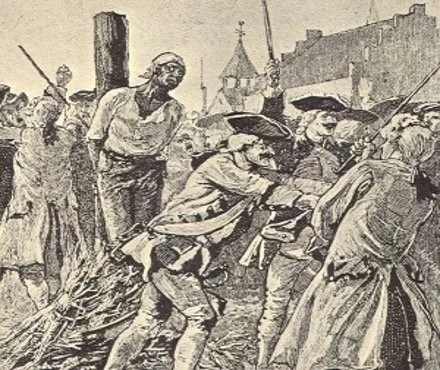
"Convicted Plotter Being Burned at Stake," Douglas O. Linder, Famous Trials: Accounts and Materials for 100 of History's Most Important Trials by the University of Missouri-Kansas City Law School (https://www.famous-trials.com/newyorkplot/364-images)
In her initial testimony in late April, for which she received a substantial cash reward and her freedom, Burton claimed that three enslaved men — Caesar, Prince, and Cuffee — conspired with John Hughson and his wife Sarah to burn down New York City. Setting the fires, Burton asserted, was the opening move of a plan to slaughter the white people who rushed to douse the flames, to be followed by overthrowing the wealthy elites and slaveowners. Disgusted that “a great many People had too much, and others too little,” the rebels would then redistribute the wealth among themselves and install John Hughson as King and Caesar as Governor. Perhaps most shocking, Burton claimed to have overheard schemes to force the white ladies of the city into concubinage for the rebel slaves.
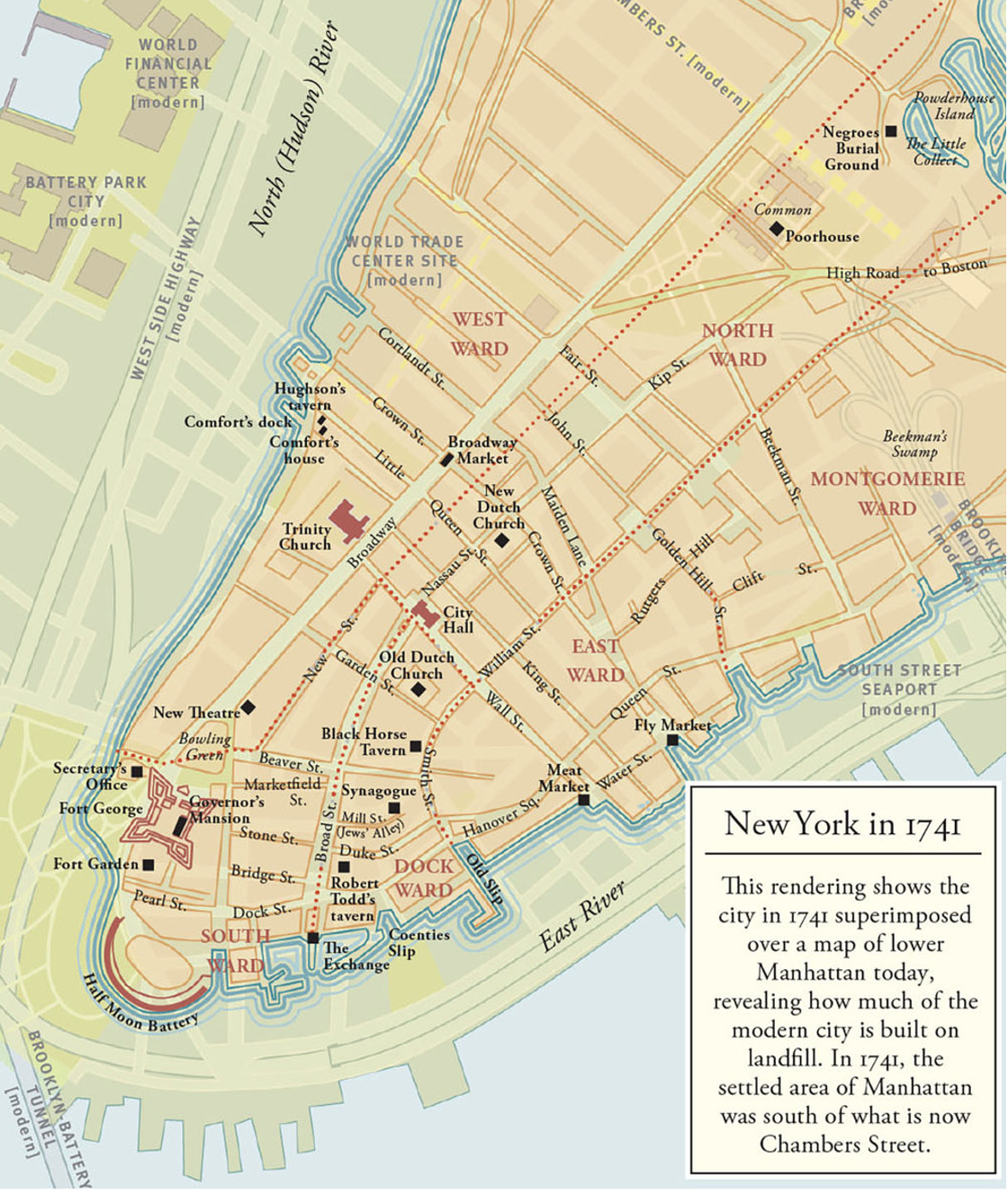
Map of New York by Jo Howard via University of Southern California Libraries Scalar Open Source Publishing Platform (https://scalar.usc.edu/works/geneva-club/media/new-york-map).
Burton’s testimony was the foundation of a series of trial presided over by Judge Daniel Horsmanden in 1741 that led to the interrogation of hundreds of people and brutal execution thirty-four people, including thirty enslaved individuals. [2] The alleged plot occurred at a sensitive time in New York’s history. Great Britain was at war with France and Spain. Factions roiled the city’s politics. Furthermore, enslaved people in Stono, South Carolina rose up the year before, using the same language of “liberty” that their enslavers did. Slave revolts were common across America (New York experienced a serious plot in 1712), and so authorities knew they were at risk. [3]
The plot captivated authorities at the time, as it has historians centuries later; yet many parts of the story remain ambiguous. Was there really a plot to overthrow slavery? The investigation relied on testimony from indentured and enslaved witnesses and was run by deeply prejudiced (and anxious) authorities. We can say with confidence that Caesar, Prince, and Cuffee conspired in some way with the Hughsons and others, and that they held each other accountable with oaths ensuring loyalty and secrecy. They undoubtedly borrowed from both Obeah and Freemasonry in forming their sworn obligations, yet historians have disagreed about how to characterize the plot. For Walter Rucker, the conspiracy consisted of “concentric circles” with Coromantees at the center directing the rest. Conversely, Jill Lepore described two different conspiracies that “overlapped”: one lead by John Hughson, and another, potentially more important conspiracy directed by a Coromantee named Jack. Both theories acknowledge interfaith cooperation but do not fully pursue its possibilities, namely that the conspirators created a fully syncretic system of social bonding through distinct but mutually intelligible cultures of oath-taking. [4] By bonding through oath-taking, they produced a creole culture of their own and challenged notions of hierarchy and difference that befuddled contemporary authorities and highlights the construction of racial difference in colonial America.
Fortunately, we know the beliefs and cultural practices that inspired and informed the enslaved conspirators. They were principally among a group called the “Coromantees,” hailing from West and West Central Africa, and following a syncretic religion known as Obeah. Obeah developed amid the chaos of war and enslavement among different Akan-speaking groups who sought to reconstruct moral and social meaning in their world. This belief placed special importance on promises and statements made before its divinities, whose undoubted power to punish transgressors underwrote notions of authority and solidarity among the practitioners of Obeah. [5]
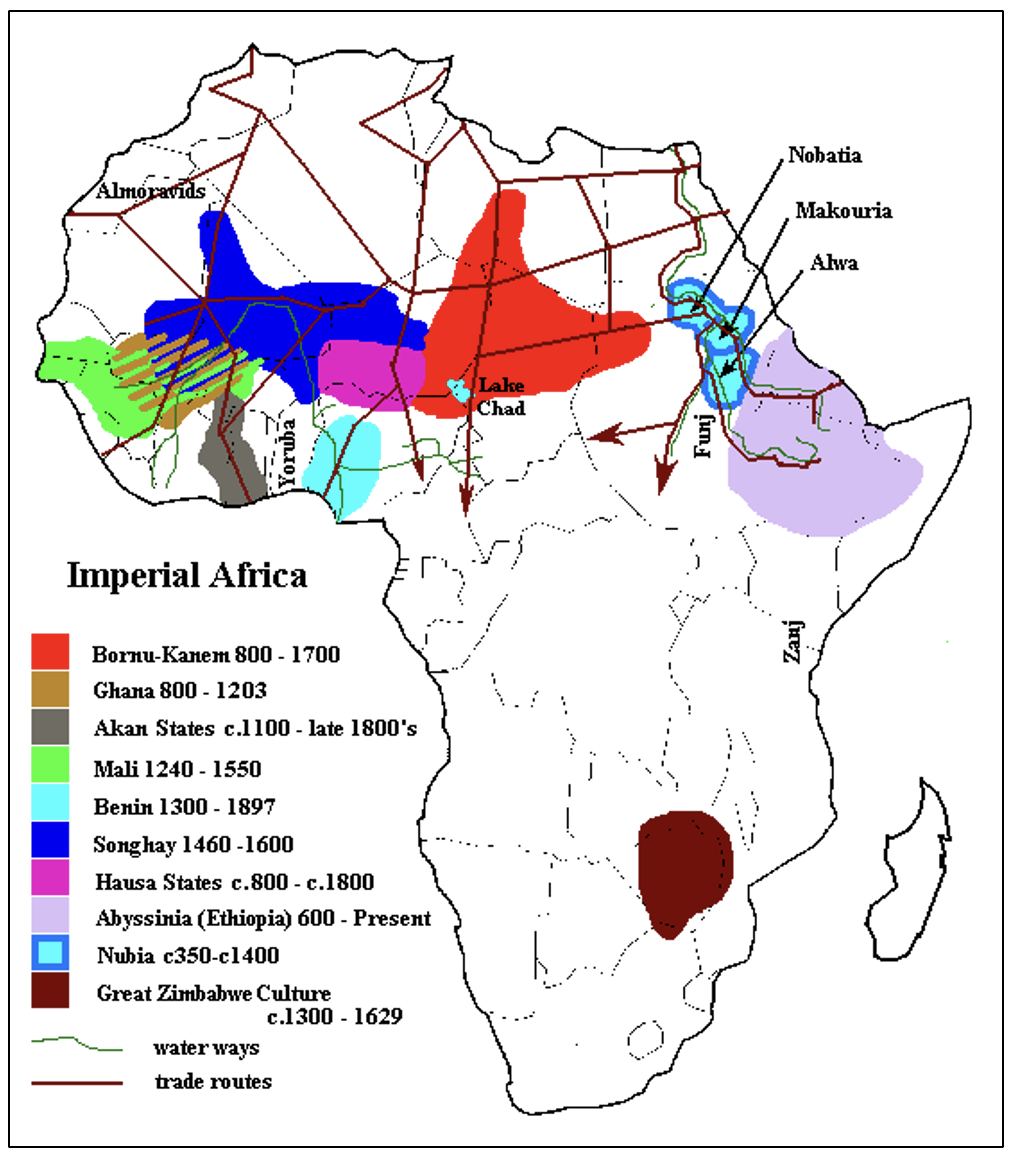
The Akan states are in gray, in parts of what is now modern Togo, Ghana, Côte d’Ivoire. Information on modern geography courtesy of Britannica Editors. "Akan states." Encyclopedia Britannica, February 8, 2025. https://www.britannica.com/place/Akan-states.
However, the enslaved conspirators merged their religion with European practices as well, incorporating the rituals of Freemasonry to unite with white co-conspirators. New York’s enslaved population had a unique level of mobility and actively participated in the city’s tavern culture. They celebrated together and found common ground with the oaths of secrecy and loyalty they administered. These oaths, though borrowed from quite diverse cultural contexts, made sense equally to all the parties involved. Jill Lepore has emphasized the frivolity of these gatherings—clearly irksome enough to authorities but not revolutionary—yet this approach belies how seriously the conspirators took their oaths. John and Sarah Hughson, Margaret Kerry, and the enslaved conspirators named above all showed great reluctance to admit to anything or to implicate others. The ubiquity of oaths throughout the trial, in the Freemason’s lodge and elsewhere, demonstrate their importance in British society. [6] Horsmanden referenced how faithfully the conspirators kept their oaths, but only to express horror at it:
It was thought that the false, ensnaring, damnable Notion (which had no doubt with Art and Industry been instill’d into these Wretches) of the Obligation of that Infernal Oath, which had been so often administered to them by Hughson and other principle Conspirators, was the true Reason of the Backwardness and Hesitancy of these Criminals, and their alternately insisting upon the Punctilio of others opening first.—The Hopes and Promises of Paradice for doing the Devil’s Work, is no new Invention of worldly, wicked and blood-thirsty Politicians, for invoking such as they are pleased to stile Hereticks, in Butchery and Destruction. Tantum Relligio potuit suadare malorum, falsa! [7]
The most offensive and frightening aspect of this plot in the minds of men like Horsmanden was its racial promiscuity—white women consorting with Black men, white men in fellowship with them. Given the ubiquitous fear of slave rebellion and foreign invasion, authorities and elites viewed these developments in the most dangerous light. Authorities insisted that it was a conspiracy headed by white men because the alternative was inconceivable, and yet they were nonetheless alarmed at the camaraderie that existed between people of different races. To authorities and colonial elites in general, the plot was so evil that they groped for a greater explanation for it.
After burning the alleged slave leaders at the stake, the inquest took on a second life as an investigation into Jacobitism, or support for the exiled Stuart claimants to the British throne. Predictably, evidence was collected against the previously unheard of “Ury” — an itinerant Latin teacher — who the court found guilty of serving as a Catholic priest and for being the mastermind behind the entire plot. As far-fetched as this theory of the conspiracy sounds, it followed a typical pattern of what authorities expected, representing all their greatest fears combined. [8]
So, what exactly happened in 1741? There is enough evidence to infer that the oath-bound conspiracy was an active attempt to overthrow slavery. Perhaps ironically, there is also reason to believe that such a theory was promoted by authorities as a self-serving pretext to try to snuff out the flickering embers of sociability, cultural belonging, and political potency among the enslaved. This essay asks us to consider what both possibilities have in common and what those commonalities can teach us. By creating sworn obligations amongst each other, Coromantees and their friends created their own sense of authority and belonging. As such, they could not help but invert the social order. Furthermore, they did it their way, incorporating Christianity and Freemasonry as they wished but also leaving ample space for the spiritual beliefs of their ancestors. Perhaps slaves intended to kill their masters and seize their wealth in 1741. Perhaps—for whatever reason—that was not their intent in the moment. What truly matters is that they had motive, and by binding themselves together through oaths they were developing the means for future rebellion. Authorities were well aware of what slaves—and their disgruntled white friends—might do. Furthermore, the fact that so many sacrificed their lives made this a real war against slavery, regardless of when and where the battles were fought. Indeed, their commitment to resistance often endured after localized plots were defeated. As historian Vincent Brown has argued, localized slave uprisings are best understood as part of one long-term slave war, which eventually achieved a major victory in what would become known as the Haitian Revolution. [9]
The 1741 plot challenges our assumptions about politics and resistance in many ways. “Slave revolts” are often separated from the discussion of political discourse within white society, though this assumption has been increasingly challenged, especially by Jill Lepore and Jack Shuler. [10] Still, notions of racial and cultural essentialism make it hard to envision truly interracial and syncretic bonds. These bonds were only possible because each contributing culture had oath-taking at its center. Oaths seemingly guaranteed the veracity of words and the reliability of promises. The basic nature of these oaths was similar enough in their respective contexts to merge into a shared understanding that bound diverse people together. They did not live by the terms set by authority, or even those of sympathetic historians. They set their own terms and established their own standards of authority and solidarity.
Kevin Murphy is earned his Ph.D. from Stony Brook University in New York. His dissertation examined the role of public and private oaths in establishing solidarity and authority across the British Atlantic, and especially during the American Revolution. In 2020-2021, he was a dissertation fellow at the McNeil Center for Early American Studies at the University of Pennsylvania. He has presented his research in four different countries and has been cited multiple times in peer-reviewed works, in addition to his own peer-reviewed publications. He is currently the McCormick Center Postdoctoral Fellow in Revolutionary Era Studies at Siena University and is drafting his first monograph, tentatively titled Oaths, Power, and the Crisis of the American Revolution.
[1] Daniel Horsmanden, A Journal of the Proceedings in the Detection of the Conspiracy formed by some White People, in Conjunction with Negro and the Slaves; For Burning the City of NEW-YORK in AMERICA, and Murdering the Inhabitants (New York: James Parker, 1744), 5-7; Jill Lepore, New York Burning: Liberty, Slavery, and Conspiracy in Eighteenth Century Manhattan (New York: Vintage Books, 2005), 37.
[2] Serena R. Zabin, ed., Daniel Horsmanden’s Journal of the Proceedings with Related Documents (Boston: Bedford/ St. Martins, 2004), xii, 1-3, 15-16, 51, 29; Walter Rucker, The River Flows on: Black Resistance, Culture, and Identity Formation in Early America (Baton Rouge: Louisiana State University Press, 2006), 101-06; Ned C. Landsman, Crossroads of Empire: The Middle Colonies in British North America (Baltimore, MD: Johns Hopkins University Press, 2010), 106-08, 121-22; Robert Hanserd, Identity, Spirit and Freedom in the Atlantic World: The Gold Coast and the African Diaspora (London and New York: Routledge, 2019), 294-96;, Horsmanden, 13, 37-38, 192.
[3] Lepore, New York Burning, 9-17, 88-91, 189-95, 244; Zabin, Horsmanden’s Journal, viii, 3, 9-12, 26; Landsman, 182-89; Hanserd, Identity, Spirit, and Freedom, 301-02.; Jack Shuler, Calling out Liberty: The Stono Rebellion and the Universal Struggle for Human Rights (Jackson: University of Mississippi Press, 2009).
[4] Rucker, The River Flows On, 104, 119-35; Lepore, New York Burning, 201, 213-14; Hanserd, Identity, Sprit and Freedom, 16-18, 27, 261-63, 293, 297-98, 301, 303-09. Interestingly, Vincent Brown does not list the 1741 plot in New York as one of the sites of the Coromantee “slave war,” despite its clear Coromantee influences. Vincent Brown, Tacky’s Revolt: The Story of an Atlantic Slave War (Cambridge, MA: Harvard University Press, 2020)
[5] Brown, Tacky’s Revolt, 11, 65-74, 153, 57; Willem Bosman, A new and accurate description of the coast of Guinea, divided into the Gold, the Slave, and the Ivory Coasts. . ., 2nd edition (London: printed for J. Knapton, D. Midwinter, B. Lintot, G. Strahan, J. Round, and E. Bell: 1721), 123-26, 138-41, Eighteenth Century Collections Online (accessed April 26, 2021); Charles Leslie, A new and exact account of Jamaica, wherein the antient and present state of that colony, its importance to Great Britain, laws, trade, manners and religion, together with the most remarkable and curious animals, plants, trees, &c. are described: with a particular account of the sacrifices, libations, &c. at this day in use among the negroes (Edinburgh: printed by R. Fleming, 1740), 324, Eighteenth Century Collections Online (accessed April 22, 2021); Bryan Edwards, The history, civil and commercial, of the British colonies in the West Indies, vol. 2 (London: Luke White, 1793), 67, Eighteenth Century Collections Online; Edward Long, The history of Jamaica. Or, general survey of the antient and modern state of that island: with reflections on its situation, settlements, inhabitants, vol. 2 (London: printed for T. Lowndes, 1774), 422-23, 473, Eighteenth Century Collections Online (accessed April 22, 2021); Yvonne P. Chireau, Black Magic: Religion and the African American Conjuring Tradition (Berkeley: University of California Press, 2003), 18, 60-62, 175n.3; Hanserd, 16-18.
[6] Richard E. Bond, “Shaping a Conspiracy: Black Testimony in the 1741 New York Plot” Early American Studies, Spring 2007, Vol. 5, No. 1 (Spring 2007), pp. 63-94 Stable URL: https://www.jstor.org/stable/23546545, 64-66, 71-72, 76-92; Thomas J. Davis, “The New York Slave Conspiracy of 1741 as Black Protest,” The Journal of Negro History, Vol. 56, No. 1 (Jan., 1971), pp. 17-30 Stable URL: https://www.jstor.org/stable/2716023, 21-24; Lepore, New York Burning, 194-95; Horsmanden, 14-26, 46-48, 103, 179. Jason T. Sharples has argued that New York slaves took part in “associative politics,” but were likely associated with Freemasons to tarnish the latter. Jason T. Sharples, The World that Fear Made: Slaves Revolts and Conspiracy Scares in Early America (Philadelphia: University of Pennsylvania Press, 2020), 168-69; Coromantee rebels commonly honored their oaths even when facing death, and for others to wait for another opportunity to resist. Hanserd, Identity, Spirit, and Freedom, 168-71, 178, 227-31; Long, 2: 465; The literature on oath-taking in Britain is substantial. For example, see Thea Cervone, Sworn Bond in Tudor England: Oaths, Vows and Covenants in Civil Life and Literature (Jefferson: McFarland, 2011); Conal Condren, Argument and Authority in Early Modern England: The Presupposition of Oaths and Offices (Cambridge: Cambridge University Press, 2006); Jonathan Gray, Oaths and the English Reformation (Cambridge: Cambridge University Press, 2013); David Martin Jones, Conscience and Allegiance in Seventeenth Century England: The Political Significance of Oaths and Engagements (Rochester: University of Rochester Press, 1999); Kevin Murphy, “Coercion and Sworn Bond in the Eighteenth-Century British Atlantic” (PhD diss., Stony Brook University, 2023)
[7] Horsmanden, 46. The Latin epitaph— “tantum religio potuit suadere malorum”—is from Roman poet Lucretius (95-55 BC) and translates as: “So much wrong could (false) religion induce.” Lucretius - Oxford Reference
[8] Horsmanden, 13-14, 21-23, 48, 94-96, 125-27, 130-32, 134, 138-39, 142-43, 156-57, 170; Sharples, 6-7, 9-10, 12-14, 3-4, 38-43, 96-102, 106-08, 18-19.
[9] Long, History of the West Indies, 2: 461-62, 465, 470-74; Brown, Tacky’s Revolt; Rucker, The River Flows On, 73-74, 84-85, 104-06, 120-25, 132-34; Horsmanden, 46, 65, 179-80, 189-91, appendix, 9; Hanserd, Identity, Spirit and Freedom, 227-31; Sharples, 177-78, 242-246; Bond, 63, 66, 93-94; Davis, 18-19, 25-30.
[10] See for example Lepore, New York Burning and Shuler, Calling Out Liberty.