
‘The Chance Begins to Assume a Fair Prospect’: Marc Brunel and the Invention of the Steamboat, Part 1
By Mark Kleinman
The Brunel name is inextricably linked with the great nineteenth-century steamships and the dawn of inter-continental travel. Isambard Kingdom Brunel designed and launched three world-changing steamships. First, the Great Western whose maiden voyage in 1838 from Bristol to New York took just 15 days, half the time of sailing ships. It was the earliest regular transatlantic steamer and used a combination of steam-paddles and sails. Five years later, the SS Great Britain sailed, this time from Liverpool. It was the first Atlantic liner built of iron and with screw propulsion, supplemented with sails on six (later five) masts. Finally, in 1858, the Great Eastern launched, accurately known during its construction as the Leviathan. It was the largest ship in the world for decades. Powered by two paddle engines, a single screw propeller and sails on six masts, it was the prototype of the modern ocean liner. [1]
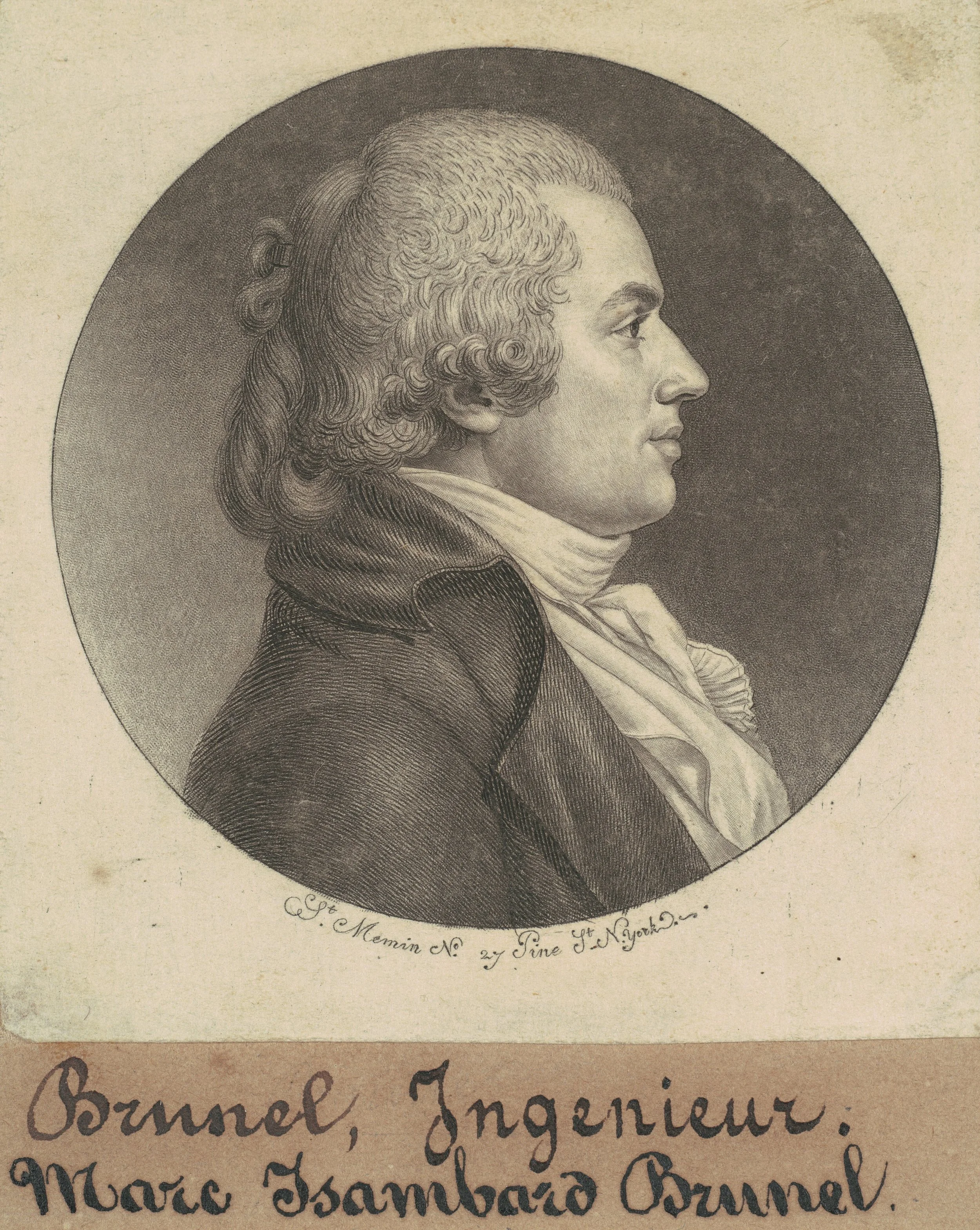
Image of Marc Isambard Brunel by St-Memin. Citation: Charles B.J. Févret de St. Mémin, portrait of Marc Brunel, 1798. National Gallery of Art, Washington, D.C., 2015.19.1584.8.3.
Twenty-five years before the SS Great Britain, Isambard’s father, Marc Brunel, had built his own, more modest steam-powered vessel. Launched in 1813, The Regent operated successfully as a mail-boat on the Thames between London and Margate. [2] But Marc Brunel had been involved with steamboats much earlier than this. And not in London, but in New York. To understand Brunel’s role, we have to delve into the dramatic story of the steamboat pioneers — a tale of big ambitions and even bigger rivalries, of invention and obsession, of patents, monopolies and legal battles, of fallings-out within families. It is an epic story, which starts on the Hudson and Passaic Rivers, has walk-on parts for Thomas Jefferson and Napoleon Bonaparte, and includes some bravura experiments in Lower Manhattan.
Experiments with steamboats had already begun by the last quarter of the 18th Century. In France, Claude de Jouffroy had piloted a steamboat upstream on the River Saône for a short distance. In the 18th Century, Britain was the home of the industrial revolution and the world leader in the application of steam technology. Despite this in Britain there was little interest in developing steamboats, for reasons both of geography and of infrastructure. Britain is a relatively small island. Nowhere in England is more than about 70-80 miles from the sea, and so the transport of goods by coastal vessels was common. Moreover, in the second half of the century, an extensive network of canals was developed during the “Canal Mania” as well as major improvements to highways financed through the use of turnpike trusts.
Hence, inventing and deploying a steam-powered boat to move goods or people at a few miles an hour did not present much of an improvement on transport by stagecoach or sailboat. Britain had the technical means to develop a steamboat, but lacked an economic motive to do so. [3]
But in America, after the end of the Revolutionary War and the establishment of an independent United States of America, the situation was very different. The United States comprised thirteen states along the Atlantic seaboard. To the west, much time and effort was spent in investigating and mapping the river routes along which people and goods could travel to exploit the advantages of the continent and settle what to European eyes was a “wilderness,” although it was already inhabited by a diversity of Native peoples. Indeed, the first activities of Marc Brunel, who left France for the United States in 1793, was helping to survey “Castorland,” a proposed new settlement for French exiles and others in Upper New York State, bordering the Great Lakes. Brunel went on to work on a range of activities, including inland navigation, submitting a design for the new Capitol in Washington, designing both a house extension and a Wall Street bank for Aaron Burr, and patenting three inventions, including a machine for copying letters. He became a US citizen in 1796, and left for England in 1799 with a letter of introduction from Alexander Hamilton to Rufus King, the American ambassador in London.
Following the end of the Revolutionary War, people and goods were beginning to travel west, over the Appalachian Mountains, into the Ohio River and the basin of the mighty Mississippi river. Goods from the interior could travel by river to the port of New Orleans from where they could be exported to the Caribbean or to Europe. But there was a catch: sailing ships could go down the Mississippi to New Orleans, the main port, but could not return against the current. On river stretches not suitable for sailboats, goods travelled by flatboats and keelboats. Flatboats were so primitive that they made one-way trips; at the destination the boats were broken up for timber. Keelboats were slightly more sophisticated, at least having a curved bow and stern and a covered cargo area. These were not broken up at the destination, but returned by a combination of oars, poles, bushwhacking (cutting through vegetation) and cordelling (towing). The keelboat workers were a tough and hard-drinking lot: Mike Fink, a celebrated keelboatman described himself as “half-horse, half-alligator.” [4]
The commercial impetus to develop steamboats was therefore huge. But the industry and skills needed to develop and implement this technology were practically non-existent. The United States was largely comprised of rural and small-town dwellers, containing very little industry, and cities were small. Early American steamboats would therefore have to be built mostly by back-country mechanics, in contrast with high-technology England, with its established engineers like James Watt, and growing industrial base:
“[W]hen it came to casting and boring cylinders, making valves, casting gears, and soldering copper sheets into pipes, all of the early steam boat experimenters were obliged to engage others more skilled in these occupations…[a] handicap… common to everyone attempting to apply the steam engine to navigation or to any other purpose [was] the unbelievably primitive nature of American industry. A foundry might cast pots and skillets, but a cylinder for a large steam engine was a different matter… Boiler makers were unknown…fashioning and repairing pipes subjected to the heat and pressure of steam was often beyond [coppersmiths’] skill.” [5]
Investment in new technologies was scarce, but “more serious than the lack of ready cash was the other obstacle confronting every early engineer — the absolute dearth of competent mechanics. Opportunities on this side of the Atlantic had been so rare that Englishmen trained to a trade preferred to hunt out and fill the openings at home. When American mechanical enterprise was first born, few Englishmen heard its faint cries and fewer still cared to cross the ocean to answer them.” [6]
The first great steamboat rivalry in America was between James Rumsey and John Fitch. It was a battle with no winner but plenty of acrimony. James Rumsey developed a steamboat using jet propulsion of water from the rear and demonstrated it publicly in December 1787 on the Potomac River, achieving four knots against the current. He moved to England in 1788 and died there four years later, aged 48 or 49. Rumsey met Thomas Jefferson in Paris (Jefferson was the United States ambassador to France between 1784-1789) and patented a “tube boiler” in both London and Paris.
Rumsey’s rival, John Fitch, developed a steamboat with an endless chain and oars which in July 1786 moved against the current of the Delaware, and the following year a full-scale version travelled at about 3 mph. But at these speeds, it could not compete with the packet ships on the Delaware or the stagecoaches on the roads along the banks. [7] Three years later, another boat, using paddles in the stern was completed and was operating from 1790 providing a regular packet service between Philadelphia and Trenton at 7-8mph. According to Dubois, this was 'the most successful of Fitch’s steam boats' but, although a success mechanically, it was a commercial failure. [8] It was faster than sailing and cheaper than the stagecoaches, but there was too much competition and not enough backers to subsidize the experiment. Fitch died in 1798, aged 55.
We have no evidence that Marc Brunel knew of or corresponded with either Rumsey or Fitch — indeed, Rumsey died before Brunel had even left France. But Brunel certainly did know the next two big figures in the steamboat story — Robert R. Livingston, known as ‘Chancellor’ Livingston, and Livingston’s brother-in-law Colonel John Stevens.
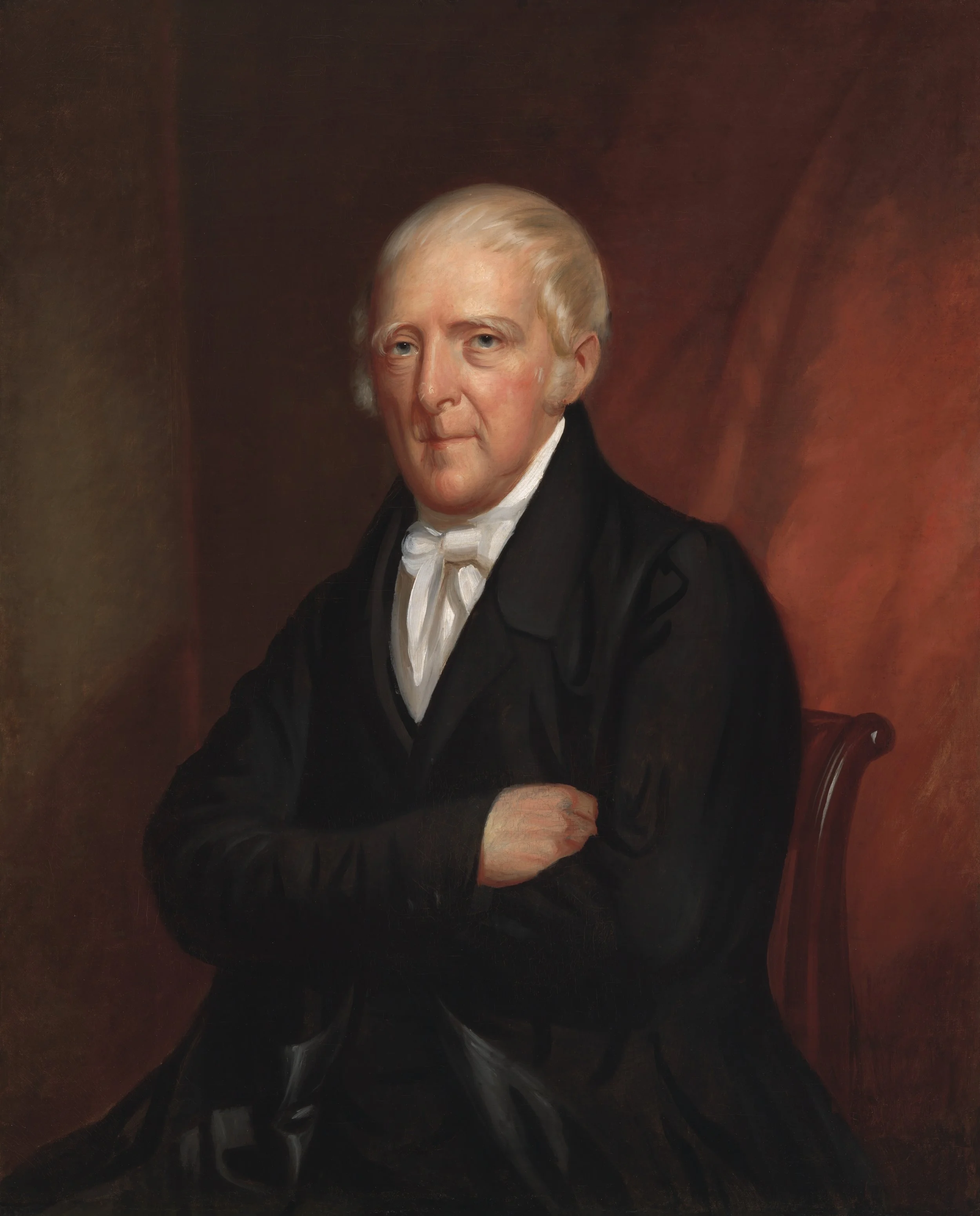
Image of Colonel John Stevens. Citation: Anon., portrait of Col. John Stevens, about 1830. National Portrait Gallery, Smithsonian Institute, Washington, D.C., NP3.75.13.
Livingston and Stevens were brothers-in-law but they were more like the Odd Couple than Brothers-in-Arms. Neither the Colonel nor the Chancellor were engineers or even mechanics, and their responses to the challenges presented by their general ignorance of engineering principles and practical skills took radically different forms.
John Stevens Jr. was born in 1749 in New York City and became a captain, later a colonel, in the American Revolutionary Army. Colonel Stevens was aware of his own lack of knowledge and technical shortcomings and he tried to remedy this both by assiduous reading and by employing whatever skilled mechanics and engineers he could find. His biographer writes that Stevens 'pored over every book dealing with fundamental principles as thus far understood. Descriptions of every effort in steam, from Savery to Newcomen, were constantly before him; on almost any night, the account of James Watt's experiments could crowd the Bible from the table under his bed-candle. If he could not build anything, he must at least know how it should be built.’ [9]
Stevens scoured the bookshops of New York for the latest science and technology treatises and if he could not find them would write to the London bookshops in the Strand and High Holborn for them. Stevens realised that reading alone was not sufficient, and he was always on the look-out for men with the technical ability to build the machines he devised. It is therefore no surprise that he later brought Marc Brunel into the steamboat enterprise — but how and when did they meet?
Colonel Stevens was rich in land, and even richer in ideas, but he was frequently short of actual cash. Fortunately, his sister Mary had married Robert R Livingston in 1770. The Chancellor was soon, in Turnbull’s words, to “catch steamboat fever,” and became a significant investor in the emerging technology, much later switching horses away from his brother-in-law Stevens and backing Robert Fulton, who generally gets the credit (perhaps unfairly) as the “inventor of the steamboat.”
Stevens’ brother-in-law was a member of the sprawling and powerful Livingston family, of Scottish and Dutch origin. RRL was one of the ‘Founding Fathers,’ a member of the committee that drafted the Declaration of Independence, and the first Chancellor of New York state. He was a gentleman-farmer, an epicure and strictly an amateur inventor. Although he had a strong interest in natural philosophy, he had little sense of mechanical principles or practical construction techniques. [10] But he was “the first wealthy and politically influential person to become passionate about steam navigation.” [11]
Livingston’s suggestions and demands were often unhelpful to his more practically minded collaborators. The Chancellor “was often led astray in his ideas of steam-engines, and always sure that his path was the best” and even “attempted technical interventions that were entirely unhelpful.” [12]
Stevens had devised his own boiler in the late 1780s, and had opposed Rumsey’s claim for a patent for the Rumsey steamboat. After Congress passed the USA’s first patent law in 1790, John Stevens, John Fitch, James Rumsay and multiple others applied for protection under the Act. [13] A commission was set up to rule on patent applications comprising the Secretary of State (Thomas Jefferson), the Secretary for War (Henry Knox) and the Attorney-General (Edmund Randolph). These were all men busy with their day jobs, and, with the exception of Jefferson, they had limited knowledge of and interest in, science and technology. They did not want the burden of reading through detailed drafts and specifications from rival inventors and adjudicating between them.
The Commissioners therefore decided to grant patents to all the applicants, on the basis of the specifications submitted, and to leave it to the courts to settle the matter. [14] The first dozen patents were issued on 26 August 1791, including one to Stevens. In Turnbull’s words, writing in 1928, “Reading these patents, it is hard to believe that engineering [in America] ever could have been so primitive; but, once that basic fact has been accepted, they loom up like signboards on the engineering highway.” [15]
In 1798, the Chancellor had the Fitch monopoly on the Hudson River (then known as the North River) set aside, and obtained from the New York State legislature his own 20-year monopoly provided he could demonstrate within 12 months that he had a boat of more than 20 tons capable of going against the current at 4 miles per hour or faster, and that he would provide a regular service between New York and Albany. [16]
The Colonel and the Chancellor now had the monopoly, the ideas and the enthusiasm. What they lacked, however, was an actual working steam engine. Here they had two options: they could import a suitable steam engine from England, preferably from the world-leading workshop of Matthew Boulton and James Watt in Soho, Birmingham. Or, they could build their own steam engine in the primitive engineering landscape of 1790s America, with a dearth of both suitable machinery and skilled engineers.
Stevens and Livingston certainly at times considered the first option. But they had earlier also entered into a partnership with Nicholas J. Roosevelt, born in 1767, a distant relative of the two later American presidents. Roosevelt had bought land in New Jersey and established there a foundry, a machine shop and a smelting works. He named it the “Soho Works” after the Boulton and Watt establishment in England, and hired skilled engineers from that establishment, including the Englishmen James Smallman and John Hewitt and the German Charles Stoudinger. Global technological know-how, human resources and experience was on its way to the “New World.”
The Chancellor was providing the money and the political influence, the Colonel was generating the ideas, and Roosevelt had the workshop and the skilled workers to make a suitable steam engine. What could go possibly wrong? In fact, many things could and many things did. There were frequent squabbles between Livingston, the anxious investor, and Stevens and Roosevelt the more practical men. Livingston became impatient with the delays that were inevitable with developing a new technology with limited resources, telling Roosevelt that if he had known earlier, he would have imported a Boulton and Watt engine from England.
On the 21 October 1798, their steamboat, the Polacca, was tested on the Passaic River, in front of an audience that included dignitaries such as the Marquess d'Yrujo, Spanish minister to the United States. The Marquess estimated the speed at “upwards of five miles an hour, but the colonel and Roosevelt were not inclined to claim more than three and a half.” [17] This result by the Polacca was largely considered a failure. [18] From Turnbull’s account, it seems the Polacca was still using a horizontal wheel in the stern, despite Roosevelt and Stevens already trying out an alternative propulsion means using elliptical paddles and a Boulton-Watt style steam engine built at Soho, New Jersey, by Roosevelt with Stoudenger and Smallman. In addition, there was excessive vibration caused by the engine.
The Chancellor vehemently rejected Roosevelt’s idea of providing motion via a vertical wheel or wheels at the side of the boat. Roosevelt would later of course be proved right on this. Livingston however insisted on a horizontal wheel at the stern: the chancellor had no faith in the side-wheeler, and thus it was years before Roosevelt's idea was generally adopted in America. In Turnbull’s view, Livingston was always confident that his own scheme —whatever it might chance to be — was the best. [19]
Around this time, Marc Brunel enters the picture. We know that Brunel was living in New York in 1797 and 1798. Commercial directories for New York list him having a ‘manufactory’ at 17 Murray Street in 1797, and at 58 George Street (now Spruce Street) in Lower Manhattan in 1798. [20]
New York City grew rapidly through the 1790s: from around 33,000 in 1790 to almost double that, 60,000 people in the Census of 1800 — still relatively small compared with its explosive growth over the next two centuries. At some time in 1797 or possibly earlier, Colonel John Stevens made contact with Marc Brunel.
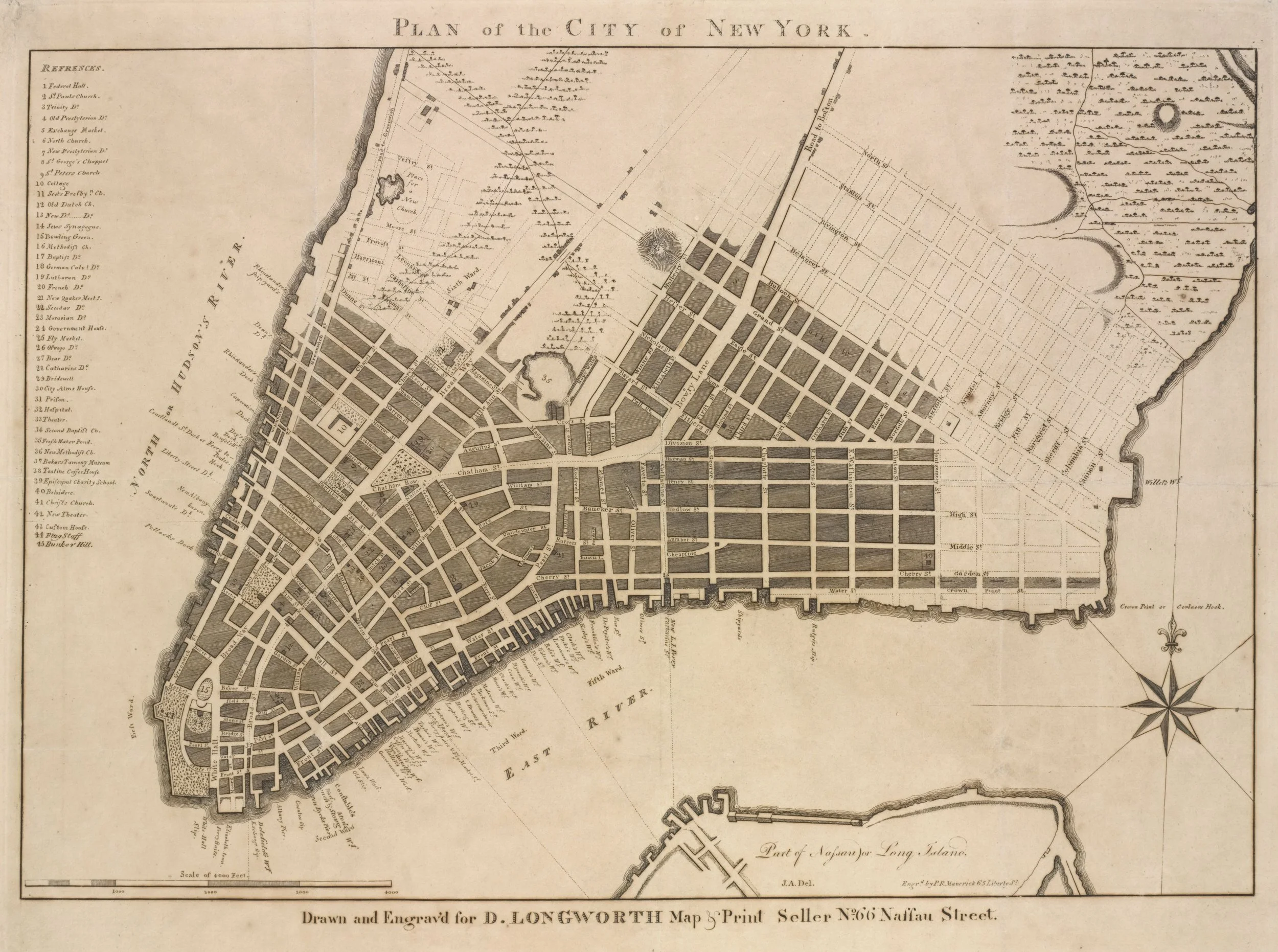
Map of New York City about 1799. Citation: ‘Plan of the City of New York,’ about 1799. New York Public Library, Eno 62A+.
Stevens’ approach to Brunel suggested that Brunel had already developed some reputation in America as an engineer. Brunel had already registered one patent — a machine for ruling books and paper — in 1796, and would register two further patents before he left for England. In addition, and unlike either Stevens or Livingston, he had considerable experience of the practicalities of navigation on both ocean-going ships and smaller boats on American rivers. He had been a sailor in the French Navy in the Caribbean for six years, and then later directly experienced the difficulties of navigating American rivers — just about the only way to the interior — in his Castorland and canals work.
Frustratingly, we do not know exactly when he met John Stevens and there is little record of how Stevens and Brunel first met. Turnbull tells the story as follows:
“Naturally planning to earn his living as a mechanic, [Brunel] applied to the colonel, who was not long in discovering that a place must be made for a young man who knew so much more than the average. Brunel found the colonel in the midst of an effort to get higher steam temperatures and consequent greater boiler efficiency. Experimenting with primitive "flash-boilers," the colonel was led to something new in engines.” [21]
That “something new” was — astonishingly — internal combustion, as a possible way of making the engine lighter and more efficient. How far did Marc Brunel get? This very question will be the subject of Part II of “Mark Brunel and the Invention of the Steamboat.”
Mark Kleinman is a writer, communicator and researcher, based in Cambridge and London. At the Brunel Museum he helps tell the story of the Thames Tunnel, and its creators, Marc Isambard Brunel and his son Isambard Kingdom Brunel. Previously Mark has been a civil servant and a policy director in the UK, and has held a number of academic posts, including at the University of Cambridge, the London School of Economics and King’s College London, as well as visiting appointments at the University of Toronto and the University of New South Wales. He is the author or co-author of four books and more than 100 published papers.
[1] I wish to thank Crystal Toscano, Reference Librarian at the Patricia D. Klingenstein Library, the New York Historical Society for scans of letters from Marc Brunel to Robert R. Livingston in 1801 and 1802 in the Robert R. Livingston papers 1707-1862; and Leah Loscutoff, Head of Archives and Special Collections, Samuel C. Williams Library, Stevens Institute of Technology for digitised letters from Marc Brunel to Colonel John Stevens, and also for a copy of R.L. Dubois’ PhD thesis. Thanks also to Jack Hayes at the Brunel Museum, London and Rachel Pitkin at the Gotham Center for New York History, New York for comments on the draft.
[2] Clements, P. (1970) Marc Isambard Brunel pp. 62-63; Brindle, S. (2005) Brunel: The Man Who Built the World p. 33.
[3] McDonald, C. (2022?) “Steamboat Inventors: The First Generation,”
https://technicshistory.com/2022/03/18/the-steamboat-inventors-the-first-generaMon/.
[4] McDonald, C. (2022?) “Steamboat Inventors: The First Generation,”
https://technicshistory.com/2022/03/18/the-steamboat-inventors-the-first-generaMon/.
[5] Dubois, R. L. (1973) ‘John Stevens: Transportation Pioneer’ PhD thesis, New York University.
[6] Turnbull, A. (1928) John Stevens: An American Record, pp. 116-117.
[7] Dubois (1973), pp. 99-100.
[8] Dubois (1973).
[9] Turnbull (1928), pp. 117-118.
[10] Both Livingston and Stevens owned enslaved people. See Gotham Center for New York City History “The Robert R. Livingston Papers” https://www.gothamcenter.org/robert-livingston-papers; Choong J. , “ A brief history of Stevens, Stevens and Stevens” The Stute, February 21st 2025 https://thestute.com/2025/02/21/a-brief-history-of-stevens-stevens-and-stevens/.
[11] McDonald (2022b) “Steamboat Inventors: The Second Generation,”
https://technicshistory.com/2022/04/19/the-steamboat-inventors-the-second-generation/.
[12] Turnbull (1928), p. 131; McDonald (2022b).
[13] Turnbull (1928); Dubois (1973).
[14] Dubois (1973), p. 112.
[15] Turnbull (1928) pp. 111-112.
[16] New York State Library, ‘Steamboats on the Hudson: An American Saga’ https://nyslibrary.libguides.com/steamboats/legislature 15 Turnbull (1928) p. 137.
[17] Turnbull (1928), p. 135.
[18] New Jersey Historical Society, ‘Manuscript Group 1508 Stoudinger-Aloufsen-Fulton drawings https://jerseyhistory.org/manuscript-group-1508-stoudinger-alofsen-fulton-drawings/ .
[19] Turnbull (1928), p. 137.
[20] Kleeberg J.M. (1995) ‘The Theatre at New York’ in Doty R.G. (ed) The Token: America’s Other Money, American Numismatic Society.
[21] Turnbull (1928), p. 139.