
Jailed for Freedom: Afro-Spanish Sailors and Legal Resistance in Eighteenth-Century New York
By Beatriz Carolina Peña
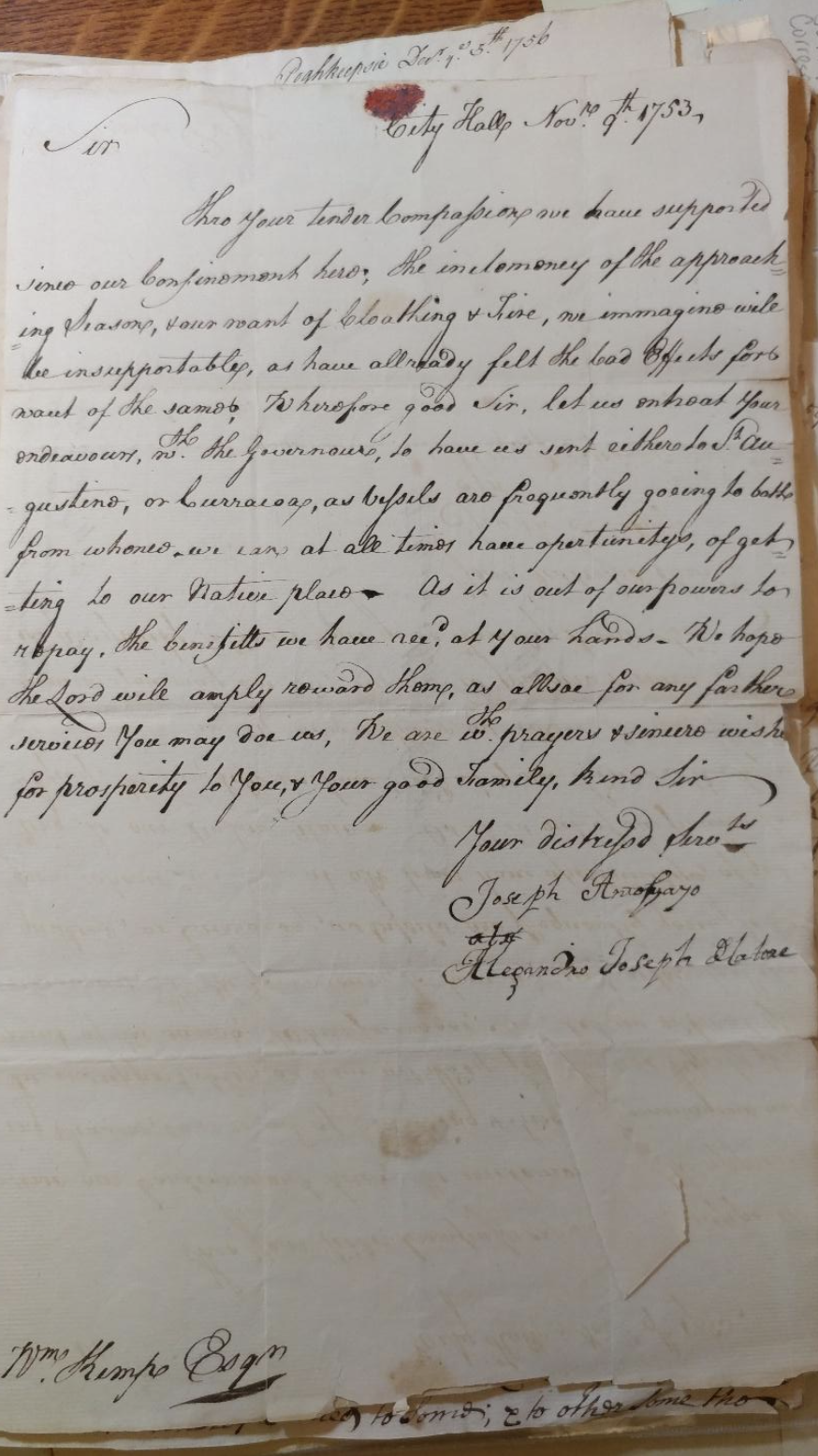
On October 20, 1753, Afro-descendant sailors Joseph Antonio Fiallo and Alejandro Joseph de la Torre wrote from prison to New York Attorney General William Kempe in Spanish, rendering his name as “Gyllerno Quenpo” — translating William into Spanish (albeit imperfectly) while phonetically approximating his surname. They addressed him as “rretorno llineral.” Unfamiliar with the English title, they associated it with their primary aspiration: retorno, or return to Spanish territories in the Greater Caribbean. [1] Their interpretation proved accurate. Despite opposition from powerful privateers and slaveholders, and the burdens of his office, Kempe was then preparing freedom petitions to the governor and corresponding with Spanish colonial officials to secure documentation supporting the liberty claims of Afro-Spanish mariners enslaved in New York.
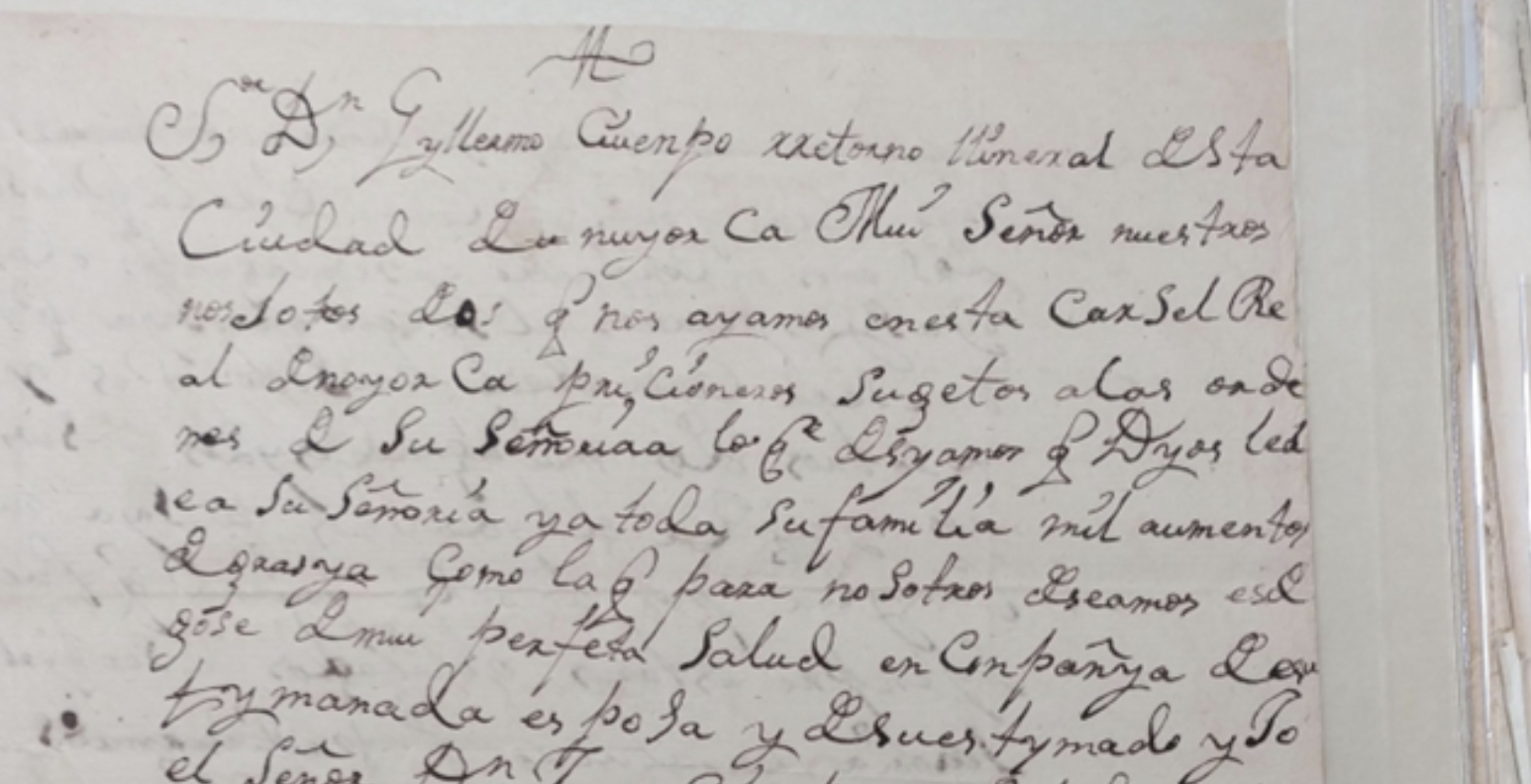
New York Historical, John Tabor Kempe Papers, 1678-1782 (bulk 1752-1774), MS 344, Correspondence, William Kempe, Letters Received, D-H, Box 15, fol. 9.
Five years earlier, on August 29, 1748, Captain Robert Troup’s brig Royal Hester captured two vessels off Havana, including the Gran Diablo (then sailing as Ana María). The encounter was deadly and left many sailors killed or wounded. [2] Sixteen-year-old Alejandro Joseph de la Torre survived, but his ordeal was only beginning. For Troup, the youth and other non-white mariners who lived through the battle immediately became what privateers and colonial authorities termed a “prize negro.”
On September 24, De la Torre arrived in New York City aboard one of Troup’s captured vessels. The prizes were adjudicated swiftly by Vice-Admiralty judge Lewis Morris. Just three days later, a newspaper notice announced the sale of “sundry likely Negro Men and Boys” captured by the Hester. Because De la Torre had been libeled as a slave by the Vice-Admiralty Court, he was likely among those sold. Merchant Charles Watkins purchased him and, seven months later, sold him to Captain Thomas Clarke for £55. [3]
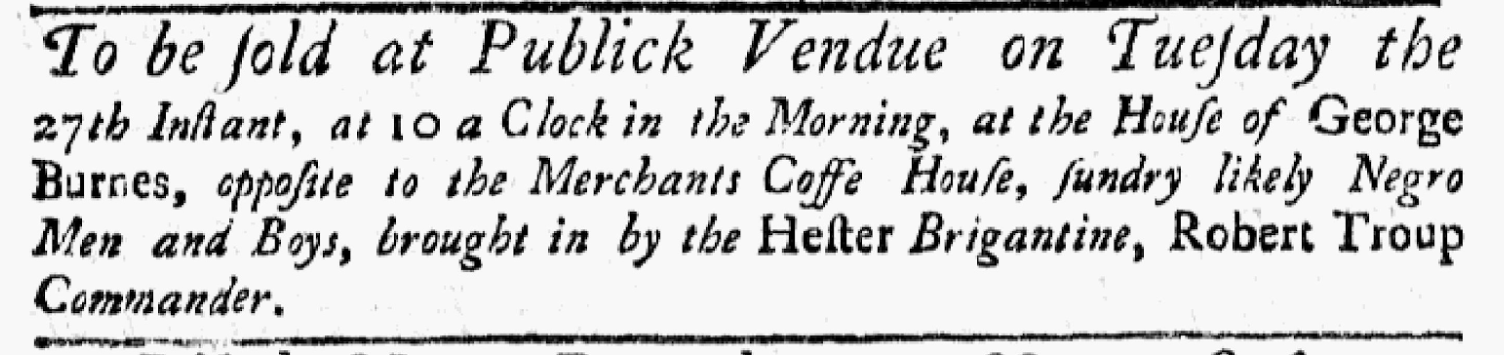
New-York Gazette, Revived in the Weekly Post-Boy, September 26, 1748, 3.
José Antonio Fiallo was likely captured during Troup’s earlier cruise (1746-1747) while serving aboard the schooner Catherina. After seizing that vessel’s cargo, Troup released the crew near Santo Domingo but carried Fiallo (a non-white individual about eighteen years old) to New York. Initially detained at Fort George with “another Mulato,” Francisco Isquiena (or Esquena), Fiallo planned to petition the governor for liberty. Troup and his agent Samuel Tingley, however, secretly removed both men from the fort and transferred them to the Workhouse. After three weeks of unlawful confinement, Tingley sold Fiallo to Hester Kortright. [4]
The experiences of Fiallo and De la Torre reveal how Spanish American sailors captured through privateering were reclassified as “prize negroes,” sold, and forced to seek freedom within a legal system structured to uphold slavery. After arriving in New York from London as attorney general in November 1752, Kempe began bringing liberty claims grounded in the Law of Nations before the governor and council. These cases illuminate both the possibilities and the limits of law in a colonial society deeply committed to racialized slavery. Though they came from different Spanish colonies and reached New York about a year apart, their paths converged on July 7, 1753, when both were placed in jail for the protection of their freedom. [5]
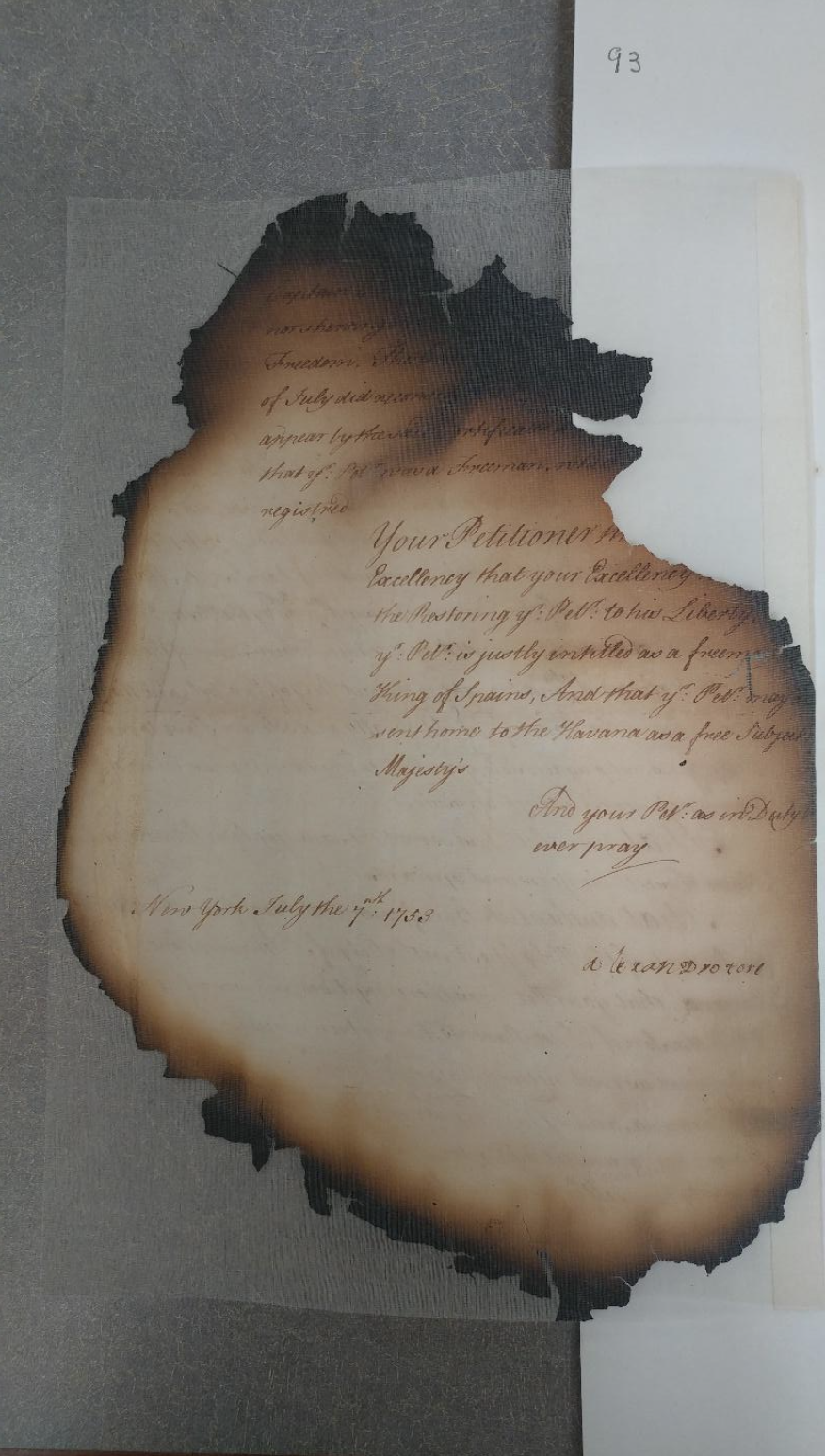
From the outset, De la Torre’s case became a struggle over time as well as legal status. Although he presented a baptismal certificate establishing that he was freeborn and the Vice-Admiralty Court recognized his freedom on July 5, 1753, Captain Thomas Clarke prevented the ruling from resulting in immediate liberty. Clarke avoided the hearing at which the certificate was considered and later petitioned to transfer the dispute to the governor and council, effectively suspending the admiralty decision without directly contesting it. He then raised a series of procedural objections — challenging the certificate, its translation, and supporting affidavits — to prolong litigation and confinement. [6]
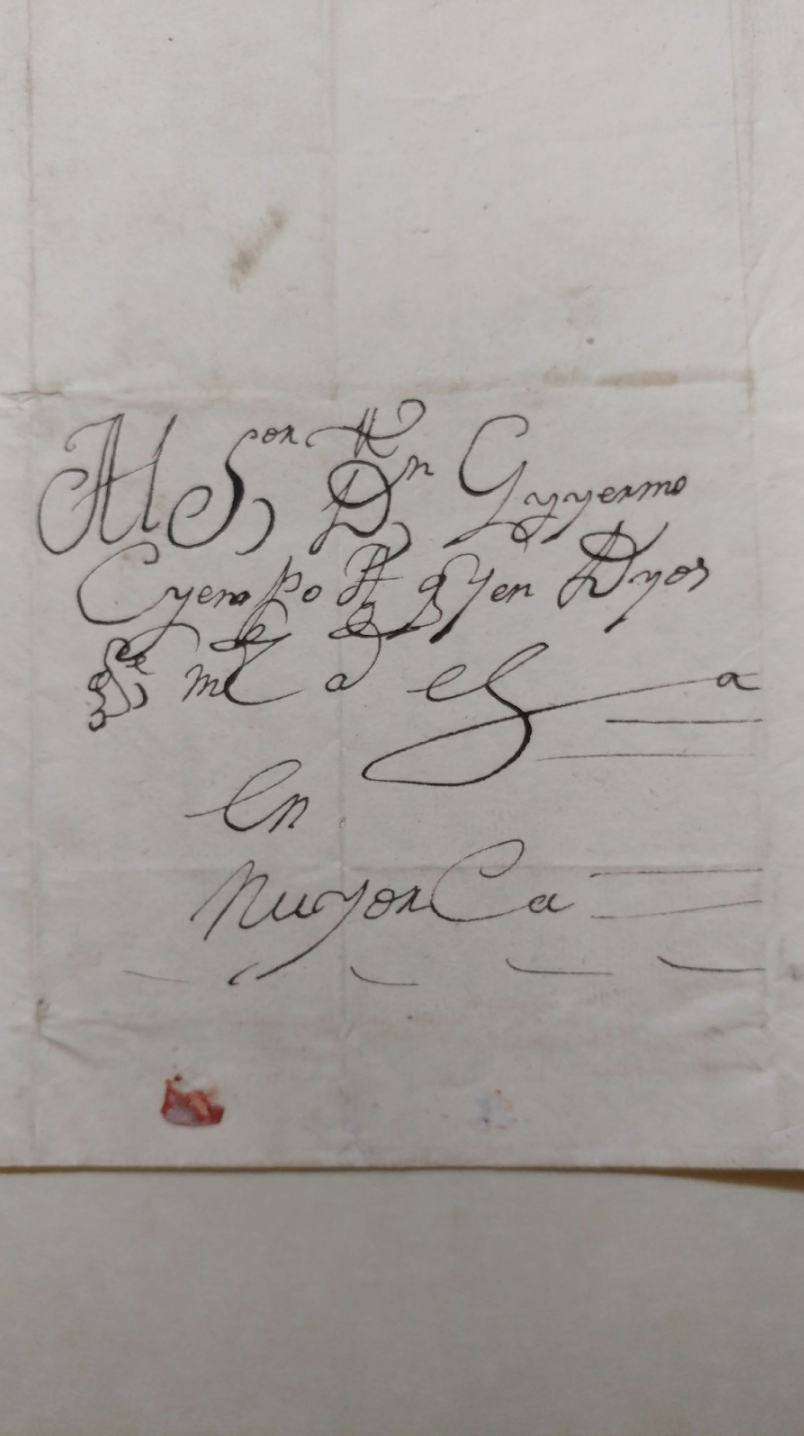
New York State Archives, New York Colonial Council Papers, Vol. 82, Part 2, 1755–56, Hardy, doc. 95(1).
Delay operated not only through legal technicalities but also through custody. Even after Lieutenant Governor James Delancey ordered that De la Torre be returned to Havana “as a free subject of the King of Spain,” he remained confined in City Hall. Kempe, who had submitted a report on July 28, 1753, “on the cases of Josepho Antonio Fallo and Alexander Joseph de la Torre, Spanish negroes,” later explained that such confinement was intended as a protective measure. In earlier cases, individuals declared free by the Admiralty Court or by the governor had been secretly removed or concealed by claimants before repatriation could be arranged. [7]
Clarke’s actions further demonstrate how delay was intertwined with the economic interests of enslavement. Kempe questioned why, if Clarke truly believed De la Torre to be enslaved by condition, he refused to pay Watkins — De la Torre’s former enslaver — and instead offered security. This refusal suggests that Clarke recognized De la Torre was, or could be, free. He was even alleged to have written to De la Torre’s father in Havana offering manumission for twenty dollars. His most obstructive tactic was claiming to possess documents proving enslavement that would require proceedings in the Court of Chancery and commissions sent into Spanish territory. Kempe described this strategy as impracticable and abusive, imposing costs and delays to keep a free man unfree. [8]
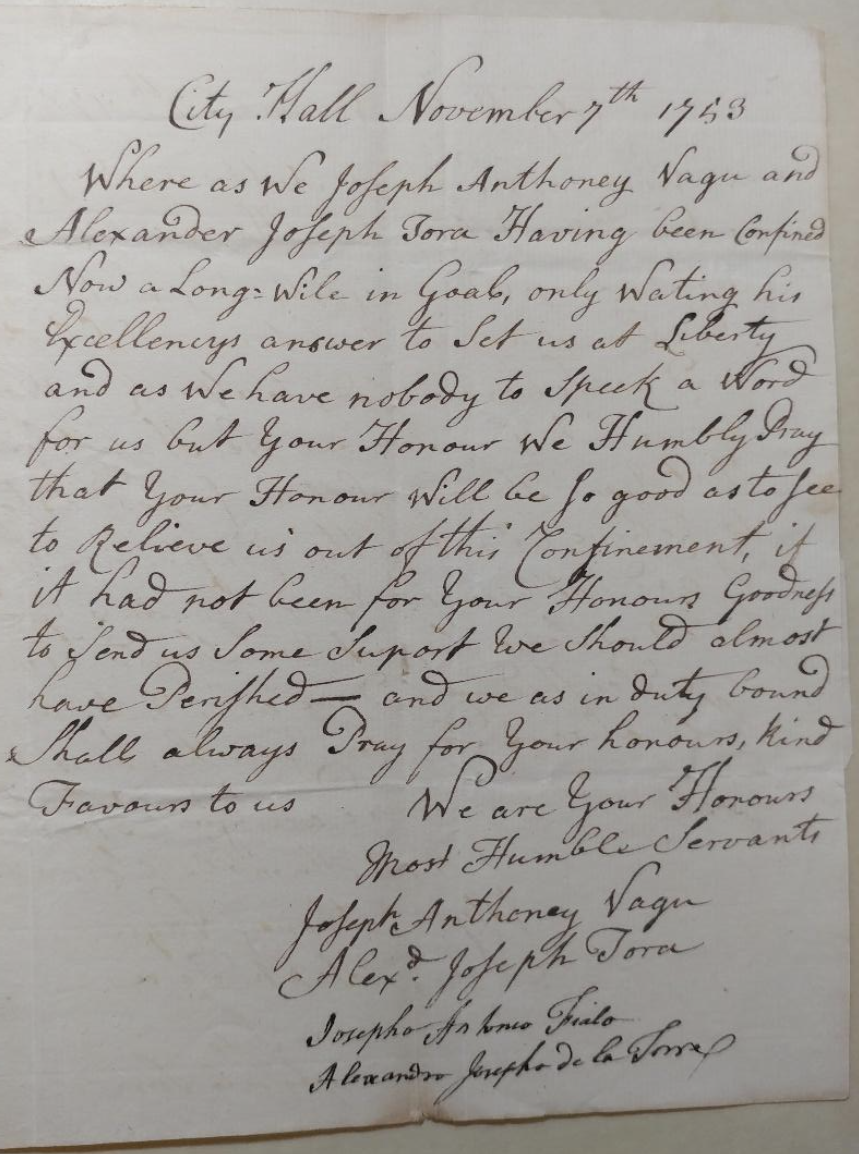
New York Historical, John Tabor Kempe Papers, 1678-1782 (bulk 1752-1774), MS 344, Correspondence, William Kempe, Letters Received, D-H, Box 15.
Fiallo’s claim rested on a substantial body of evidence, though his custody remained contested. Central to his case was a certificate of manumission signed in Caracas confirming that he had been freed in 1729 at the age of two. After the Vice-Admiralty Court confirmed that he had never been condemned as a slave, the governor, at Kempe’s request, ordered his detention in City Hall to prevent Kortright from selling or dispersing him to another province or into the countryside, where recovery would have been impossible. [9]
Affidavits from Spanish witnesses supported Fiallo’s status as a free subject of the Spanish crown. Yet the evidence suggests that these men had not known Fiallo prior to encountering him in New York. Their testimony therefore appears less a statement of personal knowledge than a strategic act of solidarity in a context where documentary proof alone had not sufficed. Other cases suggest that Kempe encouraged enslaved sailors to seek such testimony from free Spanish mariners temporarily present in the port. [10] In November 1754, Domingo José Martínez, a native of Cumaná, testified before New York’s mayor and one of the judges of the High Court of Chancery that he had known Fiallo in Caracas as a free man and tailor. A second affidavit from Don Domingo Serondo, second captain of the Spanish register Saint Joseph and Saint Helen, confirmed that Fiallo had been taken during King George’s War and was widely known in Caracas as a free Spanish subject rather than a slave. [11]
Kempe argued that this body of evidence placed the case within the jurisdiction of the governor acting in Council rather than the ordinary courts, since Fiallo’s liberty was protected under the Law of Nations rather than colonial property law. In such cases, he maintained, strict common-law rules of evidence did not apply; instead, principles of reason, equity, and justice between sovereign powers should prevail. The Vice-Admiralty Court likewise acknowledged that Fiallo had never been condemned and directed that his case be resolved by executive petition. Nevertheless, Kortright continued to assert ownership. On November 17, 1754, in violation of the governor’s orders and with the apparent consent of the sheriff, she removed Fiallo from custody, assaulted him, and confined him in the Workhouse, claiming the affidavits were insufficient. [12]
New York State Archives, New York Colonial Council Papers, Vol. 82, 1755–56, Hardy, doc. 93.
Kempe eventually secured Fiallo’s return to the dungeons of City Hall. At various points, especially early in their imprisonment, both men relied on English-speaking cellmates to write their dictated messages to Kempe, since they were unable to write in English. After nearly three years in jail, diplomatic pressure arrived, likely prompted by a request Kempe had sent to Florida. At a Council held at Fort George on May 6, 1756, Governor Charles Hardy reported receiving two letters — one from the governor of Havana and another from Alonso Fernández de Heredia, governor of St. Augustine — along with “several other Papers touching the Freedom of Spanish Negroes or Mulatoes brought into this Port during the last War, and now Slaves here.” Dated April 9, 1756, Fernández de Heredia’s letter explicitly protested the detention of Fiallo and De la Torre as a violation of the Articles of Peace. [13]
Although the outcome of their cases is not documented, Kempe’s efforts and this diplomatic intervention likely secured their repatriation. A flag of truce sailed to Spanish territories in early August 1756, and records note the departure of freed individuals. Although “one Francis Johnstone, of New York, copper,” unlawfully seized “a negro, who had been declared a freeman” from that vessel, it remains possible that Fiallo and De la Torre were among those who successfully departed. [14] If so, their liberty was achieved through legal advocacy, executive intervention, and international diplomacy overcoming the deliberate delays of enslavement.
The story of Fiallo and De la Torre reveals how imperial warfare, privateering, and slavery converged in eighteenth-century Atlantic ports, where freedom — only rarely attained by Afro-Spanish mariners enslaved in New York — could depend as much on diplomacy and legal strategy as on the fortunes of imperial war. Their prolonged confinement underscores a striking paradox: in a slave society, jail could become a fragile space of protection. By mobilizing the Law of Nations, colonial officials, foreign governors, and imprisoned sailors themselves transformed individual petitions into matters of international concern. Their cases remind us that the struggle for freedom in the Atlantic world often unfolded through slow legal battles as much as dramatic acts of resistance.
New York State Archives, New York Colonial Council Papers, Vol. 82, 1755–56, Hardy, doc. 93.
Beatriz Carolina Peña, Ph.D., specializes in colonial Latin American studies. Her work draws on historical, legal, and archival research to examine race, slavery, and maritime worlds in the early modern Atlantic. She is the author of nine books in Spanish and English, including award-winning studies of Afro-Spanish and Indigenous mariners in colonial America, and her research has been supported by the John Carter Brown Library and CUNY.
[1] New York Historical, John Tabor Kempe Papers, 1678-1782 (bulk 1752-1774), MS 344, Correspondence, William Kempe, Letters Received, D-H, Box 15, fol. 9.
[2] New-York Evening Post, September 26, 1748, 3; New-York Gazette, revived in the Weekly Post-Boy, September 26, 1748, 2; New York State Archives, New York Colonial Council Papers, Vol. 82, Part 2, 1755–56, Hardy, doc. 95(1). Hereafter cited as: NYSA, NYCCP, manuscript volume number, year, governor, doc. number.
[3] NYSA, NYCCP, 82, Part 2, 1755–56, Hardy, doc. 120; NYSA, NYCCP, 83, 1751–56, Hardy, docs. 93, 95(2), fol. 2v.
[4] NYSA, NYCCP, 83, 1751–56, Hardy, docs. 98, 99c, 100.
[5] NYSA, NYCCP, 83, 1751–56, Hardy, docs. 94, 100.
[6] NYSA, NYCCP, 83, 1751–56, Hardy, docs. 89, 94, 95(1), 98, 99c, 100, 101b-c. See also Edmund Bailey O’Callaghan, ed., Calendar of Historical Manuscripts, in the Office of the Secretary of State, Albany, N.Y. Part II (Albany: Weed, Parsons and Company, 1866), 602, 660-661.
[7] Berthold Fernow, comp., Calendar of Council Minutes 1668–1783 (New York: Harbor Hill Books, 1987), 388; NYSA, NYCCP, 83, 1751–56, Hardy, doc. 95(1).
[8] NYSA, NYCCP, 83, 1751–56, Hardy, docs. 94, 95(1), 99a.
[9] NYSA, NYCCP, 83, 1751–56, Hardy, docs. 98, 99b, 99c, 100, 101b-c.
[10] Beatriz Carolina Peña, 26 Years a Slave: Juan Miranda and Other “Spanish Negroes” in Colonial New York (Leiden: Brill, 2025), 201-203.
[11] NYSA, NYCCP, 83, 1751-56, Hardy, docs. 97, 99c, 100, fols. 2-3r.
[12] NYSA, NYCCP, 83, 1751-56, Hardy, docs. 98, 99a, 99c, 100, fols. 1v, 3r-3v.
[13] The National Archives of the U.K., CO 5 1199 004, Minutes of the Council of New York Beginning the 30th day of November 1755, and ending the 11th day of November 1756, fol. 181r.; NYSA, NYCCP, 82, Part. 2, 1755-56, Hardy, doc. 121; NYSA, NYCCP, 83, 1751–56, Hardy, doc. 101a; Fernow, comp., Calendar of Council, 427; O’Callaghan, ed., Calendar, 662.
[14] O’Callaghan, ed., Calendar, 658.