
‘The Chance Begins to Assume a Fair Prospect’: Marc Brunel and the Invention of the Steamboat, Part 2
By Mark Kleinman
Marc Brunel’s task, set him by Colonel Stevens, was to use internal combustion to make a steamboat engine that was lighter and more efficient than Stevens and Roosevelt’s previous attempts. This engine had to be “simple, within the limits of American manufacturing skills, and economical enough both to construct and maintain… Stevens [therefore] entered into a series of collaborations with men who possessed the technological skills he lacked. Marc Isambard Brunel was one… Stevens became acquainted with Brunel in New York and employed him to make the machinery for his new experiments.” [1]
Brunel had a “manufactory” at premises in Murray Street, New York City in 1797, and subsequently on George (now Spruce) Street in 1798. Both locations were close to what is now City Hall Park, where the Declaration of Independence was read to American soldiers on 9th July 1776. His quest, while there — to apply an internal combustion engine to the problem of the steamboat — was not as outlandish as might appear at first sight. As Turnbull says:
“The internal combustion engine originated with Papin and the Abbé Hautefeuille, Frenchmen of about 1680, who used powder explosions for motive power. A century later, in England, John Barber mixed coal-gas with air in a retort, lighted this mixture, and discharged it against a paddle-wheel. In 1794 the explosion of gases ignited outside a cylinder was first used by Robert Street, another Englishman, to operate an actual piston. It is entirely possible that the colonel had studied Street's engine, but his own is the earliest that has been found in any American record.” [2]
And so Spring 1798 found Marc Brunel “busy making a working model according to Stevens’ plans.” [3] It involved a cylinder and a piston, like a steam engine. Inflammable gas was mixed with air, was introduced into the cylinder, and ignited. The explosion pushed the piston to the top of the cylinder, creating a vacuum, and the piston was drawn down again. Connected to a crank, it could impart elliptical movement to paddles.
Brunel wrote to Stevens in January of 1798 setting out to receive his commission, and, presumably at Stevens’ insistence, made clear that the idea originates with Stevens and not with Brunel:
“I do hereby certify that the machinery for propelling a boat, a draft of which Mr. Stevens has put into my hands for the purpose of constructing a working model, is not in any part my invention but, as far as I know, altogether an invention of his own.” [4]
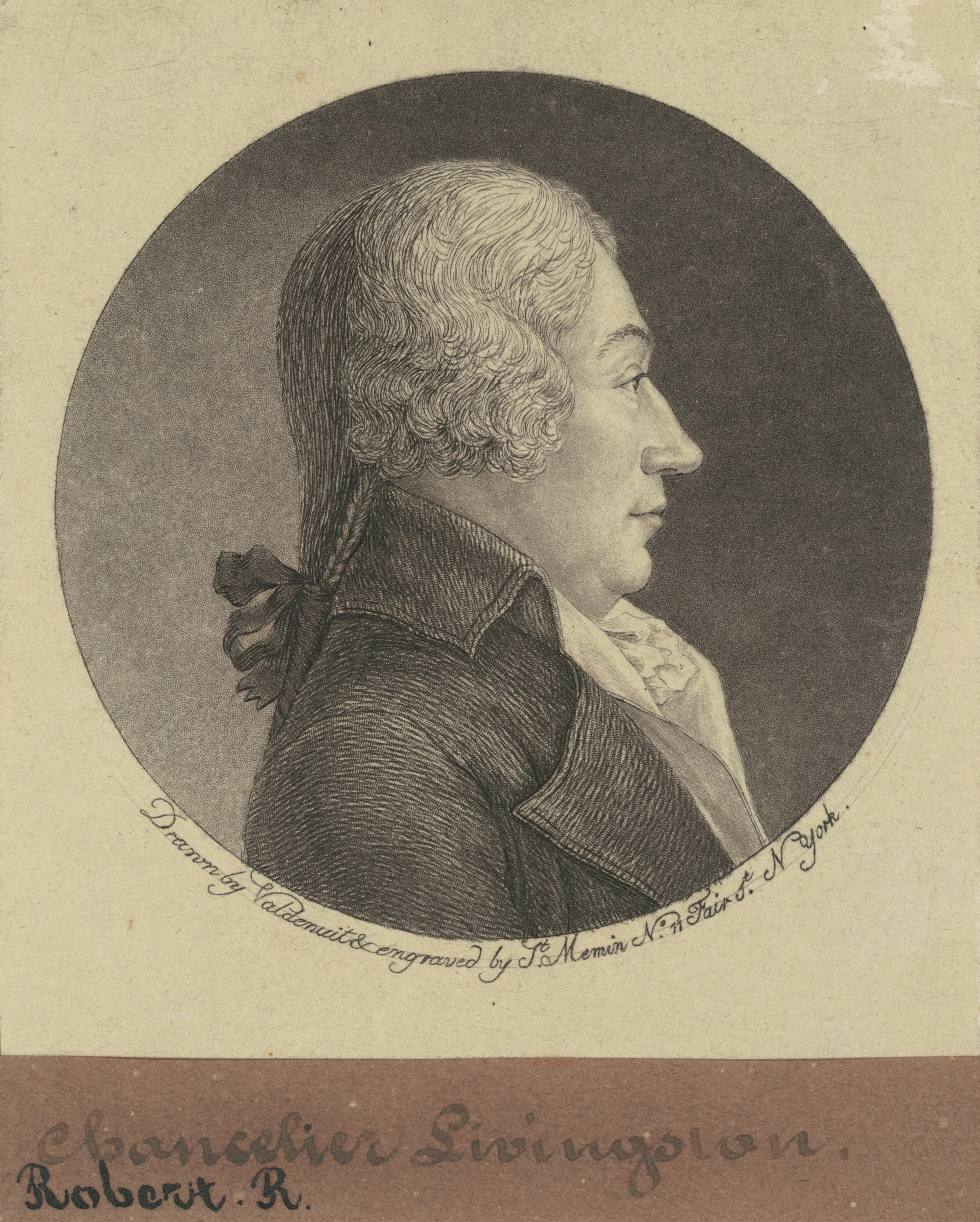
Image of Robert R. Livingston by St-Memin. Charles B.J. Févret de St. Mémin, portrait of Robert R. Livingston, 1796. National Gallery, Washington, D.C., 2015.19.1584.1.3.
Another letter from Brunel to Stevens gives more detail on the experiments he had undertaken. The letter is undated, but Brunel was clearly encouraged by progress so far:
“Soon after your going off, I began some experiments on the machine. The heat of the brass cup was sufficient to create the gas. Having injected some Spirit with the Seringe [sic] and kept the candle by the hole in the front (I mean the hole which was shut with a little bit of wood) an explosion took place; such a one as to blow water out from the horizontal or square pipe with a great vilence. The fire ruched through all the apertures, though there was but little spirit injected. I tried immediately a second explosion, which impressed like the first one. I could not get a third explosion, the cylinder being quite full with Smoke. I blowed out all the smock [sic] and then tried again. I met with the former success… The Chance begins to assume a fair prospect.” [5]
In the winter of 1797–98, Brunel—still in his twenties—worked in a dingy downtown New York workshop, experimenting toward a machine powerful enough to propel a loaded boat upriver. It has the air of speculative fiction, yet it was precisely in such circumstances that he began to find his métier.
We know nothing about Brunel’s New York manufactories beyond their addresses. The previous year (1796) he had become an American citizen, suggesting he was thinking in terms of more than temporary residence in the U.S.. Clearly, he employed men to work in his manufactory – but how many men, who were they and what skills did they possess? What other inventions was he working on at this time, and how was he making his living?
We do know that the Chancellor wrote to William Constable on the 4th November 1798, asking him to meet James Watt in London in order to purchase a steam engine. [6] Three months later, Brunel had himself left for England, never to return to the USA. Was Brunel’s journey partly related to Livingston’s desire for a Boulton and Watt steam engine? At least one author thinks so: Roger G. Kennedy claims that “Chancellor Livingston told William Constable that he sent the young man to England to promote a steamboat scheme..” [7] Kennedy gives no reference for this, however.
The plot thickens further. Brunel wrote to Livingston in January of 1799, just before his departure from New York to England as follows:
“Expecting to sail for London by the 25th, at latest, of this month, I offer you the services it might be in my power to render you on the subject of your late improvements on hydroliques and steam machine. Your late improvements particularly upon the steam engine without friction is in my opinion of very great importance and reflect much honor upon the inventor. I flatter myself that undertaking perfectly your principle, I am able to bring your invention to an early practice by making a model of about 150th power upon which I will be able to make all the experiments requisite to ascertain the practicability of this valuable discovery.” [8]
Brunel went on to pitch to Chancellor Livingston both for an advance and for a share in profits as follows:
“As it is not in my power to make advances for the expenses, I hope you will join to your orders a credit of 800 dollars upon some friends of yours or Mr Constable’s to whom I shall be accountable for by communicating to him my operations. I hope at the same time you will allow me a share of one third in the profits arising from that discovery which ought never be made public previous to its execution. If your orders to Mr. Constable cannot be conciliated with my proposals or some thing like them, nothing is said on that subject and you many rely upon my discretion.” [9]
This is a remarkable letter. On the eve of his departure for England, and with Constable presumably already in London and negotiating with James Watt, Brunel is delicately but clearly suggesting to Livingston an alternative course of action via Livingston authorising Brunel to make a model of a Livingston-designed steam engine. We do not know, at least from this letter, what the Livingston ‘improvements’ on the Watt steam engine might have been, but the experience of Stevens and Roosevelt with Livingston’s earlier suggestions of engineering improvements does not give confidence. Was Brunel unaware of this? Or —more likely — Brunel was flattering the Chancellor into releasing the money and agreeing to a profit-share before perhaps planning to design his own engine. At this point, we do not have sight of any reply from Livingston.
We have no further record of Brunel working with Stevens, nor of any further development of the internal combustion idea as the method of propulsion for a steamboat. But the “Odd Couple” of the Chancellor and the Colonel had evolved into the Dream Team of Livingston, Stevens, Roosevelt and Brunel. The four men probably never met together, but they were nonetheless engaged in a common enterprise even if only for a very limited time. This 1790s “Dream Team” based in New York and New Jersey might have continued and deepened their relationship and thereby played a significant role in the industrialization and economic development of the U.S. — but circumstances meant that it was not to be.
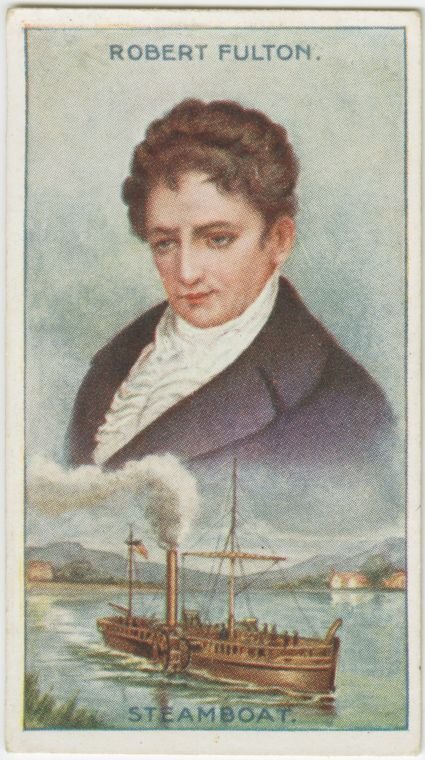
Image of Robert Fulton and his steamboat. Robert Fulton and his steamboat, commemorative cigarette card, 1850. New York Public Library, H46-12-2.
Stevens continued his steamboat work after Brunel left for England. In 1804, assisted by his sons, he successfully trialled the Little Juliana, with a multi-tubular boiler and a high-pressure engine driving twin screws. This was an important historical milestone: the “first practical screw-driven steam boat.” The technology and engineering of the time did not at this stage permit the further development of steamboats driven by screw propellers. These would develop later in the nineteenth century. Isambard Kingdom Brunel, Marc’s son, would build the first Atlantic liner with both an iron hull and screw propulsion, the SS Great Britain, which arrived in New York on the 7th August 1845, welcomed by huge crowds, after a journey of just 15 days. [10]
In this regard, Stevens was ahead of his time: “with the re-introduction of the screw propeller in 1839, all of the elements Stevens had combined in the Little Juliana became essential factors in steam navigation of the ocean.” [11]
In 1799 Nicholas Roosevelt was contracted by the US government to provide coppersheathing for six new 74-gun ships for the fledgling US navy. But when Jefferson replaced Adams as President in 1801, the contract was cancelled, causing severe financial loss to Roosevelt. [12] Also in 1799, Benjamin Henry Latrobe, architect and future supervisor of the building of the U.S. Capitol, commissioned Roosevelt to provide steam-driven pumps for the Philadelphia Waterworks. In 1808 Roosevelt married Latrobe’s daughter Lydia, some 24 years his junior, in a gala wedding on Capitol Hill with the President’s wife, among other social luminaries attending. Latrobe initially opposed the marriage but eventually consented.
Roosevelt and Latrobe later became partners with Fulton in building steamboats for the American West. Their steamboat the New Orleans successfully completed an epic voyage from Philadelphia down the Ohio and Mississippi rivers to New Orleans in 1811-12. The pregnant Lydia Roosevelt insisted in accompanying her husband, together with her young daughter. The Roosevelts’ second child was born on the trip during a stop in Louisville in October 1811. While waiting for the river to deepen so that the steamboat could negotiate the Falls on the Ohio River, Roosevelt ran excursion trips up-river, against the current to demonstrate the efficacy of steam technology. After several adventures, the New Orleans reached its namesake city on 10 January 1812. This steamboat, according to one author, had 'proved to be the prototype for the western river steamboats that revolutionised transportation and commerce along the inland rivers. [13]
Meanwhile, Chancellor Livingston’s career continued its upward trajectory. In 1801, Thomas Jefferson appointed him to be Minister to France. In this role, Livingston successfully negotiated the Louisiana Purchase, a milestone in the development of the U.S. and a spectacular gain for the new nation. The Louisiana Purchase, comprising some 530 million acres, effectively doubled the size of the country, for a price of just $15 million.
Marc Brunel’s engagement with Chancellor Livingston did not end with the failure of the internal combustion steamboat. The “Dream Team” was over, but Marc Brunel was keen to maintain his relationship with Robert Livingston after they each had separately moved to the other side of the Atlantic. On 18 December 1801, Brunel in London wrote to Livingston in Paris, and referred, as he had in his letter of 1799 on the eve of his departure from America, to Livingston’s supposed “improvements on the steam engine.” Given what we know of the views of Stevens and Roosevelt and also (later) of James Watt about the Chancellor’s engineering ideas, this was once again, likely to be calculated flattery on Brunel’s part. [14]
Brunel also had other reasons for writing to the Chancellor in the latter’s new role as the US Minister in France. In particular, he was seeking Livingston’s help in approaching the French Government with regard to Brunel’s patented invention of machinery for making pulley blocks for ships. [15] This was a key Brunel invention which Brunel later convinced the Admiralty in Britain to take up, but had not yet done so. [16] In a further letter to Livingston on 4th February 1802, Brunel refers to his lack of success so far in Britain, suggests an intermediary look at his blockmaking invention and report to the French Minister about it, but also says that he has some hope of being involved with blockmaking for the British Government and is meeting that evening the Inspector General in the Navy Department on this subject. [17] In both these letters he refers to personal financial pressures. In the February 1802 letter, Brunel appears to distance himself from further substantial involvement with Livingston’s steam engine ‘improvements.’ These letters were written during an 18 month period of cessation of hostilities between Britain and France (October 1801 to April 1803) who were otherwise at war with each other for more than 20 years after 1793.
In Paris, Livingston met Robert Fulton and effectively abandoned Stevens and Roosevelt to partner with Fulton. Robert Fulton’s peripatetic career moving between the U.S., England and France provides an interesting counterpoint to that of Marc Brunel. Fulton was born in Pennsylvania in 1765, and moved to England in 1786 where he was a successful painter as well as an inventor involved in canals and other civil engineering projects. In 1797 he moved to Paris where he tried and failed to interest Napoleon and the French government in his ideas for ‘torpedoes’ and (human-powered) submarines. He was also interested in developing steam-powered vessels.
In 1804 he moved to Britain, developing “torpedoes,” that is, mines, for Napoleon’s arch-enemy, the Royal Navy. In 1806 he returned to the United States, and in 1807 his and Robert Livingston’s steamboat, the North River — later renamed the Clermont after the Chancellor’s mansion on the Hudson — plied a commercially successful trade between New York and Albany along the Hudson.
Fulton and Livingston are generally credited with inventing the first successful steamboat. But a case can be made for at least equal billing for Stevens and Roosevelt earlier. Dubois’s judgement on Stevens is that he “deserves to be included with the steam boat pioneers in every sense of the word. He did not invent the steam boat nor did he claim to: but for that matter, no one else did either, despite their claim.” [18] And Turnbull points out that the Stevens/Roosevelt steamboat the Polacca, was the first non-condensing and double-acting boiler in use on the American continent, and its trip on the Passaic happened years before Fulton and Livingston’s later boat the Clermont steamed on the Hudson. Moreover, Stevens was an early proponent of screw propulsion, which eventually replaced paddle-wheels steamships.
Stevens and Roosevelt’s achievements in steamboat development do not as far as we know relate directly to Brunel’s internal combustion experiments. But as a skilled engineer and former mariner, perhaps Brunel made other suggestions to them, beyond fulfilling his commission to attempt an internal combustion machine? Until and unless we find further letters or other evidence from this time, this must remain speculation. Brunel’s engagement with some of the American steamboat pioneers in the 1790s helps us to understand better his wider story and his achievements, and also brings out the importance of the crucial years he spent in the United States. In particular it can be argued that Marc Brunel’s location, not just in America, but specifically in New York City was important.
New York was still a very small city at that time. Its population doubled between 1790 and 1800, but was still only 60,000 at that date compared with 600,000 in Paris and 1 million in London. Brunel’s location first in Murray Street, then in George Street, placed him close to, among others, Nicholas Roosevelt, Alexander Hamilton and probably Robert Livingston’s town address. More generally, he was living and working in New York City just at the point when the still nascent city was beginning its rapid trajectory from local backwater to global metropolis.
By the end of his time in the U.S., Marc Brunel was clearly brimming with ideas and inventions. He fully deserves Alexander Hamilton’s description of him as “an inventor of ingenious machines” as well as justifying his own comment, ascribed to him by his descendant Celia Brunel Noble in her 1938 biography of The Brunels Father and Son, that he brought with him from America to England “some small means and many great ideas.” [19] These ideas were developed by Marc Brunel from his own genius — but developed in the specific milieu of New York in the last decade of the eighteenth century.
Mark Kleinman is a writer, communicator and researcher, based in Cambridge and London. At the Brunel Museum he helps tell the story of the Thames Tunnel, and its creators, Marc Isambard Brunel and his son Isambard Kingdom Brunel. Previously Mark has been a civil servant and a policy director in the UK, and has held a number of academic posts, including at the University of Cambridge, the London School of Economics and King’s College London, as well as visiting appointments at the University of Toronto and the University of New South Wales. He is the author or co-author of four books and more than 100 published papers.
[1] Dubois, R. L. (1973) ‘John Stevens: Transportation Pioneer,’ PhD thesis, New York University, pp. 130-131.
[2] Turnbull, A. (1928) John Stevens: An American Record, p. 140.
[3] Dubois (1973), p. 131.
[4] Marc Brunel to John Stevens, 30 January 1798, Stevens Institute of Technology, Samuel C. Williams Library, Stevens Family Papers Reel 12, ref 651; also in Turnbull (1928), pp. 139-140.
[5] Marc Brunel to John Stevens, undated, Stevens Institute of Technology, Samuel C. Williams Library, Stevens Family Papers Reel 12, ref 544-545; also in Turnbull (1928), pp. 140-141.
[6] Robert R. Livingston to William Constable giving instructions for purchasing a steam engine, 4 November 1798, Gilder Lehman Institute of American History, https://www.americanhistory.amdigital.co.uk/Documents/Details/Robert-R--Livingston-to-William-Constablegiving-instructions-for-purchasing-a-steam-engine/GLC04330.
[7] Roger G. Kennedy, Orders from France: The Americans and The French in a Revolutionary World (1989), p. 82.
[8] See Lot #209, 'Marc Isambard Brunel Autograph Letter Signed’ RR Auctions, 2021 https://www.rrauction.com/aucMons/lot-detail/345137406220209-marc-isambard-brunel-autograph-lettersigned/.
[9] Ibid.
[10] https://www.ssgreatbritain.org/arriving-at-the-big-apple/.
[11] Colonel John Stevens (1749-1838) Obituary, 'Science News a Century Ago,' Nature, 5 March 1938. 33 Dubois (1973), p. 428.
[12] Maurer, M. (1945), ‘Coppered Bottoms For The United States Navy, 1794-1803’, US Naval Institute Proceedings Vol 71/6/508.
[13] Leland R. Johnson (2011) ‘Harbinger of Revolution: The Voyage of the New Orleans’ Indiana Historical Society Traces of Indiana and Midwestern History Summer, pp. 14-23.
[14] James Watt to Rt Hon. Robert R. Livingston, 16 Jan 1801, with enclosure of separate document of Watt’s ‘observations,’ Matthew Boulton Papers, Wolfson Archive Centre, Birmingham Library MS 3219/4/1/5/6/37a.
[15] Marc Brunel to Robert R. Livingston, 18 December 1801, Robert R. Livingston Papers 1707-1862, New York Historical Society Manuscripts Collection.
[16] See Clements P. (2008) ‘Marc Isambard Brunel’; Beamish R. (1862) Memoir of the Life of Sir Marc Isambard Brunel.
[17] Marc Brunel to Robert R. Livingston, 4 February 1802, Robert R. Livingston Papers 1707-1862, New York Historical Society Manuscripts Collection.
[18] Dubois (1973), p. 101.
[19] The Brunel Museum, https://thebrunelmuseum.com/such-patronage-as-in-your-situation-and-in-his-may-be-proper-how-alexander-hamilton-helped-marc-brunel-get-to-england/, and Celia Brunel Noble, The Brunels: Father and Son, London (1938).