Masthead_Gloucester_Kearn.jpg

Gotham

On the (Queer) Waterfront

​On the (Queer) Waterfront

Reviewed by Elvis Bakaitis

On the (Queer) Waterfront is currently on view at the Brooklyn Historical Society (March 6-August 4), and offers glimpses of individual LGBTQ lives from the mid-1800s through the post-WWII period. Co-curated by Avram Finkelstein and Hugh Ryan, the exhibit is based on Ryan's recently published book, When Brooklyn was Queer, which focuses on the borough as a whole, though with a strong anchor (pun intended) to the waterfront.

Read More
Pinstripe Nation: The New York Yankees and American Culture

Pinstripe Nation: The New York Yankees and American Culture

Reviewed by Tony Calandrillo

In Pinstripe Nation: The New York Yankees and American Culture, Baker University professor Will Bishop explores how the success, failure, and attendant drama of the New York Yankees fits into the larger narrative of American culture, and how both the Yankees and that culture constantly mirror each other in the 20th century. In the introduction, Bishop makes this point clearly when he states that “what plays out in our little cocoons of sport is so often a close parallel of what is going on outside of them, only dramatized in a way that frequently makes it clearer.” According to the author, “the narratives that play out in the world of sport often are somehow able to help us better see and understand who we are as a society, what we value, and how we are changing.” For the particular case of the New York Yankees, this mirror narrative sees that the Yankees’ story of success parallels and is interwoven with the narrative of American success in the twentieth century. For his book, Bishop uses the work of Roland Barthes in relation to unspoken communication through symbols to illustrate how the Yankees have been used as an American cultural icon from their rise to national prominence in the 1920s through the end of the twentieth century.

Read More
When Long Island City Was the Next Big Thing

When Long Island City Was the Next Big Thing

By Ilana Teitel

For about a hundred days this winter, Long Island City was in the spotlight as a neighborhood about to be transformed. Amazon was coming, the national media was running articles about the 7 train, and brokers were selling condos via text messages. The word was out about this patch of western Queens and its waterfront views, central location, cultural diversity, and overtaxed infrastructure.

And then, on Valentine’s Day, it was over. Amazon pulled out and locals began to debate whether that much change would have been good or bad for LIC. But, this wasn’t the first time that Long Island City was the neighborhood that almost, maybe, soon, was about to take off. Here’s a look at three other times that LIC was briefly New York’s Next Big Thing.

Read More
The Rebel Cafe: Sex, Race and Politics in Cold War America's Nightclub Underground

The Rebel Cafe: Sex, Race and Politics in Cold War America's Nightclub Underground

Reviewed by Burton W. Peretti

Stephen R. Duncan’s new book admirably fills a void in the historiography of 20th century American culture. We long have recognized that between the storied nightclub era of Prohibition days and the age of rock ’n’ roll, there was a perceptible but elusive set of nightlife entertainment venues that kept radical left-wing political values percolating during the Depression, World War II, and the Cold War. Historians have explored chapters in New York City’s interregnum — David Stowe, for example, covers Cafe Society in the late 1930s, Patrick Burke describes the jazz clubs on 52nd Street, and James Gavin chronicles European-style cabaret — but a comprehensive history, with more of a national perspective, has been lacking. Duncan’s ambitious and wide-ranging work makes a terrific new contribution toward defining the paramount significance of radical and intimate performance venues of the 1940s, 1950s, and early 1960s.

Read More
We’ve Come a Long Way Baby: A Backward Glance at Library Service Availability at the Municipal Colleges

We’ve Come a Long Way Baby: A Backward Glance at Library Service Availability at the Municipal Colleges

By Sandra Roff

You are still waiting for that interlibrary loan book or perhaps a video that you wanted to show your class, and you are wondering what is taking so long. After reviewing Reading Publics: New York City’s Public Libraries 1754-1911 by Tom Glynn it became clear that in the nineteenth-century, at a time when reading was the only way to get information, the availability of libraries was extremely limited, and what we now recognize as the job of a library was not realized until the twentieth century. The earliest libraries that opened in New York City operated as private corporations, with the wealthy buying shares to borrow books. Special interest groups also started libraries such as the General Society of Mechanics and Tradesmen, who had a library with a small annual fee. The New-York Historical Society opened in 1805 with a mission to collect New York City materials, but again membership was restricted to the elite. Other libraries followed but they all required a fee and in addition, many had extremely limited hours.

Read More
Dredging Newtown Creek: An Interview with Mitch Waxman

Dredging Newtown Creek: An Interview with Mitch Waxman

Interviewed by Joseph Alexiou

Writer and photographer Mitch Waxman is the leading authority on the history of Newtown Creek, a toxically polluted industrial waterway on the border between Brooklyn and Queens. In addition to his reporting and documentation, Waxman leads regular tours on land and by boat while spreading the unique stories of New York’s most centrally located contaminated coastline to the community.

Read More
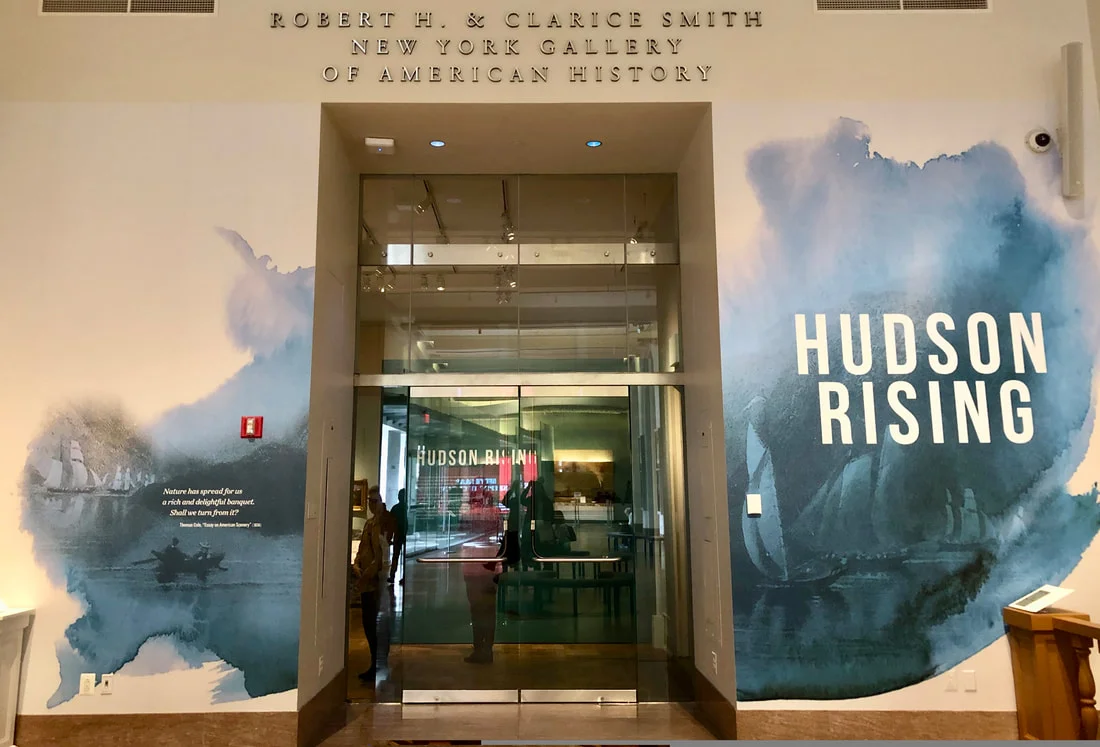
Hudson Rising

Hudson Rising

Reviewed by Kara Murphy Schlichting

What metaphor captures the relationship between the Hudson River, the cities that line its shores, and the people who plie its waters? Is the river a touchstone by which thinkers trace American ideas about nature? Is it an allegory, teaching those humbled in the face of ecological change to repent humanity's role? Is it the exemplar of the declension narrative present in American environmental storytelling? Or is the river more like a battle cry, rallying those committed to environmental activism and resiliency? Hudson Rising, the new exhibit at the New York Historical Society, contends it is all of these things. This deeply researched, thoughtfully presented, and satisfyingly interdisciplinary exhibit introduces the visitor to myriad people who have used and shaped the river, confronted ecological ruin, and turned towards preservation to mitigate degradation.

Read More
"All the Single Ladies": Women-Only Buildings in Early 20th c. NYC

"All the Single Ladies": Women-Only Buildings in Early 20th c. NYC​

By Nina E. Harkrader

The growth of manufacturing and industry in Northeastern cities during the early to mid-nineteenth century increased demand for female labor in the United States. As a result, the number of single working women living in urban areas grew significantly. These newly arrived women workers were expected to find their own lodging, but there were no precedents for housing single women in cities. On top of that, the much lower wages paid to female workers greatly limited their housing choices, and many ended up living in squalid situations: shared bedrooms in tenement buildings or hired rooms in boarding houses with male lodgers. For women workers in cities, two problems emerged: a literal housing crisis, but a figurative one as well, as this was a period when female chastity, innocence, and domesticity were celebrated and expected of women, who would perform the role of “the angel in the house” and rarely, if ever, appear unaccompanied in public.

Read More
Urban Ornithology: 150 Years of Birds in New York City

Urban Ornithology: 150 Years of Birds in New York City

Reviewed by Leslie Day

I lived on a boat on the Hudson River in Manhattan from 1975 to 2011 and it was then that I became an avid birder. Living on the Hudson I watched canvasback ducks with their beautiful red heads arrive each winter in huge numbers in the 1980’s. And I observed them as their numbers diminished greatly after the 1990’s. When I first moved to the river there were many laughing gulls that migrated to the city each April. My father’s birthday was April 12th, around the time they’d show up. The happy sound of their calls would bring me running outside to my deck to look at them and hear the joyous cries — my harbinger of the beautiful warm months to come. By the time I moved away in 2011, there were just a few arriving each spring.

Read More
The Picture the Homeless Oral History Project: Don’t Talk About Us, Talk With Us

The Picture the Homeless Oral History Project: Don’t Talk About Us, Talk With Us

Today on the blog, former Executive Director of Picture the Homeless Lynn Lewis speaks with Molly Rosner about her experience conducting oral history interviews as both an organizer and an oral historian. Quotes from interviewees in the project have been interspersed throughout the text.

Read More