Masthead_Gloucester_Kearn.jpg

Gotham

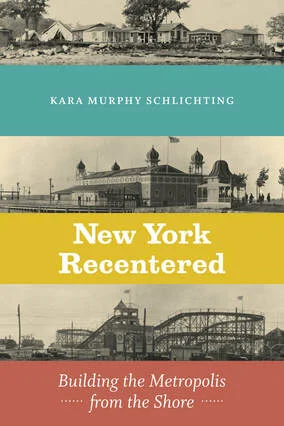
New York Recentered: Building the Metropolis from the Shore

New York Recentered: Building the Metropolis from the Shore

By Kara Murphy Schlichting

In 1865 New York City park commissioner Andrew Haswell Green came to the conclusion that the city had outgrown Manhattan Island. In a report for the Board of Commissioners of Central Park, Green argued that the city’s future should include its mainland environs of Westchester County north of the Harlem River. He articulated a river-spanning future for New York. Green reasoned that lower Westchester was “so intimately connected with and dependent upon the City of New York, that unity of plan for improvements on both sides” of the Harlem was “essential.”

Reprinted with permission from New York Recentered: Building the Metropolis from the Shore, by Kara Murphy Schlichting, published by the University of Chicago Press. © 2019 by the University of Chicago Press. All rights reserved.

Read More
The Girl on the Velvet Swing

The Girl on the Velvet Swing

Reviewed by Emily Brooks

In The Girl on the Velvet Swing: Sex, Murder, and Madness at the Dawn of the Twentieth Century, Simon Baatz explores the dramatic and violent relationship between three infamous figures in late nineteenth and early twentieth century New York City. The story of Evelyn Nesbit, Stanford White, and Harry Thaw, a beautiful young performer, a famous middle-aged architect, and a notorious scion of a wealthy family, respectively, captivated their contemporaries and continues to appeal to historians more than a century later.

Read More
Recovering New York’s Entangled Dutch, Native American, and African Histories: An Interview with Jennifer Tosch

Recovering New York’s Entangled Dutch, Native American, and African Histories: An Interview with Jennifer Tosch

By Andrea Mosterman

Many of New York’s Dutch colonists and their descendants relied on the labor of enslaved people. Some historic sites have struggled to address this part of their history and looked for ways in which they can share it with their visitors. For example, an exhibit at the Old Stone House in Brooklyn, built in 1699 by Hendrick Claessen Vechte, includes a brief discussion of the home’s enslaved residents. Yet, much of the Dutch history of slavery in New York City and its surroundings is still little known, especially among the general public.

Read More
History Museums and Capitalism: The Need for Critical Conversations

History Museums and Capitalism: The Need for Critical Conversations

By Andrew Urban

In November, 2018, the Public Historian published a review that I wrote of the Lower East Side Tenement Museum’s newest tour: Under One Roof. The tour interprets the lives of three families who lived in the tenement at 103 Orchard Street — which was acquired by the museum in 2007 — from the 1940s up until the recent past. Addressing post-World War II immigration and migration to the Lower East Side, the educators leading the tours that I took did an excellent job highlighting how Americans have frequently been reluctant to welcome the world’s “huddled masses,” national myths notwithstanding.

Read More
The State Versus Harlem

The State Versus Harlem

By Matt Kautz

Over the past few years, Americans have paid greater attention to the harm caused by opiates and rising heroin use, specifically in white, rural areas. The New York State Department of Health has dedicated a large portion of its website to sharing statistics of opioid overdoses in the state, warning signs about what addiction looks like, information on the state’s program for monitoring doctor’s prescriptions, and how those addicted can receive treatment.

Read More
Carol Lamberg's Neighborhood Success Stories: Creating and Sustaining Affordable Housing in New York

Carol Lamberg's Neighborhood Success Stories: Creating and Sustaining Affordable Housing in New York

Reviewed by Nicholas Dagen Bloom

Building and operating subsidized housing in New York City is a tough business. Carol Lamberg, a master at the trade, offers us a candid and nuanced account of the perils and promise of this enterprise in her readable autobiographical account, Neighborhood Success Stories. Lamberg, who served for decades as the Executive Director of the Settlement Housing Fund, helped build the organization into one of the most respected affordable developers and managers in the city, with outstanding multi-family properties in the Bronx and Lower East Side.


Read More
A Love Letter to Babette Edwards: Harlem’s “Othermother”

A Love Letter to Babette Edwards: Harlem’s “Othermother”

By Terri N. Watson

On February 5, 1971, Babette Edwards and Hannah Brockington submitted a joint letter of resignation from I.S. 201’s Community Education Center to David X. Spencer, chairman of the governing board for the Arthur A. Schomburg I.S. 201 Educational Complex. The three-page letter outlined their frustrations with the teachers and school leaders who worked in the complex and their belief that “schools exist to make teachers and principals happy; not a place where children learn.” In the opening paragraph Edwards explained the challenges faced by the parents of Harlem:

For the last fifteen years we have fought those people who have deliberately crippled our children. Now in 1971 we are still fighting the same fight, only conditions are worse, because the cripplers in the past (largely white) have now been joined by the destructive opportunistic education pimps (largely black), who prey on the Harlem community, sucking it’s life blood, the community’s future, which is embodied in their children.[1]

Edwards led I.S. 201’s Community Education Center and, along with her dear friend and neighbor Hannah Brockington, served on its 21-member governing body. The center was housed in I.S. 201: a windowless structure that contained an intermediate school and nearly a dozen centers and programs created to meet Harlem’s needs.[2] It was also one of the three demonstration school districts established in 1967 after New York City’s Black and Hispanic parents demanded a say in their children’s schooling.[3] The other two districts were located in Ocean Hill-Brownsville, Brooklyn, and in lower Manhattan.[4]

Read More
Guest UserComment
Hugh Ryan's When Brooklyn Was Queer

Hugh Ryan's When Brooklyn Was Queer

Reviewed by Benjamin Serby

“Pick a random book about ‘New York City’ history, and chances are, it will mention Brooklyn… sporadically if at all. The chance that it talks about the queer history of Brooklyn? Nearly zero.” Thus writes Hugh Ryan, a curator and author whose new book, When Brooklyn Was Queer, marks a first attempt at correcting the ingrained Manhattan-centrism of queer studies and recovering the stories of queer Brooklynites in particular.

Read More
Capital City: An Interview with Sam Stein

Capital City: An Interview with Sam Stein

In Capital City: Gentrification and the Real Estate State, Sam Stein offers a theoretical and empirically grounded discussion of how gentrification became a generalized fact of urban life in the 21st century, and how we can not only stop it, but also build cities that work for all, not just the wealthy few. Centering his discussion around the contradictory and often hidden role of professional planners, Stein illustrates how the state has been central to the rise of real estate in urban political economies, leveraging state “police powers” to turn devalued urban land into a profitable commodity — the so called “spatial fix” that capital requires from time to time in moments of crisis. By bringing to life the diverse set of state and non-state actors responsible for turning the places we cherish into products to be bought and sold, Stein also reveals the contingencies and limits of real estate capital’s power over our lives.

Read More
On the Hot Seat: An Interview with John Garvey of the Taxi Rank & File Coalition

On the Hot Seat: An Interview with John Garvey of the Taxi Rank & File Coalition

John Garvey is a Brooklyn native and lifelong New York City resident. During the 1970s, he was a leading activist in the Taxi Rank & File Coalition, a group of radical cab drivers determined to fight their bosses and a union leadership they perceived as corrupt and ineffective. Later in life, John worked as an educator in New York City jails and headed the Teacher Academy and Collaborative Programs at the City University of New York, where, among other things, he was instrumental in establishing the CUNY Prep program, which offers out-of-school youth a pathway to college. ​He is an editor of Insurgent Notes, of Hard Crackers: Chronicles of Everyday Life, and was an editor of Race Traitor, a journal that published between 1993 and 2005 whose motto was “treason to whiteness is loyalty to humanity.”

This interview, conducted by Gotham's Andy Battle, has been condensed and edited for clarity.

Read More