Masthead_Gloucester_Kearn.jpg

Gotham

Happenings: Art, Play, and Urban Revitalization in 1960s Central Park

Happenings: Art, Play, and Urban Revitalization in 1960s Central Park

By Marie Warsh

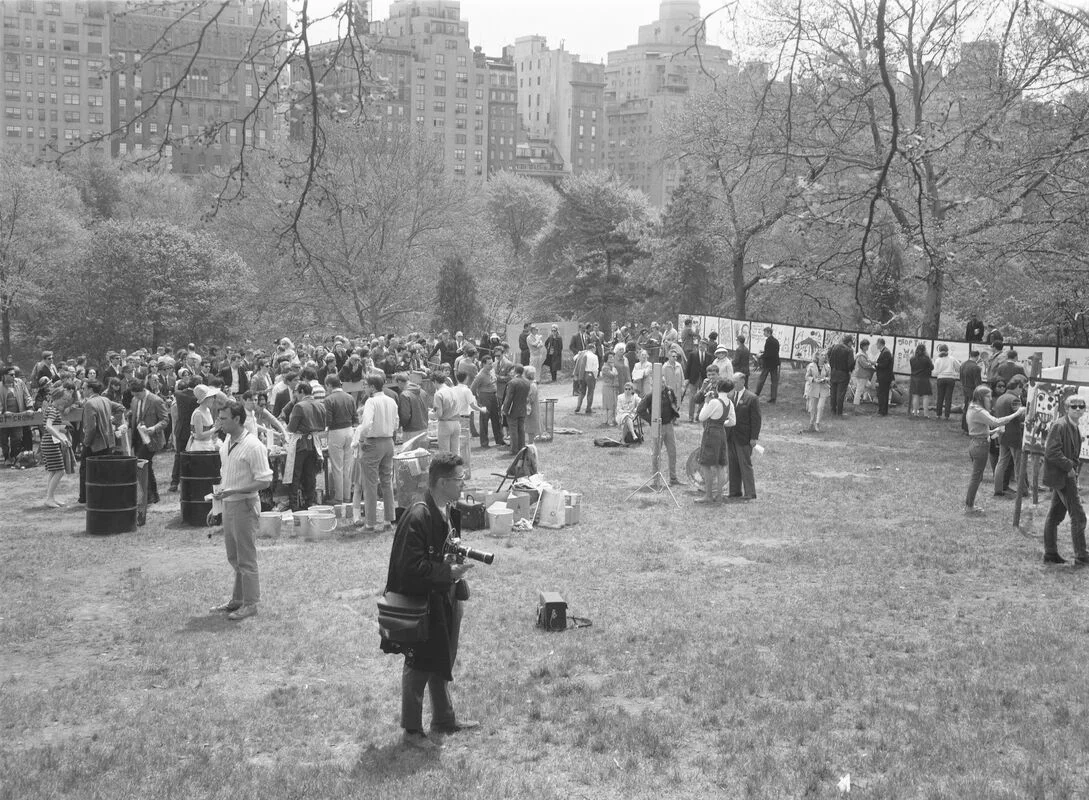
On November 16, 1966, an unprecedented event took place on the Sheep Meadow in Central Park. Beginning at midnight, thousands of New Yorkers convened on the park’s largest lawn to watch the Leonid meteor showers, which were expected to be particularly brilliant. Although the crowd was let down — dense cloud cover prevented visibility — the gathering nonetheless offered a convivial atmosphere. Spectators brought chairs, blankets, and hot beverages, and the event became an after-dark picnic, with some marveling at the novel scene. One woman observed, “All these people in the park after midnight, and no one is getting mugged.”

Read More
The Deuce Times Two

The Deuce Times Two

By Jeffrey Escoffier

“It was the best of times, it was the worst of times.” The famous opening line of Dickens’ Tale of Two Cities certainly seems like an appropriate way sum up 1970s New York, but I cite it also because the novel itself comes up in The Deuce’s first season as a book that launches a young prostitute on the road to reading and going back to school. Objectively life in New York City during the 1970s and early 80s was pretty bad — high crime rates, rampant homelessness, loose trash everywhere, whole neighborhoods of abandoned buildings crumbling and burning — yet it was an incredibly creative time as well: in music, art, performance, theater and sexuality. This was brought home to me recently when a 70-year-old retired professor of history said to me: “I know everything was so terrible in that period, but it was also incredibly exciting.”

Read More
(Podcast) Discovering Ancient Greece and Rome in the Modern City

(Podcast) Discovering Ancient Greece and Rome in the Modern City

Today on Gotham, Beth Harpaz, editor of CUNY SUM, interviews Elizabeth Macaulay-Lewis about Classical New York: Discovering Greece and Rome in Gotham. The new volume, co-edited with Matthew McGowan, explores how and why New York City became a showcase for the art and architectural styles of ancient Greece and Rome — from the public spaces at Rockefeller Center to the Gould Memorial Library at Bronx Community College.

Listen to their interview here.

Read More
One Hundred Years of Equity Strikes and Labor Solidarity

One Hundred Years of Equity Strikes and Labor Solidarity

By Caroline Propersi-Grossman

In August 1919, following months of stalled negotiations, the New York City section of Actors’ Equity Association (Equity) called a strike against The Producing Managers Association, a trade group composed of theater owners and producers including the Shubert, Ziegfield, and Belasco theater owners. Equity’s demands were modest. The strike called for a standardized eight-show work week with additional compensation for extra matinee performances and higher wages for chorus performers. The Producing Managers Association responded by refusing to recognize Equity, filing injunctions against individual actors, and occasionally attempting to open negotiations with the actors’ union on a theater-by-theater basis.

Read More
Ephemeral Reminders of the Good Government Movement

Ephemeral Reminders of the Good Government Movement

By Sandra Roff and Sarah Rappo

For an archivist, opening a box from an unexpected archival collection can reveal strange and often wonderful items that can shed light on persons, places or events. Much of what is found between the pages of reports, tucked into scrapbooks, or loosely scattered in cartons can prove to be unexpected treasures for researchers. Under the umbrella term ephemera, the value of these archival finds has been chronicled in assorted journal articles and in the publications of the Ephemera Society.

Read More
Art's Great Good Place? Warhol's Silver Factory and Its Legacy

Art's Great Good Place? Warhol's Silver Factory and Its Legacy

By Jeffrey Patrick Colgan

Andy Warhol is a famous artist. With his platinum blonde wig, cosmetic surgery, and cool gaze resting atop impossibly high cheekbones, his visage alone is known by almost every American. So too his art, with its repetition, immediacy, bold splotches of non-gradated color, and mass-culture subject matter. For many outside of the art world he alone represents 20th Century visual art. Within the art world, and the adjacent fields of art history and the philosophy of art, the biography and artistic output of Warhol—endlessly examined and discussed as it is—primarily repeats the same few narratives.


Andy Warhol—From A to B and Back Again, Whitney Museum of American Art
November 12th, 2018 - March 31st, 2019

Read More
(Podcast) Clarence Taylor's Fight the Power: African Americans and the Long History of Police Brutality in New York City

In his most recent book, Clarence Taylor, dean of the history of the civil rights movement in New York, looks at black resistance to police brutality in the city, and institutional efforts to hold the NYPD accountable, since the late 1930s and '40s.

Listen to this interview here.

Read More