“Mortars over Stapleton Heights”: Audre Lorde on Staten Island
By David Allen
In the poem, “On My Way Out I Passed Over You and the Verrazano Bridge,” Lorde contemplates leaving Staten Island where she had lived for nearly thirteen years. Her connections to the place were complex, bringing together her love of nature, her need for a place to write and work, to be with her lover and her children, as well as with other poets and activists. All these had come to pass within a social and political climate inscribed with racism, homophobia, and violence.
Review: Hugh Ryan’s The Women’s House of Detention: A Queer History of a Forgotten Prison
Reviewed by Rachel Corbman
Fifty years ago, an art deco prison towered over Greenwich Village. Between the years of 1929 and 1971, tens of thousands of women and trans masculine people passed through the Women’s House of Detention, waiting for a trial or serving sentences. In The Women’s House of Detention: A Queer History of a Forgotten Prison, Hugh Ryan convincingly demonstrates why this largely forgotten prison matters to queer history. Despite Ryan’s central focus on the so-called House of D, The Women’s House of Detention does not read like an institutional history. Rather, Ryan weaves together the life histories of dozens of women and transmasculine people, following them before and after their time at the House of D.
Review: Terry Williams, The Soft City: Sex for Business and Pleasure in New York City
Reviewed by Timothy J. Gilfoyle
Public sex in New York evolved amidst wide-ranging social and economic change in Gotham from 1979 to 2018. The “Disneyfication” of Times Square and the elimination of the most visible forms of public pornography attracted the most attention and commentary. But an evolving sexual revolution of sorts simultaneously occurred throughout the city. For four decades, the sociologist and ethnographer Terry Williams was watching closely, taking notes. Literally.
Anti-Asian Violence and Acts of Community Care from the 1980s to the Present
Vivian Truong Interviewed by Hongdeng Gao
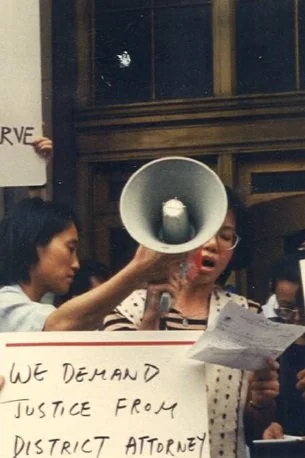
Today on the Blog, Gotham’s editor Hongdeng Gao speaks with Vivian Truong, author of “From State-Sanctioned Removal to the Right to the City” and a core committee member of the A/P/A Voices: A COVID-19 Public Memory Project.Truong discusses segregationist and police violence against Asian American, Black and Latinx residents in southern Brooklyn in the 1980s and 1990s and the cross-group, cross-issue movements that developed in response to such violence.
The Complicated Legacy of Paul Moss, La Guardia’s Infamous “Gutter-Cleaner”
By Jonathan Kay
Outside the conference room at the Bow Tie Partners offices in Times Square, there is a framed letter, dated September 5, 1944, addressed to one “Master Charles B. Moss, Jr.” — the grandson of legendary New York City film exhibitor B.S. Moss (1878-1951), who still presides over the family film and real-estate business.
Decline, Rebellion, and Police Politics: Rethinking the Dissolution of New York’s Civil Rights Coalition
Reviewed by Joseph Kaplan
In his final book before his life was taken by an assassin’s bullet, Martin Luther King Jr. reflected on the state of the Civil Rights Movement and the conditional allyship of whites. According to King, whites generally believed “that American society is essentially hospitable to fair play and to steady growth toward a middle-class Utopia embodying racial harmony.” Emerging from a decade of unprecedented mobility in which a highly unionized white labor force entered the middle class en masse, many viewed the Civil Rights Movement as part of the unbroken march of progress.
“We Accuse”: The Harlem Rebellion, Bill Epton’s Anti-Carceral Activism, and the rise of the Surveillance State
By Joseph Kaplan
On July 16th, 1964, a mere three weeks after the passage of the Civil Rights Act, off-duty police officer Thomas Gilligan shot and killed fifteen-year-old Black student James Powell outside of Harlem’s Robert Wagner Junior High School. Gilligan claimed that he shot the 5’6” 122-pound Powell in self-defense when the teenager charged him with a knife, a claim disputed by several of Powell’s classmates. While the events of that day remain contested, there is firm agreement that this was the spark for the first major urban rebellion of the 1960s.
The History of Gambling and the Future of Marijuana
By Matthew Vaz
With recreational marijuana crossing over to legalization in New York State, there is authentic optimism that the new system of regulation will be of benefit to the communities that have long been targeted by discriminatory policing. While these developments are encouraging, New York’s history with transforming illicit activity into budgetary salvation gives reason for caution. The largest endeavor of this kind was the tortured legalization of numbers gambling by the New York State Lottery, a historical process which featured many of the same themes of race, exclusion, and budget crisis.
Today on the blog, Gotham editor Willie Mack speaks to filmmaker and geographer Brett Story about her book, Prison Land: Mapping Carceral Power across Neoliberal America. Story reexamines the prison as a set of social relations which includes property, race, gender, and class across the urban landscape. In this way, Story demonstrates how carceral power is distributed outside of the prisons walls to include racially segregated communities, gentrifying urban spaces, and even mass transit.
Explaining Amelia Norman’s Murder Attempt: Julie Miller’s Cry of Murder on Broadway
Reviewed by Lindsay Keiter
On the steps of the Astor Hotel on a fall evening in 1843, Amelia Norman plunged a small knife into her former lover’s chest. Immediately apprehended, Norman’s subsequent trial for attempted murder caused a media sensation. Championed by an unlikely coalition of middle-class moral reformers, including abolitionist Lydia Maria Child, and working-class political activists, Norman’s story did not “change history.”