Masthead_Gloucester_Kearn.jpg
Posts in Manhattan
Ephemeral Reminders of the Good Government Movement

Ephemeral Reminders of the Good Government Movement

By Sandra Roff and Sarah Rappo

For an archivist, opening a box from an unexpected archival collection can reveal strange and often wonderful items that can shed light on persons, places or events. Much of what is found between the pages of reports, tucked into scrapbooks, or loosely scattered in cartons can prove to be unexpected treasures for researchers. Under the umbrella term ephemera, the value of these archival finds has been chronicled in assorted journal articles and in the publications of the Ephemera Society.

Read More
Myth #9: A System of Block and Lot Divisions

Myth #9: A System of Block and Lot Divisions

By Gergely Baics and Leah Meisterlin

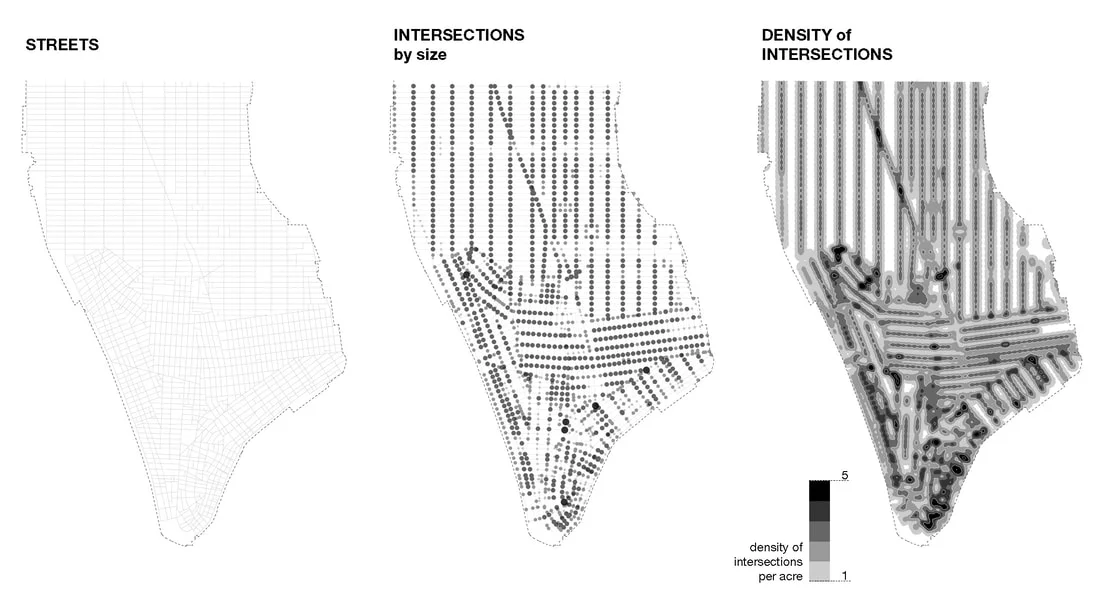
The New York City grid is often understood as a foundational system of land subdivision and cadastral allotment. Accordingly, the grid divides Manhattan into a highly regularized system of rectangular shaped blocks, subdivided into lots, making standard (and stackable) units of real estate available for urban development. The grid accomplishes the city’s apportionment through its collection of more frequently spaced and narrower east-west cross-streets and less frequently spaced and wider north-south avenues — each serving as partition and demarcation between the blocks with their nested lots. Indeed, conceptualizing the grid as a system of subdivided blocks highlights its underlying cadastral logic. Previous posts (#4 and #6) have addressed two myths following from this line of reasoning, specifically the extent to which block sizes determined lot sizes, and how the relentless regularity of blocks and lots contributed to rampant real estate speculation.

Read More
Cut-Throat: The Murder of William Lurye

Cut-Throat: The Murder of William Lurye

By Andy Battle

On an average day at midcentury, New York City’s Garment District was a chaotic welter of sewing, schlepping, and schmoozing. But on May 12, 1949, the streets went silent for William Lurye, an organizer for the International Ladies Garment Workers Union (ILGWU), the 400,000-strong body representing workers in the women’s clothing trade. Three days earlier, Lurye had been shoved into in a telephone booth in the lobby of a building on West Thirty-Fifth Street that housed dozens of loft-style garment factories. There, two assailants had stabbed the thirty-seven year-old father of four in the neck with an icepick.

Read More
To Build a Mature Society: The Lasting Legacy of Martin Luther King, Jr.’s “Beyond Vietnam” Speech

To Build a Mature Society: The Lasting Legacy of Martin Luther King, Jr.’s “Beyond Vietnam” Speech

By Kristopher Burrell

At Riverside Church in Harlem on April 4, 1967, exactly one year before his assassination, Martin Luther King, Jr. delivered a blistering and sophisticated critique of U. S. intervention in Vietnam. His “Beyond Vietnam” speech was prescient in ways that continue to haunt our society into the present day.

Read More