Masthead_Gloucester_Kearn.jpg
Posts in Manhattan
Myth #9: A System of Block and Lot Divisions

Myth #9: A System of Block and Lot Divisions

By Gergely Baics and Leah Meisterlin

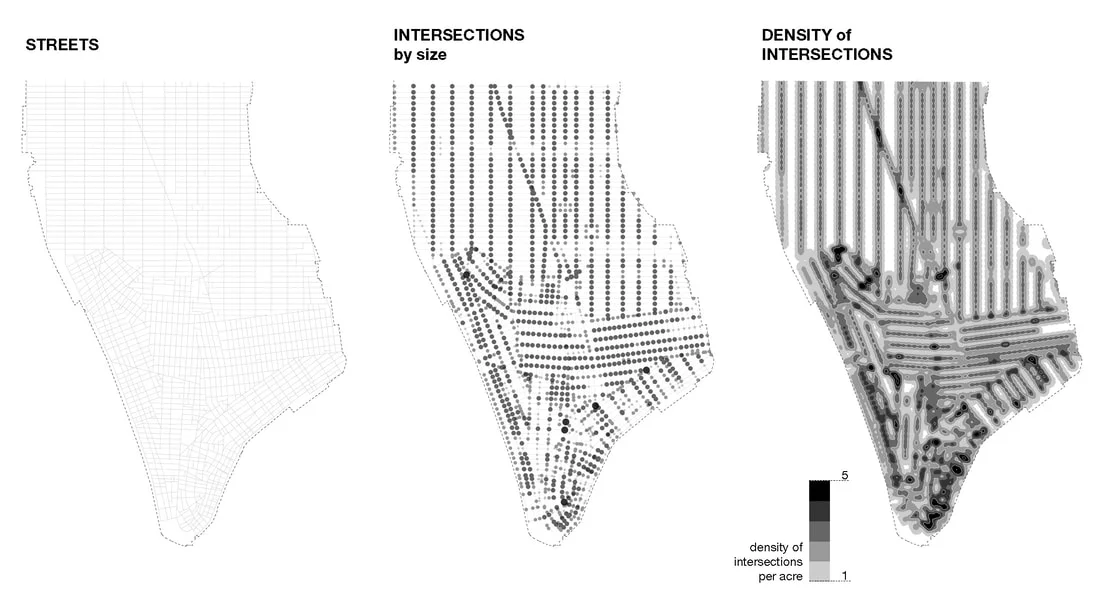
The New York City grid is often understood as a foundational system of land subdivision and cadastral allotment. Accordingly, the grid divides Manhattan into a highly regularized system of rectangular shaped blocks, subdivided into lots, making standard (and stackable) units of real estate available for urban development. The grid accomplishes the city’s apportionment through its collection of more frequently spaced and narrower east-west cross-streets and less frequently spaced and wider north-south avenues — each serving as partition and demarcation between the blocks with their nested lots. Indeed, conceptualizing the grid as a system of subdivided blocks highlights its underlying cadastral logic. Previous posts (#4 and #6) have addressed two myths following from this line of reasoning, specifically the extent to which block sizes determined lot sizes, and how the relentless regularity of blocks and lots contributed to rampant real estate speculation.

Read More
Cut-Throat: The Murder of William Lurye

Cut-Throat: The Murder of William Lurye

By Andy Battle

On an average day at midcentury, New York City’s Garment District was a chaotic welter of sewing, schlepping, and schmoozing. But on May 12, 1949, the streets went silent for William Lurye, an organizer for the International Ladies Garment Workers Union (ILGWU), the 400,000-strong body representing workers in the women’s clothing trade. Three days earlier, Lurye had been shoved into in a telephone booth in the lobby of a building on West Thirty-Fifth Street that housed dozens of loft-style garment factories. There, two assailants had stabbed the thirty-seven year-old father of four in the neck with an icepick.

Read More
To Build a Mature Society: The Lasting Legacy of Martin Luther King, Jr.’s “Beyond Vietnam” Speech

To Build a Mature Society: The Lasting Legacy of Martin Luther King, Jr.’s “Beyond Vietnam” Speech

By Kristopher Burrell

At Riverside Church in Harlem on April 4, 1967, exactly one year before his assassination, Martin Luther King, Jr. delivered a blistering and sophisticated critique of U. S. intervention in Vietnam. His “Beyond Vietnam” speech was prescient in ways that continue to haunt our society into the present day.

Read More
Relics of the Underground: The Afterlife of Cultural Spaces

Relics of the Underground: The Afterlife of Cultural Spaces

By Jeffrey Patrick Colgan & Jeffrey Escoffier

In early 1974, members of the punk band Television spotted a newly reopened yet unavoidably dingy lower Bowery bar on their way home from rehearsal. Returning soon after, they approached the owner Hilly Krystal and asked if he would host performances by bands that were playing a different kind of rock music. After an initial four-week residency by Television, CBGB & OMFUG (Country, Bluegrass, Blues & Other Music for Uplifting Gormandizers) continued to host countless bands and fostered the emerging punk and No-Wave music scenes of the 1970s and 1980s. Even after its role in any identifiable and burgeoning music scene came to an end in the 1990s, it still hosted performances until its ultimate demise in 2006 — its final sendoff facilitated by Blondie and Patti Smith. By 2008 the former venue was occupied by clothing designer John Varvatos, who kept some of the graffiti, stickers, and concert posters as accents to the calculated ‘subversiveness’ of the items on sale.

Read More
New Podcast Series, Hosted by Gotham

New Podcast Series, Hosted by Gotham

Today on Gotham, something different: a podcast.

From now on, we'll occasionally be featuring not just written but oral interviews on the blog, with authors of recent books dealing with New York City history. The series is a partnership with the New Books Network, a consortium of academic podcast channels whose very admirable goal is, like ours here at The Gotham Center, to raise the level of public discourse by introducing serious research to much wider audiences than normally get scholarly work.

Today, Beth Harpaz, editor of CUNY SUM, interviews the esteemed Cuban scholar and sociologist Lisandro Pérez about his new book, Sugar, Cigars and Revolution: The Making of Cuban New York.

Listen to their interview here.

Read More
"The New York Curb Market… Which has No Organization Whatever”: The Enclosure of New York’s Last Outdoor Stock Market, 1900-1921

"The New York Curb Market… Which has No Organization Whatever”: The Enclosure of New York’s Last Outdoor Stock Market, 1900-1921

By Ann Daly

Visitors to the New York Curb Market, located on the Broad Street sidewalk, also called “the gorge,” found themselves overwhelmed by the noise and frenzy. Hundreds of men on the street “writhed, leaped, swayed.” In New York’s last outdoor stock market, where orders were communicated by yelling or signaling out a window and anyone with lungs could trade, financial journalist Edwin C. Hill claimed in 1920, “some of those whirling dervishes down the street could borrow a million on their moral credit; for others the jail beckons.”

Read More