
The Pigs of The City of New York: 1624-1895
By Johann Smoller - Marcotullio
When the Dutch first settled the city of New Amsterdam in 1624, they brought pigs as a food source for their colonial project. They could hardly have anticipated the long-term tensions that these animals would cause for the city's future residents. Public policy is often phrased as a “war” against a hated enemy. In 2023, for example, New York City’s Commissioner of Sanitation, Jessica Tisch, declared a “War on Rats.” [1] In a similar vein, throughout the early history of New Amsterdam and New York City, a series of “Wars on Pigs” were waged over centuries against the city’s urban swine.
Unbeknownst to the Dutch colonists, their successors, the English occupiers, the politicians of Tammany Hall, and ultimately the Progressive Reformers, would all adopt variations of this warlike framing on pigs. The details of the various conflagrations with swine of interest, along with the broader impacts and effects of pig-control and pig-eradication policies, had significant and lasting consequences. Ultimately, pigs hold an important place in the history of domesticated animals in urban areas.
The Hogs of New Amsterdam (1625-1672)
In 1624, the Dutch West India Company (WIC) sponsored the colonization of North America by sending 30 families from the Walloon region of the Dutch Republic to what is now New York City, along with supplies, including pigs. Although most pre-1700 WIC records were destroyed or sold for profit when the company went bankrupt, some colonial records survive to tell the story.
Pigs provided a convenient food source for colonists. They required little maintenance, consumed almost anything, including garbage, and efficiently converted that material into meat. Nearly the entire animal could be butchered for various culinary uses. Their rapid and prolific reproduction, as well as their capacity to reach large sizes (up to 700 lbs), made them popular domestic animals. Their rapid growth, however, led to tensions within communities almost immediately. [2] Only thirteen years after New Amsterdam’s founding, in 1638, pigs became the subject of a series of legal disputes among citizens. The first of such cases is Cornell Lambertsen Cool vs. Jan Celes. Cool demanded “reparation for the damage the defendant's hogs caused.” [3] The court would settle and ordered “each to keep his hogs penned in.” [4] This first case of free-roaming pigs established the recurring relationship between pigs, their owners, the New Amsterdam authorities, and, later, the New York authorities. The relationship was defined by the animal owner’s need for protein and the challenges of controlling the animals.
Four additional cases of hog-related damage were filed in 1638 alone. [5] By 1640, the situation reached new heights of tension. Authorities in New Amsterdam established the first laws regulating pigs, fining owners whose pigs trespassed on farmland ten stivers for the first offense, and one guilder and forty stivers for the second offense. [6] Although the 1640 law was passed by the Director and Council, it had little real effect. In response in 1641, authorities attempted to exert control by restricting the trade of pigs to Fort Amsterdam. [7] This policy changed the way pigs were bought and sold, but did little to curb the path of destruction pigs left in the city.
In 1647, Peter Stuyvesant was appointed Director-General of the colony of New Netherlands and the city of New Amsterdam. The following year, Stuyvesant wrote, “Hogs here around Fort Amsterdam daily commit great damage.” [8] At the same time, “considerable damage is done to Individuals.” [9] Stuyvesant, like those before him, would attempt a crackdown on the city's pig population and their owners through a decree that demanded pigs be penned in at all times. He issued two further orders to this effect. [10] However, again, these policies did little as the authorities lacked the enforcement capacity necessary to control the actions of the increasingly large pig-owning city population. [11]
By 1650, Fort Amsterdam was in complete disrepair due to the city's pigs: “This Fortress, formerly in tolerable condition, has been in a great degree trodden down by Hogs.” [12] The effect of restricting pig trading to the Fort itself in 1641 led to greater trouble and decay in the Fort. Stuyvesant reversed the law, banning pigs from the Fort and effectively forcing them to roam the streets, where owners found other locations to trade. They congregated near the city walls, structures that required four repeated repairs between 1647 and 1654 due to the city's hog damage. By 1654, Stuyvesant ordered the seizure of all pigs found near the walls. [13] He also seized Jan Claessen Alteras’s pig farm on Hog Island (Roosevelt Island). [14] Despite these efforts and the continued measures issued by Stuyvesant in 1661, 1662, 1663, 1673, and 1674 to prevent pigs from freely roaming the city, they remained a persistent urban problem. [15]
Before 1657, all attempts to regulate pigs focused on their owners, but this would change that year. Stuyvesant established five city waste collection sites to clean the streets, and prohibited the dumping of trash and offal. Despite these decrees, there was little ability or political will to enforce them, and the decrees were ignored by the populace. The city’s residents still relied heavily on pigs for food, and there was little he could do to stop them. [16] Despite the failure in enforcement, a new approach of focusing on the underlying conditions that sustained the pigs would foreshadow later success. When the British captured the city in 1664 and again in 1674, it was obvious to the victors that the Dutch had failed to win the war on pigs.
Dirty Hogs and Dirty Water (1672-1837)
Archaeological evidence from 17th and 18th-century New York City indicates that domesticated pigs were the second most common domesticated animal in the city, after cattle. [17] The British established what would become known as The Duke of York’s Laws, which largely upheld many pre-existing Dutch regulations, instituting fines and seizures for trespassing pigs. [18] Notwithstanding their attempts at control, the pig problem expanded into sanitation and public-health concerns. 18th-century medical theory attributed disease to foul smells and fumes, known as “miasmas,” and the city’s growing pig population contributed significantly to offensive odors and wastewater.
The English passed laws to protect the city’s freshwater and air from pollution. Under the 1744 Law to Remove and Prevent Nuisances within the City of New York, authorities declared, “the health of the Inhabitants of any City Does in a Great Measure Depend upon the Purity of the Air of that City… No person or persons within this City shall keep any Live hog or hogs to the South Ward of the Fresh Water afore said under the Penalty of Three Shillings for Every hog for every day.” [19]
Pigs would continue to plague the people of New York City, however. The 18th century also witnessed significant population growth in New York City, leading to the expansion of its physical boundaries. As the poor population grew, the pig population in New York increased, with more owners and urban waste to feed on. Their numbers skyrocketed. By 1820, the city was home to 20,000 pigs and 122,000 people. [20]
Public health deteriorated accordingly during the 18th and 19th centuries as New York City’s population expanded, sanitation waned, and disease epidemics emerged. Smallpox wiped out approximately 8% of New York City’s residents in 1731 and recurred in 1752 and 1766. Measles broke out in 1729, and yellow fever killed 10% of the population that year, returning in 1743. Following the Revolutionary War, yellow fever struck almost every summer during the 1790s. [21] To combat these epidemics, in 1805, the New York City Common Council established the Board of Health.
However, parts of the population themselves responded by fleeing the city, if they could. Wealthy New Yorkers would flee the “miasma” of the city's urban core during times of disease, relocating further north to suburbs like Greenwich Village. Many residents believed that the bad air and smells created by the city's pigs contributed to the city's ill health and miasma. The contamination of the primary drinking water source, the Collect Pond in Lower Manhattan, became a concern for an increasingly concentrated population. In 1817, the issue of pigs in the Collect Pond was addressed in the Laws respecting Swine, which imposed a ten-dollar fine for any pig found in the pond. [22] As other sanitation-related diseases (typhus, cholera, and tuberculosis) persisted, fire hazards increased, worried warehouse owners, and the city shifted focus from pig control to the construction of the Croton Aqueduct in 1837. The aqueduct, which carried water 41 miles south from the Croton River to the city, helped reduce disease rates; nevertheless, it did not solve the public health impacts associated with the city’s pig population. [23]
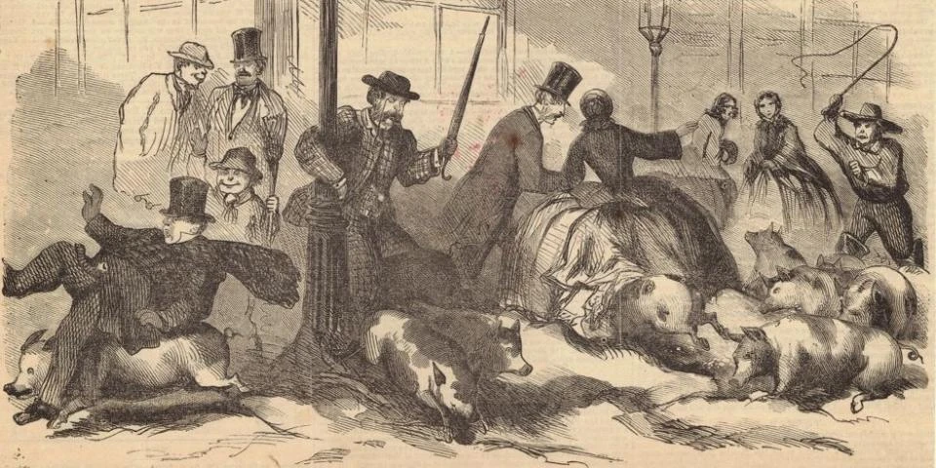
The Miriam and Ira D. Wallach Division of Art, Prints and Photographs: Picture Collection, The New York Public Library. ""Pork lively" — a sketch from nature at the corner of Broadway and Fourth Street" (1859). New York Public Library Digital Collections.
Despite the authorities’ attempts to impose stricter restrictions on the free-roaming pigs, tensions between supporters and opponents of the pigs reached a boiling point in the early 19th century. During targeted crackdowns, these efforts sparked public resistance, leading to mobs fighting authorities to protect their animals and way of life. Alternatively, law was also taken into private hands when mobs tried to enforce pig control, often using violence against hog drivers. [24] The urban working-class, especially immigrant women, became central to the cities’ pig trade. Attempts to restrict the pig trade, and hence the availability of food for these people, led to riots in 1825, 1826, 1830, and 1832. [25] This period of public violence and class rift would set the stage for the politics of pigs that emerged during the Tammany Hall era. A clear divide emerged between working-class New Yorkers, who relied on street pigs to maintain their self-sufficiency, and the wealthy residents, who saw their destruction of property and dirt as both a public health issue and a moral failing.
Ending the Hog Economy (1837-1860)
Debates over pig regulation raged. Some argued for going beyond the 1817 Laws respecting Swine; others, the opposite. One man went before the court to oppose regulations stating that pigs were “our best scavengers, as they instantly devour all fish guts, garbage, and offal of every kind.” [26] However, enforcement remained the primary concern for those seeking to regulate animals they did not rely upon, with little attention paid to devising different approaches to the issue.
Conditions changed in 1845 with the establishment of the Municipal Police Department, followed by the construction of Central Park in 1858. The architect, Fredrick Law Olmsted, a social crusader himself, envisioned parks as a way to counteract the "savage condition” of New Yorkers, who lived among the piggeries. [27] Olmstead would build his park to help purify the air and reduce the moral decay of New York. [28] He would utilize the Parks Commission to relocate residents in the way of his project, including those in “Hogtown.” [29]
Hogtown was a settlement located in the then 22nd Ward, near today’s Carnegie Hall [figure 2]. The New York Times described Hogtown as: “shanties in which the pigs and the Patricks lie down together while little ones of Celtic and swinish origin lie miscellaneously. [30] In 1859, Daniel E. Delavan, a compromise candidate amongst Tammany Hall Democrats, was expected to cause little trouble and was subsequently appointed as the city Inspector. Contrary to expectations, Delavan aggressively targeted piggeries and, in July of 1859, initiated a ban on all piggeries south of 86th Street. [31]
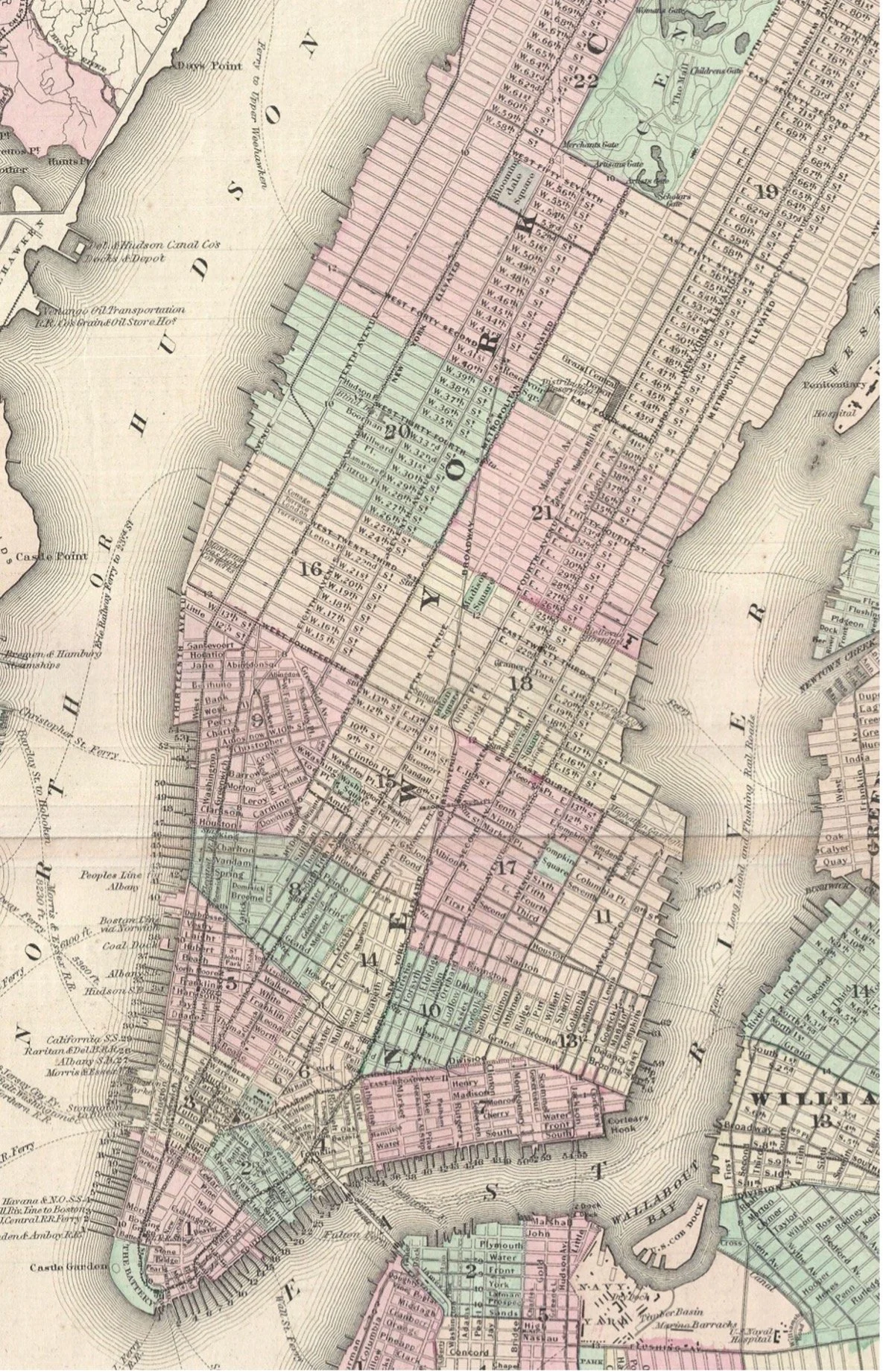
Lionel Pincus and Princess Firyal Map Division, The New York Public Library. "G. Woolworth Colton's new map of New York City, Brooklyn, Jersey City, Hoboken etc. (1866). The New York Public Library Digital Collections.
Delavan gave piggery owners three days’ notice to clear out, move uptown, or shut down. On the third day, he returned with 87 soldiers and the Metropolitan Police officers to forcibly remove them. [32] Delavan’s inspectors seized any pigs or anything they left behind [figure 3]. By September, they removed 9,000 pigs and destroyed 3,000 piggeries. [33]
While Delavan’s campaign succeeded in his war against the pigs of New York below 86th Street, it merely displaced them to the city’s periphery, including “Pig Alley” near 125th Street, from the valuable land for the wealthy around Central Park. [34]
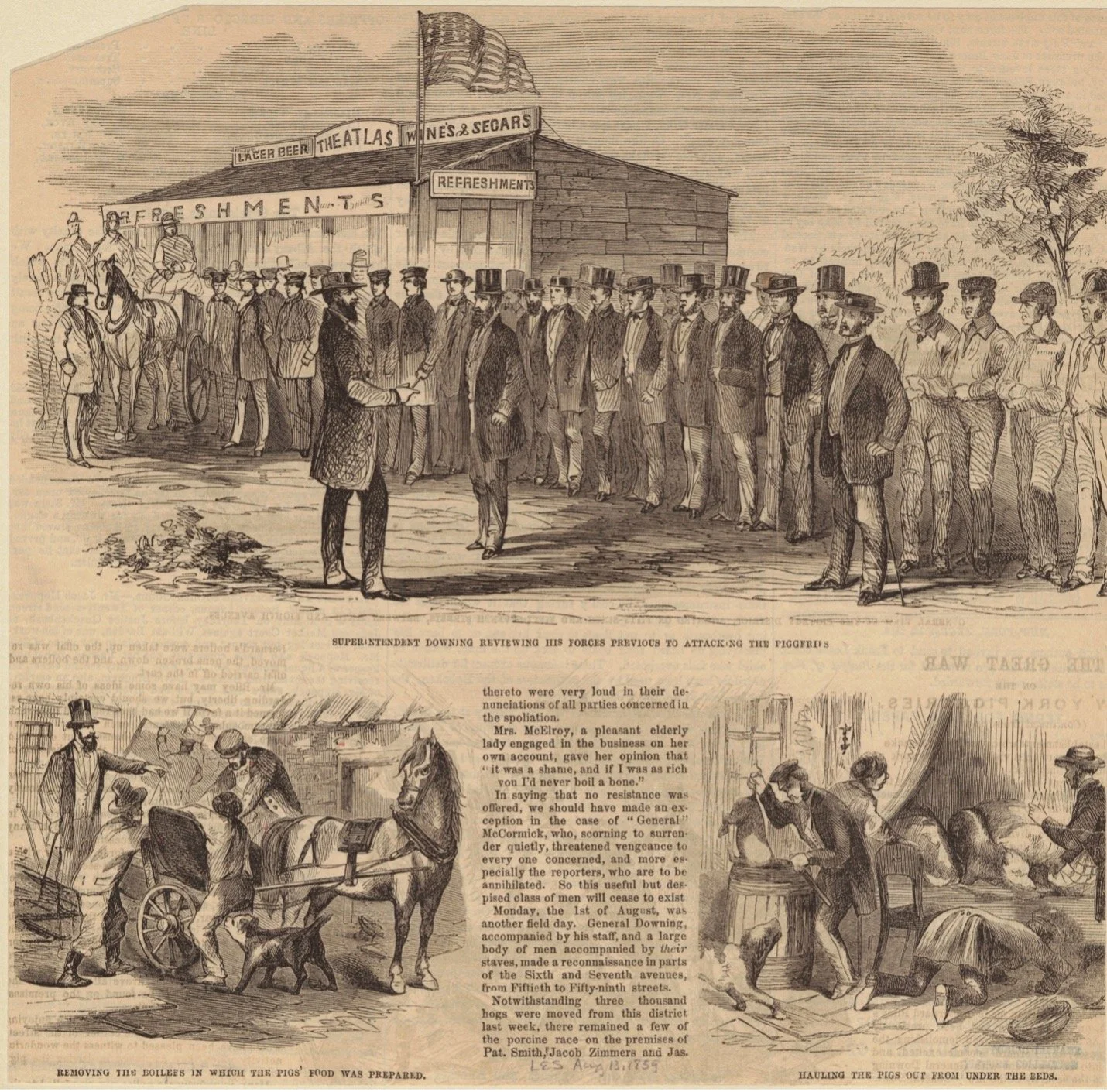
The Miriam and Ira D. Wallach Division of Art, Prints and Photographs: Picture Collection, The New York Public Library. "Superintendent Downing reviewing his forces previous to attacking the piggeries" (1859). New York Public Library Digital Collections.
While Olmstead and Delavan succeeded, for the first time in New York City’s history, in winning their battle with the pigs, this repression of pigs also came to symbolize the broader repression of immigrant communities. Elites increasingly equated the animals with the people who kept them, viewing both as dirty and representing the city’s moral failure. This first success against the piggeries was achieved due to the city's newfound ability to enforce its laws, often through violence and the will to achieve its goals, which had been lacking under British, Dutch, and earlier American rule.
Sweeping the Hogs Aside (1861-1895)
As New York City continued expanding after the Civil War, its public health concerns grew alongside it. In 1867, the First Tenement Act prohibited keeping pigs in homes, though enforcement remained challenging. [35] Later that year, the city banned hog drivers; however, individual roaming pigs in upper Manhattan and other parts of the city were still permitted. [36]
In 1890, Jacob A. Riis wrote and photographed his ground-breaking work How the Other Half Lives. In his first chapter, he documented the living conditions of impoverished New Yorkers. He noted that “swine roamed the streets and gutters as their principal scavengers.” [37] His book played a major role in ending free-roaming pigs by emboldening progressives.
In 1895, William Lafayette Strong, a Progressive reformer, was elected mayor. He appointed Theodore Roosevelt as his Police Commissioner and George Waring as Commissioner of Sanitation. Both men proved instrumental in the final eradication of New York’s pig population. Waring, who had worked on Central Park in 1857, ran the Department of Sanitation like an army and addressed the pig problem not by restricting population and trade, but by removing their food source. His 2,000 “White Wings” army cleaned the streets of the city day and night, leaving very little for the animals to eat.
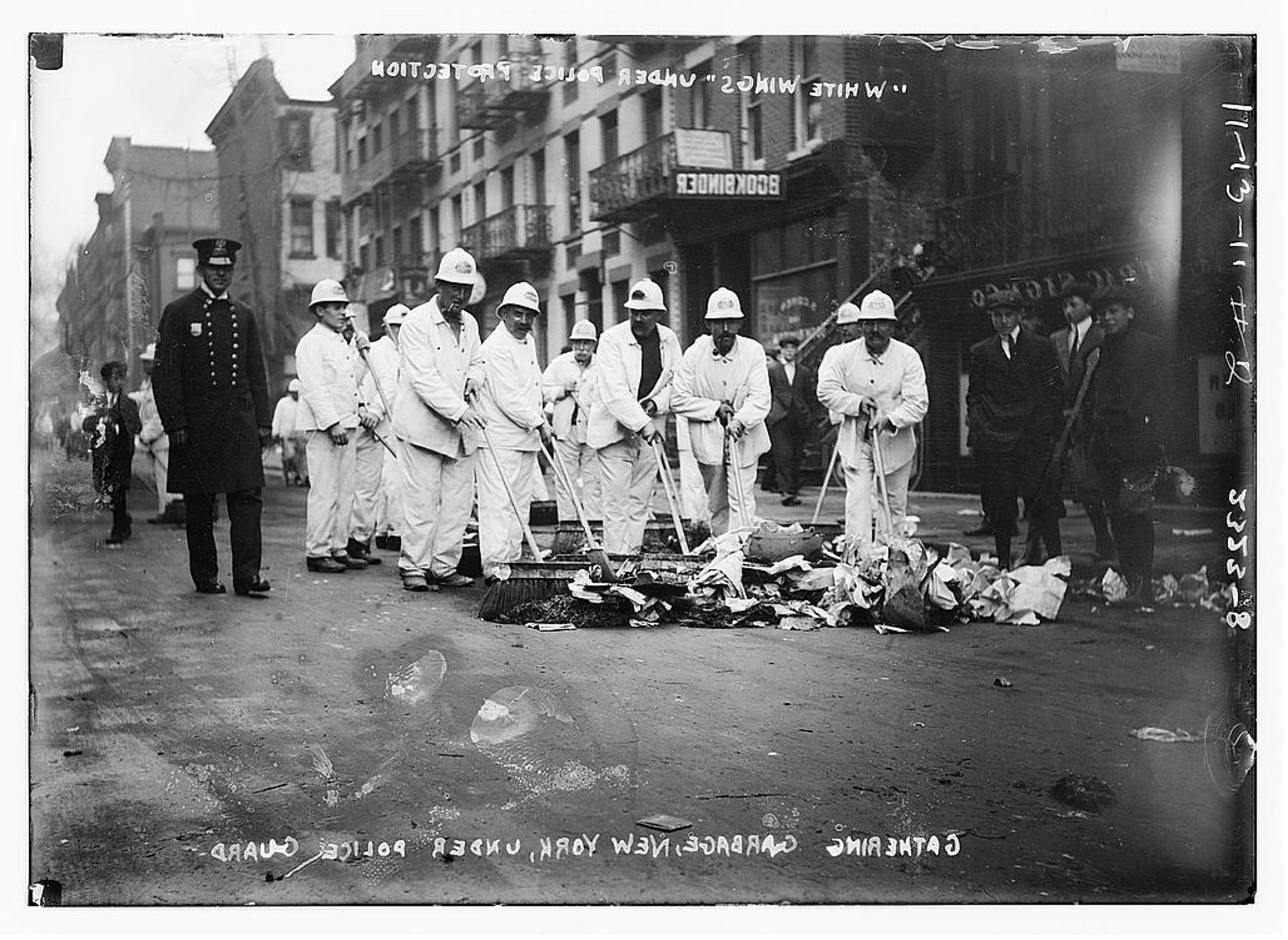
George Grantham Bain Collection “White Wings Under Police Protection” (1911) — Flickr Commons project, 2009, Library of Congress Prints and Photographs Division.
Meanwhile, Roosevelt cracked down on police corruption and, more than ever, improved enforcement of New York City laws. With no more waste to eat and stricter enforcement in place, the pigs of New York ultimately disappeared. [38] New York City's Sanitation Department won its ‘war’ with the pigs by targeting the animals’ means of survival. By eliminating the city's trash and waste, officials removed both the reasons pig defenders offered and the resources that sustained the animals. Their success came only when they shifted their focus from the pigs themselves to the physical and social conditions that enabled them to thrive.
Johann Smoller - Marcotullio recently completed an M.A. in History at University College London (UCL), where his research examined concepts of liberty in the eighteenth-century Parisian landscapes designed by Thomas Blaikie. He is currently pursuing a degree in planning at The Bartlett Faculty of the Built Environment, UCL.
[1] ‘Mayor Adams, Sanitation Commissioner Tisch Announce Next Phase of War on Rats: All Businesses Must Place Trash in Containers’, New York City Mayor's Office, 19 September 2023.
[2] Ed Crews, ‘Ossabaw Island Pigs’, Colonial Williamsburg Foundation, 2009.
[3] Ralph L De Groff, Council Minutes, 1638-1649, trans. Arnold J.F. Van Laer, vol. 4, NEW YORK HISTORICAL MANUSCRIPTS: DUTCH (New York: The Holland Society of New York, n.d.), 30.
[4] De Groff, Council Minutes, 1638-1649, 30.
[5] Ralph L. De Groff, Council Minutes, 1638-1649: 25–32.
[6] E. B. O’Callaghan, Laws and Ordinances of New Netherland: 1638-1674 (Albany: Weed, Parsons and Company, 1868), 22–23.
[7] O’Callaghan, Laws and Ordinances of New Netherland: 1638-1674, 29.
[8] O’Callaghan, Laws and Ordinances of New Netherland: 1638-1674, 85.
[9] O’Callaghan, Laws and Ordinances of New Netherland: 1638-1674, 85.
[10] O’Callaghan, Laws and Ordinances of New Netherland: 1638-1674, 64, 74.
[11] Adriaen van der Donck, Remonstrance of New Netherland, and the Occurrences There. (Weed, Parsons and Co., 1856), 58.
[12] O’Callaghan, Laws and Ordinances of New Netherland: 1638-1674, 118.
[13] O’Callaghan, Laws and Ordinances of New Netherland: 1638-1674, 170.
[14] I. N. Phelps (Isaac Newton Phelps) Stokes, Victor Hugo Paltsits, and F. C. (Frederik Caspar) Wieder, The Iconography of Manhattan Island, 1498-1909 : Compiled from Original Sources and Illustrated by Photo-Intaglio Reproductions of Important Maps, Plans, Views, and Documents in Public and Private Collections (New York : Robert H. Dodd, 1915), 207.
[15] O’Callaghan, Laws and Ordinances of New Netherland: 1638-1674, 394, 416, 420, 453, 511, 523.
[16] Edwin G. Burrows and Mike Wallace, Gotham: A History of New York City to 1898 (Oxford University Press, 2000), 43, 111.
[17] Haskell Greenfield, ‘From Pork to Mutton: A Zooarchaeological Perspective on Colonial New Amsterdam and Early New York City’, Northeast Historical Archaeology 18, no. 1 (23 January 2014): 99.
[18] Richard Nicolls, ‘The Duke of York’s Laws: 1665-75’, New York, 1665, Historical Society of the New York Courts.
[19] Mead Dodd, Minutes of the Common Council of the City of New York, 1675-1776 (New York: The Authority of the City of New York, 1905), 120.
[20] Kenneth T. Jackson, Lisa Keller, and Nancy V. Flood, The Encyclopedia of New York City: Second Edition (Yale University Press, 2010), 1048.
[21] T. Jackson et al., The Encyclopedia of New York City, 1049.
[22] Arthur Everett Peterson, Minutes of the Common Council of the City of New York, 1784-1831 (New York: the city of New York Analytical Index A-K., 1917), 215.
[23] George H. Rappole, ‘The Old Croton Aqueduct’, IA. The Journal of the Society for Industrial Archeology 4, no. 1 (1978): 15–25.
[24] ‘New-York Evening Post 6 September 1826, ‘New-York Evening Post 18 July 1826.
[25] Burrows and Wallace, Gotham, 477.
[26] ‘Minutes of the Common Council of the City of New York, 1784-1831 / Published by the City of New York v. 9 (1817-1818), 462.
[27] Robert Lewis, ‘Frontier and Civilization in the Thought of Frederick Law Olmsted’, American Quarterly 29, no. 4 (1977): 394.
[28] Roy Rosenzweig, The Park and the People: A History of Central Park (Ithaca, N.Y.: Cornell University Press, 1992), 20.
[29] McNeur, Taming Manhattan, 161.
[30] ‘METROPOLITAN NUISANCES’, The New York Times, 5 June 1858.
[31] McNeur, Taming Manhattan, 163–65.
[32] ‘THE OFFAL AND PIGGERY NUISANCES’, New York Times, 27 July 1859.
[33] McNeur, Taming Manhattan, 172–74.
[34] Burrows and Wallace, Gotham, 747.
[35] Tenement House Acts, 908, Health Department City of New York Laws of 1867 (1867).
[36] Enrique Alonso and Ana Recarte, ‘Pigs in New York City; a Study on 19th Century Urban “Sanitation”’, University of Alcalá, 2001, 42.
[37] Jacob A. Riis, How the Other Half Lives, Gutenberg EBook (New York: Charles Scribner’s Sons, 1890).
[38] Steven Mintz, ‘“Taking Stock of Our Resources”: A Request from Theodore Roosevelt, 1908’, OAH Magazine of History 21, no. 2 (2007): 45–48.