
Kelley Kreitz, Printing Nueva York: Spanish-Language Print Culture, Media Change, and Democracy in the Late Nineteenth Century
Reviewed By Cathy Cabrera-Figueroa
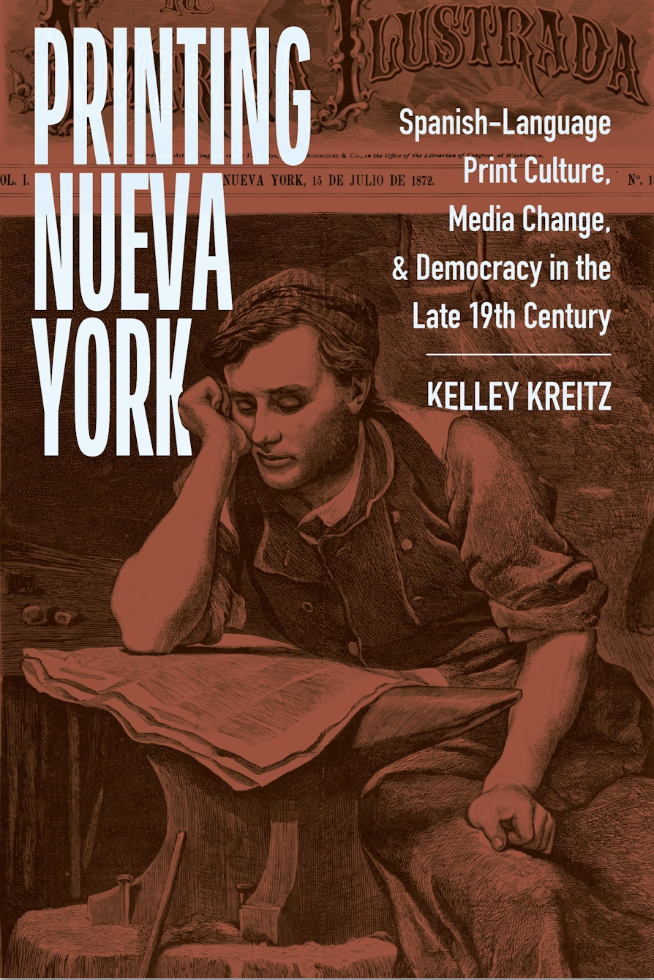
Printing Nueva York: Spanish-Language Print Culture, Media Change, and Democracy in the Late Nineteenth Century
by Kelley Kreitz
NYU Press
January 2026, 283 pp.
Kelley Kreitz's Printing Nueva York is a compelling yet nuanced contribution to the historiography of New York. By highlighting the cultural and material significance of print within New York City's Spanish-speaking communities, Kreitz explores the city as a center for transnational exchange. The book demonstrates that New York was not only a local urban center but also an important hub for the broader hemisphere, linking Latin America, the Caribbean, and the United States.
The late nineteenth-century Anglophone-centric historical narrative centers on Gilded Age industrialism, the rise of the English-language mass press, and the Great Men of American capital, an age of modernism often associated with the solitary, alienated artist. Kreitz counters this narrative by illuminating the poets and writers of the Hispanic Atlantic who found their artistic keys to modernity through the development of the mass press. The introduction of undersea telegraph cables enabled a “simultaneous experience” amongst the reading public that connected Manhattan to Havana, Mexico City, and Caracas in seconds. [1] As Venezuelan editor Nicanor Bolet Peraza ecstatically observed in 1887, the new media allowed news to "fly from one hemisphere to another... and join two worlds in thought." [2] For Spanish-speaking exiles, this New York City became a refuge and also a hotbed of media innovation, where editors and revolutionaries could experiment with participatory models of democracy that challenged U.S. capitalist structures.
Place is critical to Kreitz’s argument. Rather than keeping things abstract, she shows exactly where the Spanish-language press operated, highlighting how concentrated Hispanic print culture was in the center of the city’s business district. In the 1870s and 1880s, Spanish-language newspapers were not on the fringes but instead were deeply embedded in Lower Manhattan, often located right alongside major U.S. newspapers. The editors of La América Ilustrada could see the statue of Benjamin Franklin, considered the father of American printing, from their windows in Printing House Square. [3] It was a daily reminder of how dominant the English-language press was, but it also showed that Hispanic editors were part of the same fast-growing media world. They were not cut off from new technology; they were using the same advanced printing presses and telegraph systems to reach readers across the Americas. Being in such proximity encouraged the exchange of ideas, but it also made clear that they were developing a different way of organizing their work, known as the taller.
Kreitz describes the taller as a kind of collaborative workspace that supported what she calls “collective mobilization.” [4] Unlike the increasingly profit-driven and individual-focused U.S. press, the taller emphasized cooperation. At a time when figures like Joseph Pulitzer and William Randolph Hearst were helping to shape “New Journalism,” which often treated readers as consumers of sensational stories, the taller saw journalism as a tool for building community and encouraging political engagement. [5] Instead of focusing on circulation numbers or promoting star reporters, Hispanic editors in Nueva York valued the craft of writing and the intellectual side of publishing. For writers connected to Latin American modernismo, magazines became spaces to experiment, think deeply, and develop ideas, rather than just products to sell as widely as possible. [6] While the U.S model leaned toward individual fame and exclusive reporting, the taller model acted more like a network, promoting collaboration between writers, editors, and printers to produce ideas collectively.
Kreitz also emphasizes New York as a place of exile, migration, and political activism. In this context, newspapers and pamphlets were tools for political mobilization, identity formation, and forging community. This perspective demonstrates how local developments in New York were shaped by, and in turn shaped, political movements across the Americas. The city serves as a backdrop to immigrant life and is an active participant in transnational struggles, including independence movements and reform campaigns. Highlighting New York's role as a publishing center by tracing the circulation of printed materials demonstrates how ideas moved across borders and how New York City became a cradle of intellectual exchange. Thus, Kreitz reinforces the importance of considering New York within a transnational framework rather than as an isolated local or purely national space.
Printing Nueva York, therefore, shifts the boundaries of what constitutes New York history. Traditional narratives often focus on English-language sources and Anglo-American players, which marginalizes the multicultural and multilingual dimensions of New York. By centering Spanish-language print culture and the communities that produced it, Kreitz challenges this narrative. The book recasts New York as an interconnected, multilingual metropolis whose development we cannot fully understand without considering its ties to Latin America and the Caribbean. Kreitz's use of Spanish-language sources provides evidence and challenges the idea that history should rely mostly on English sources. By highlighting these sources, Kreitz underscores the diversity of voices that have shaped New York's past. Highlighting these sources is significant because it recovers marginalized perspectives and reframes established narratives.
The book's emphasis on print culture can present some limitations. While highlighting the intellectual and political life of Spanish-speaking communities, it offers less insight into other dimensions of New York's history, such as economic structures, urban development, or everyday social life outside of print networks. As a specialized study, it provides depth rather than a broad overview, and the book's findings can be usefully added to broader narratives of New York City's history. However, the book may also be challenging for readers unfamiliar with Latin American and Caribbean history. While the book's transnational scope is one of its greatest strengths, it does require some background knowledge to understand and appreciate fully.
Printing Nueva York demonstrates that the history of New York City is comprehensive, with strong connections to the Spanish-speaking Americas. Kreitz's focus on print culture reveals the city's place for intellectual production and exchange, where ideas circulated across linguistic and national boundaries. This perspective not only enriches our understanding of the past but also shapes how we think about New York in the present, as a global city shaped by diverse communities and transnational networks.
Cathy Cabrera-Figueroa is a PhD candidate in Latin American History at the Graduate Center, City University of New York. She holds a Master’s Degree in History from the Graduate Center, CUNY, and a Master’s Degree in Liberal Studies from Lehman College. Her research focuses on nurses in Puerto Rico in the early twentieth century.
[1] Kelley Kreitz, Printing Nueva York: Spanish-Language Print Culture, Media Change, and Democracy in the Late Nineteenth Century (New York: NYU Press, 2026), 34.
[2] Kreitz, 1.
[3] Kreitz, 31.
[4] Kreitz, 142.
[5] Kreitz, 66.
[6] Kreitz, 34, 53.