
“Permit” for Men’s Clothes: Crossdressing, Disguise, and Law in Turn-of-the-Century New York
By Margot Lipin
Anti-crossdressing laws were almost universally adopted across America between the late nineteenth and mid-twentieth centuries. New York’s was somewhat unusual. While most were a part of municipal public indecency laws that specifically prohibited dressing as the opposite sex, New York’s was a state law that addressed a ban on disguise more generally. [1] Under the 1845 law, “every person” who appeared in public, in a “manner calculated to prevent him from being identified,” was to be “deemed a vagrant.” [2] Upon conviction, disguised persons could be sentenced for up to six months in jail; fines were also common. [3] The law was originally meant to target anti-rent protesters outside of the city who dressed in calico dresses and masks as they resisted rent collectors and burned eviction notices. Eventually it was used to target crossdressers. People who dressed contrary to the sex they were assigned at birth increasingly found themselves in court after 1865, in New York and elsewhere, as morality campaigns reignited in cities throughout the nation. [4]
Anyone who dressed outside of gendered sartorial norms, who looked deviant, faced risk of arrest. [5] The legal basis of New York’s anti-disguise law was state police power. Nineteenth-century courts defined a state’s police powers in relation to the Tenth Amendment as regulating citizens’ health, safety, and morals — in practice, this meant expansive power over people’s everyday lives. [6] Through police power, states used law to not only regulate daily life, but also to relegate people into categories of identity, such as race, class, and sex. [7] This was the legal basis of New York’s anti-disguise law. How did police determine who was ‘disguised?’ By looking at their dress and appearance. Because crossdressers fashioned themselves in ways that defied neat categorization, they challenged the key ways in which law “names, blames, and claims.” [8] Examining crossdressing through the lens of fashion and law thus illuminates the contested process through which people were constructed as criminal subjects through their self-presentation.
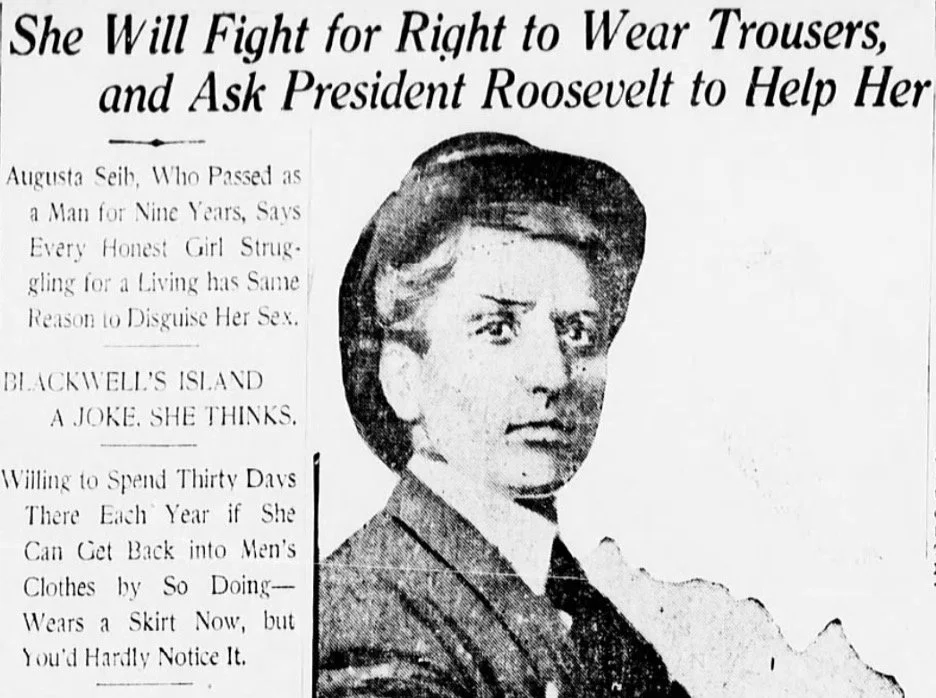
“She Will Fight For Right To Wear Trousers, and Ask President Roosevelt to Help Her,” Evening World, July 11, 1908.
Gus Seib, whose birth name was Augusta, was just one New Yorker whose sartorial choices collided with the law. When Seib was arrested in the summer of 1908, they had been presenting as a man for nine years in the city while working in hospitality and nightlife. On July 4th, police found Seib passed out on the street from heat exhaustion. Seib’s biological “identity was only revealed” after police took them to a hospital to be treated. [9] They then brought Seib to Night Court for their “masquerade.” In the Jefferson Market courtroom, Seib wore the men’s clothes they were found in: a grey men’s suit, a striped shirt, and a necktie. “In her hands,” the Oakland Tribune wrote, Seib “fumbled a low-crowned derby hat, in exactly the same way that a thoroughly embarrassed man might.” [10] Seib’s olive-skinned face “was as utterly mannish as her costume. [11] In other words, Seib appeared in court as a man. The judge quickly sentenced Seib to five days in the Workhouse on Blackwell’s Island. Overnight, Seib became something of a sensation. Their case gained national attention, prompting a plethora of news coverage across the country, which often conveyed a degree of sympathy for Seib’s plight.
Through popular media reproductions of Seib’s appearance and encounter with the criminal justice system, they became visually stamped with illegality. After their first arrest, police continued to arrest them, up to several times a day, for wearing men’s and women’s clothes. “Her identity being known, she can no longer wear a man’s suit without being arrested,” wrote the Brooklyn Daily Eagle. [12] When Seib went out in women’s clothes to avoid being arrested, police detained them for masquerading in women’s clothes. They could not win. In August, Seib hired a lawyer to seek a restraining order against the city police, because they were arrested no matter what they wore. Seib claimed that they:
“wore men’s clothing to find my husband and to get employment in a man’s capacity and now that I wear clothes like any other woman I can’t walk along the street without being molested. Because my face looks more like a man than a woman. I am grabbed and held until I prove my story. I can’t wear men’s clothing, without arrest, until I get proper permission, nor can I wear women’s clothing without being taken for a man. What am I going to do? I want to live as a man the rest of my life and I hope that the necessary proceedings to permit me to do so will soon be completed.” [13]
Seib dressed in a way that felt most suitable for them. They worked and were accepted in their community as they dressed and lived as a man. [14] When they wore the clothing of their sex at birth, they were still met with police harassment and arrest. Seib even added that they were trying to find their husband who had deserted them, in effect arguing that their desired gender fashion was separate from their sexuality. [15]
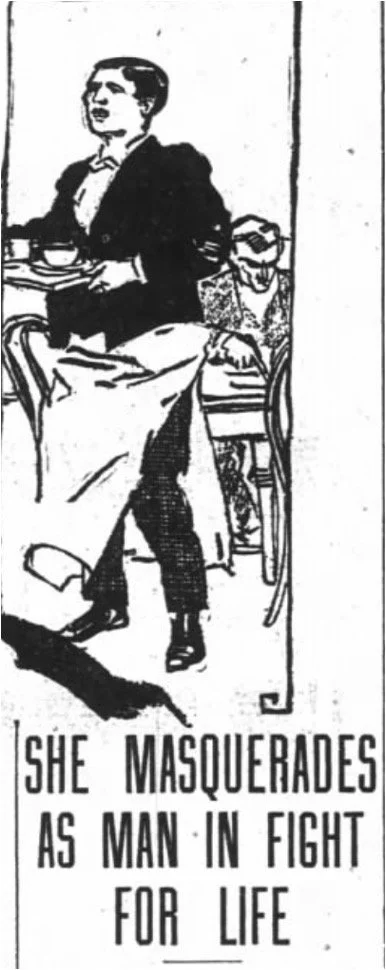
“She Masquerades As Man In Fight For Life,” Oakland Tribune, July 12. 1908.
The vagueness of the anti-disguise law licensed police to arrest anyone whose dress and appearance they perceived as other. The zeal and frequency with which police arrested people like Gus Seib suggests they paid particular attention to people like them, and made a sport out of harassing them. It did not appear that Seib’s case against the New York Police Department was successful. Neither was their media appeal to the President. News reports of Seib facing the same legal problems with their dress appeared in Philadelphia and St. Louis over the next few years. Although ordered by judges to do so across several states, Seib refused to change how they dressed. Seib’s insistence on dressing as they pleased despite legal prohibition of crossdressing indicated some of the challenges inherent to mandating people’s dress. It was easier said than done. [16]
Through its anti-disguise law, the state of New York claimed the power to determine its citizens’ “true” identities, in order to decide if and when they were disguised. “However much you may look like what you are not,” a San Francisco newspaper wrote addressing crossdressers, “you will very feel very much like a curtailment of your real self as you proceed…to the nearest police station. [17] Here and elsewhere, the process of being apprehended and arrested for crossdressing was framed as a process of exposure. Police were tasked with unmasking, or rather, undressing, people’s true selves. Crossdressing was not only offensive to Anglo-Christian moral sensibilities, it was often portrayed as a form of deceit — and in New York, it was legally constructed as such.
It was clear, then, that crossdressing raised not only social, cultural, and moral questions about sartorial regulation, but also legal ones. Complaints of police arrests violating crossdressers’ liberties often conveyed a belief that dressing was an intimate part of bodily autonomy, outside of the sphere of government regulation. These complaints also often questioned the link between dress and identity, which served as the legal basis for policing crossdressing in New York. For example, when a “Miss Denyse” was arrested in January 1884 “because she chose to dress in what is called male attire” in Brooklyn, their friend wrote to Phoenix, a small Brooklyn newspaper, that “Through the act of this ignoramus Miss Denyse was deprived of her liberty for several days, only to be discharged by the judge at last because she had committed no crime in thus dressing.” [18] The writer emphatically denied that Miss Denyse had done anything criminal, asserting that they had liberty to dress in men’s clothes. It was “no excuse for either society or the officer to say” that Miss Denyse had “unsexed herself.” [19] Miss Denyse was simply exercising their liberty to dress as they pleased. In arresting and convicting crossdressers under New York law, police and judges had to (at least in theory) establish that dressing in clothing of the opposite sex was a statement of identity — flattening a diverse range of sartorial presentations and practices into a singular prohibited self-fashioning: disguise. [20]
As crossdressers were brought to New York courts for violating the state’s anti-disguise law, they challenged state authority to know and sort its citizens. New Yorkers insisted that they possessed the freedom to dress up as anyone or anything. They could cavort and express themselves in any number of leisure establishments. Such freedom blurred traditional hierarchies, provoking elite anxieties. The development of the city’s trademark anonymity led reformers, lawyers, and elites to call on police to know, sort, and discipline an increasingly unruly urban population. [21]
Vagrancy laws were one way in which states used their police powers to assign a deviant status to particular kinds of people — beggars, prostitutes, and “disguised persons,” to name a few. [22] Vagrancy laws attached public dress to identity, including New York’s, and were thus useful catch-all tools for “keeping people in place.” [23] Although the law itself was ambiguous, banning disguise and concealment, not dressing contrary to one’s biological sex, police and most judges treated crossdressing as definitively criminal. Police filled in the blanks left by the vagueness of the law by enforcing it as they saw fit. Crossdressers were easy targets.
Black crossdressers were doubly deviant under the law. While white crossdressers were sometimes treated with some sympathy, Black crossdressing, when it was reported, was often linked with other kinds of crime. John Moore was arrested for vagrancy in Brooklyn when a detective heard “there was a man masquerading in women’s clothes on the corner” who had been robbing white men with “extraordinary muscular power.” [24] White Americans had long pointed to Black style—flamboyant or flashy dress in particular — as evidence of racial otherness and criminality. Black crossdressing was thus perceived as more dangerous to the social and legal order than white crossdressing. Yet it was often white responses to Black self-fashioning that veered into violence. [25]
In the Magistrate’s Court records at the New York Municipal Archives, Moore’s crime was listed as “Vagrancy (Going about in Disguise). [26] Usually the charge written for people arrested for crossdressing was simply “vagrancy,” which makes it difficult to identify crossdressers using lower court records alone. Many different types of people were brought to court for vagrancy between the end of slavery and the Great Depression. Without further context, there is usually no way to distinguish between a beggar or a crossdresser, both of whom were types of vagrants under New York law. It is interesting that the clerk added the disguise specification to Moore’s vagrancy charge. This may have been because Black people were regularly arrested for vagrancy for little more than looking “raggedy.” [27] Perhaps the clerk wanted to specify that Moore was not in court because they dressed shabbily, but because they dressed contrary to the identity they were supposed to.
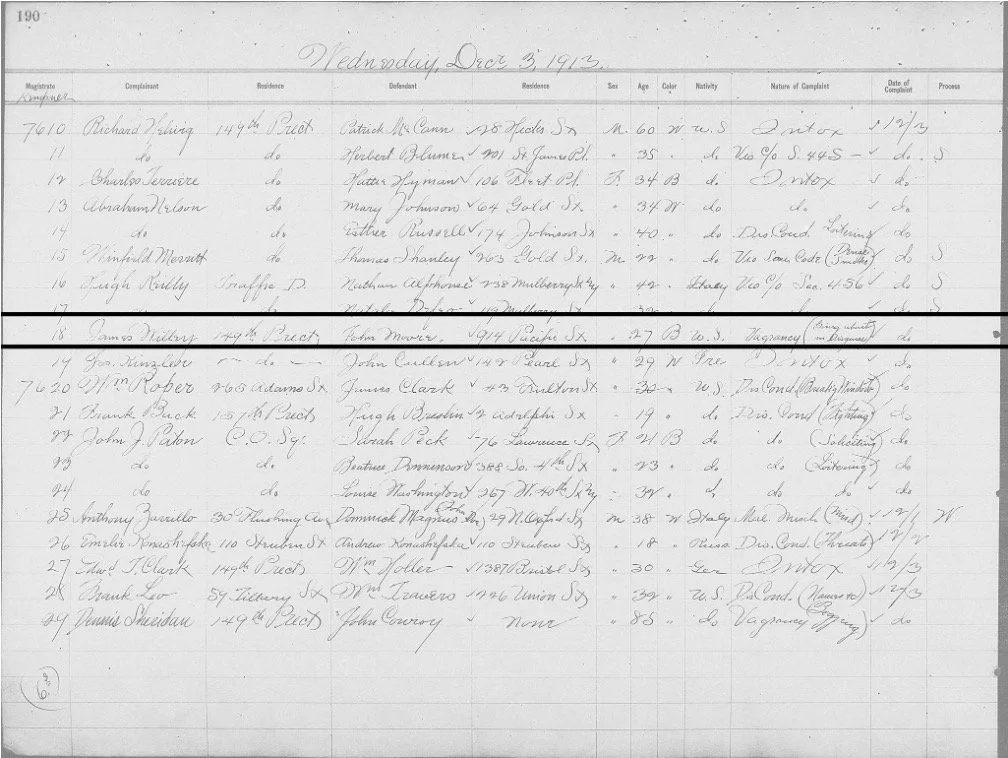
Page from Magistrates’ Court Docket Book, with highlighted portion showing John Moore charged with vagrancy (going about in disguise). At the bottom, there was another person who was charged with vagrancy (begging), showing the different types of vagrancy cases seen in New York City courts. People v. John Moore (December 3, 1913), Magistrates Court Docket Books, First District, Brooklyn, New York Municipal Archives.
In the press, Moore’s “masquerade” was depicted as a simple means to a criminal end. We do not know if they always preferred to wear women’s clothes, or sometimes wore them for fun, or to scratch out a living. In a crucial period where knowledge of race, gender, and sexuality was produced and remade, newspaper accounts of white and Black crossdressing tended to reinforce racialized gender: white crossdressers, especially those assigned female at birth, wore men’s clothes to claim autonomy, wages, and citizenship reserved for white men. It was unbecoming, but understandable. Black crossdressers, on the other hand, reflected the idea that Black men were “true” men, and Black women were not “true” women. Deviant gender presentation was seen as just another part of Black criminality. [28]
Sometimes crossdressers explicitly declared that no police officer or judge had any business telling them how they should dress, and that their choice of clothes was not illegal. Others acted as if they had a right to choose their self-fashioning by ignoring judicial mandates that they change their clothes, sometimes preferring to go to jail (multiple times) rather than agree to dress as they were ordered. Some New Yorkers possessed physical characteristics that did not allow them to neatly fit into legal categories of man or woman, causing them to be arrested by police no matter how they dressed.
These fashion-forward, gender-crossing New Yorkers refused to stay put. Their stories reveal how people have long dressed contrary to their assigned sex at birth, and asserted that they had every right to do so. They experimented and innovated in fashion and scorned intervention by the state. We tend to take for granted the process by which we assign meaning to fashion, especially gender. When we undress this process, we see how people have always pushed boundaries through dress, despite legal repression. Without them, this city would not be the fashion capital that it is today.
Margot Lipin (she/hers) is a Ph.D. candidate in Jurisprudence and Social Policy at UC Berkeley. Margot’s research lies at the intersection of American legal and cultural history. Her dissertation examines the role of fashion in the legal process of constructing individuals as deviant and criminal subjects according to their dress and appearance between the end of slavery and the Great Depression. Margot’s work has been supported by the Center for the Study of Law and Society at UC Berkeley and the Organization of American Historians.
[1] Over forty American cities passed anti-crossdressing laws between the Civil War and the First World War. Only California also had a statewide anti-disguise law; Kate Redburn, “Before Equal Protection: The Fall of Cross-Dressing Bans and the Transgender Legal Movement, 1963–86” Law and History Review 40, no. 4 (2022), 680-681; Clare Sears, Arresting Dress: Cross-Dressing, Law, and Fascination in Nineteenth-Century San Francisco (Durham, NC, 2015), 3.
[2] “An act to prevent persons appearing disguised and armed,” New York Legislature, 68th Session, Chap. 3, § 1.
[3] Ibid; A “pretty girl” was fined ten dollars and released after being caught dressed in men’s clothes in Harlem in 1887. “Dressed in Male Attire,” New York Times, June 6, 1887.
[4] Redburn, “Before Equal Protection,” 689; See generally Risa Goluboff, Vagrant Nation: Police Power, Constitutional Change, and the Making of the 1960s (Oxford, 2016).
[5] See generally William N. Eskridge Jr., Gaylaw: Challenging the Apartheid of the Closet (Cambridge, MA, 2002) and Sears, Arresting Dress.
[6] Legal scholars have examined how states used police power as a basis for broad social control, epitomized by vagrancy laws, Jim Crow laws, and eugenic sterilization laws. The Supreme Court famously defined police powers in this way in The Slaughter-House Cases, 83 U.S. 36 (1873) and Lochner v. New York, 198 U.S. 45 (1905); on the expansive use of police power for social control see Markus Dirk Dubber, The Police Power: Patriarchy and the Foundations of American Government (New York, 2005).
[7] Mark Neocleous, “Theoretical Foundations of the ‘New Police Science,’” Markus Dirk Dubber, and Mariana Valverde, eds., The New Police Science (Stanford, CA, 2008), 27; Ariela Gross, “Beyond Black and White: Cultural Approaches to Race and Slavery” (Columbia Law Review 101, April 2001), 651-656; see Kimberlé Crenshaw, Neil Gotanda, Gary Peller, and Kendall Thomas, eds. Critical Race Theory : The Key Writings That Formed the Movement (New York, 1995).
[8] Christopher L. Tomlins, “Introduction: the Many Legalities of Colonization,” in Bruce Mann and
Tomlins, eds, The Many Legalities of Early America, The University of North Carolina Press, 2012, 2.
[9] Different news articles reported that Seib was taken to different hospitals, so it is unclear which one exactly. “Trousers Not Allowed; Skirts Mean Arrests,” Brooklyn Daily Eagle, August 5, 1908, Digital Transgender Archive;“Woman Lives as Man for Nine Years,” Unknown newspaper clipping, Digital Transgender Archive.
[10] She Masquerades as Man in Fight for Life," Oakland Tribune, July 12, 1908, Digital Transgender Archive.
[11] Ibid.
[12] Trousers Not Allowed; Skirts Mean Arrests,” Brooklyn Daily Eagle, August 5, 1908, Digital Transgender Archive.
[13] Ibid.
[14] After Seib’s (very public) arrest, patrons continued to come to their restaurant greeting them with “Hello Gus!” “She Will Fight for Right to Wear Trousers, and Ask President Roosevelt to Help Her,” Evening World, July 11, 1908.
[15] Turning to male appearance after being deserted or jilted by a man was a common story among coverage of female husbands and people assigned female at birth who were caught wearing men’s clothes. See Jen Manion, Female Husbands: A Trans History (Cambridge, 2020).
[16] “Augusta Seib in Male Attire in Philadelphia,” Evening World, September 24, 1908; “Prefers Jail to Skirts,” Evening Times-Republican, May 31, 1911.
[17] “Changing Clothes to Make Men Women and Women Men,” San Francisco Call, May 21, 1911, Digital Transgender Archive.
[18] “Arrest of Miss Denyse,” Phoenix, January 1884, Digital Transgender Archive.
[19] Ibid.
[20] As Clare Sears shows, crossdressers could include “fast women” who dressed as men to go out, feminist dress reformers, female impersonator entertainers–or people dressing up for fun; Sears, Arresting Dress, 18, 7.
[21] On the opening of the “bonds of urban anonymity,” see Nan Goodman, “Law In Popular Culture, 1790-1920: The People and the Law,” in The Cambridge History of Law in America (Cambridge University Press, 2008), 415-416; On the anonymity of fashion in city life, see Elizabeth Wilson, Adorned in Dreams: Fashion and Modernity (New Brunswick, 2003), 137; On New York police professionalization and knowability, see Matthew Guariglia, Police and the Empire City: Race and the Origins of Modern Policing in New York (Durham, 2023), 4.
[22] “An act to prevent persons appearing disguised and armed,” New York Legislature, 68th Session, Chap. 3, § 1; on vagrancy laws as status crimes, see Goluboff, Vagrant Nation, and Bryan Wagner, Disturbing the Peace: Black Culture and the Police Power After Slavery (Cambridge, MA, 2009).
[23] Goluboff, Vagrant Nation, 5.
[24] “Negro Had Criminal Record,” Brooklyn Daily Eagle, December 3, 1913.
[25] Shane and Graham White, “Stylin:” African American Expressive Culture from Its Beginnings to the Zoot Suit (Ithaca, NY, 2018) 5, 91-93, 124, 221
[26] People v. John Moore (December 3, 1913), Magistrates Court Docket Books, First District, Brooklyn, MN #11116, Roll #1, June 17, 1913-April 14 1914, Vol #1, New York Municipal Archives.
[27] Wagner, Disturbing the Peace, 40.
[28] See Manion, Female Husbands; Sarah Haley, No Mercy Here: Gender, Punishment, and the Making of Jim Crow Modernity (Chapel Hill, 2016), 11; Eskridge, Gaylaw, 3, 22; See generally Khalil Gibran Muhammad, The Condemnation of Blackness Race, Crime, and the Making of Modern Urban America (Cambridge, MA, 2011).