
Reputation and Ruin in Young Dr. Tyng's New York, Part II: A Human Engine
By Helen Lane
Newspaper editors loved Tyng Jr.’s fracas with church authorities, and their coverage of the trial made him a martyr, bringing more members to his flock. [1] Some journalists hoped he would join the newly founded Reformed Episcopal Church, which he very nearly did. The Brooklyn Eagle skewered the press's sudden "enthusiasm for religious truth" and wrote off Tyng's decision to stay as calculated to keep his name in the papers and Episcopalian money in his pocket, while the New York Herald speculated that he was simply too busy to consider leaving. [2] Tyng Jr. was in fact a man of action, involved in all aspects of the institutions he ran. Nearly every description notes his workaholic tendencies and his ability to organize others, though one writer remarked that "like so many such human engines he was a great smoker to the detriment of body if not of mind." [3]
Whatever the truth of his tobacco habit, Tyng Jr. was growing his operations at a rapid pace. By 1873, the original, fanciful, cottage ornée building by Mould had grown too small for the crowds he attracted. It was torn down, and the monumental replacement designed by Eidlitz, which opened in 1874, held an auditorium-style sanctuary, an onsite staffed dispensary and infirmary, a large kitchen and eating hall, and several Sunday school classrooms. It came to be known as the Church of the Holy Oilcloth for its brilliantly colored brickwork patterns. [4]
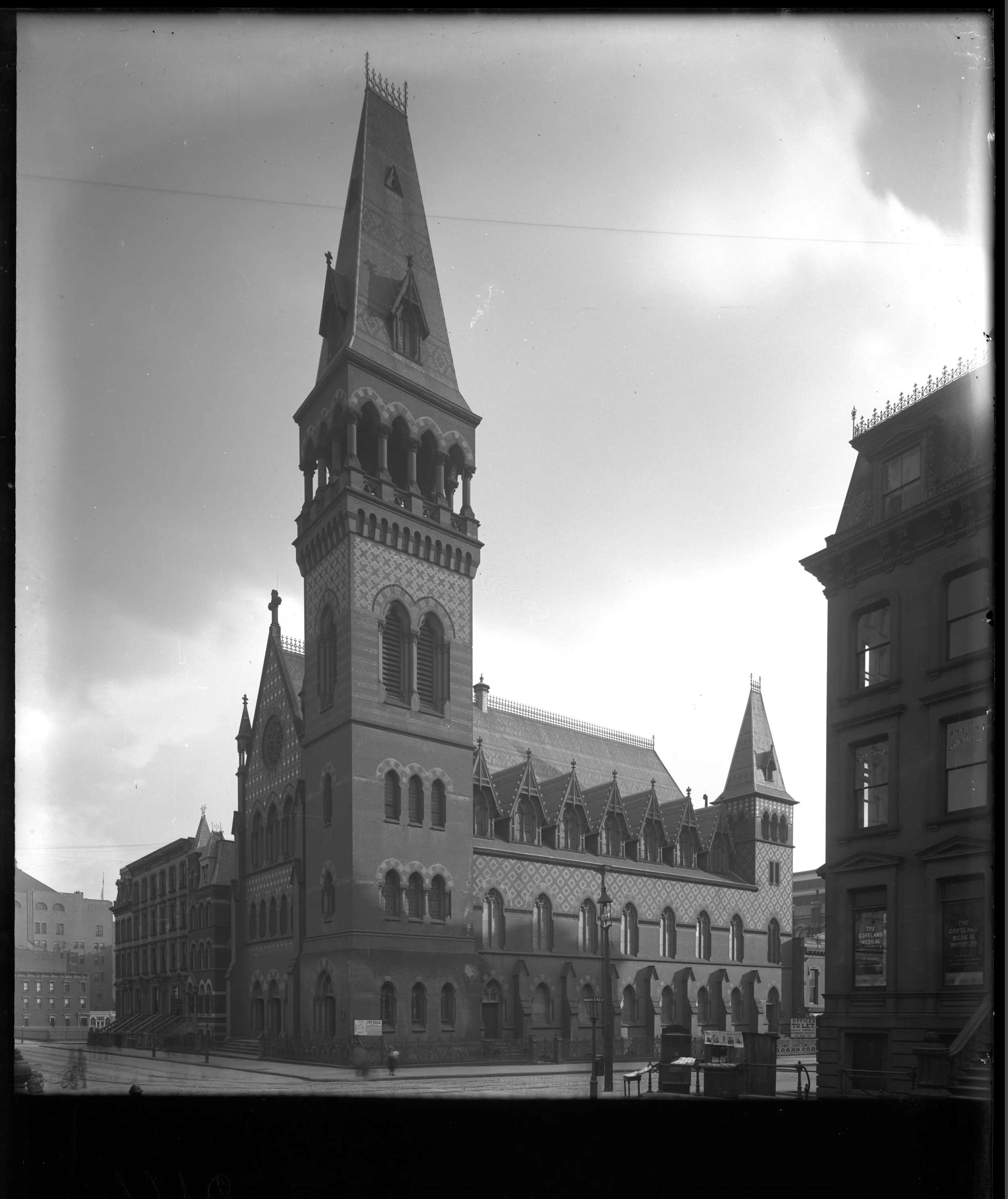
Fig. 1: The second Church of the Holy Trinity circa 1895. Note“For Sale” sign in front. Bracklow, Robert L. Holy Trinity Church (Dr. Tyng’s Church), E. 42nd Street and Madison Avenue, New York City. 1895. Photography. NYHS Digital Collections. https://digitalcollections.nyhistory.org/items/150631-holy-trinity-church-dr-tyngs-church-e-42nd-street-and-madison-avenue-new-york-city#block-views-block-rights-and-reproductions-rights-block.
Tyng modeled himself after several influential preachers, being compared to Gough and Spurgeon. A major influence was Henry Ward Beecher, in whose presence Stephen Tyng, Jr. would have grown up. The Congregationalist minister had frequently shared the platform with Stephen Tyng Sr. in their joint work for organizations such as the National Freedman’s Relief Association. [5]
As Tyng Sr. entered retirement, Beecher began to appear with his son, frequently sharing pulpit and stage with Tyng Jr. between 1866 and 1874. [6] The association gained Stephen Tyng Jr. audiences drawn by Beecher’s dazzling performances, while Beecher could ride the wave generated by Tyng’s sensationalized trial and youth. Physical proof of Beecher’s desire to link himself with Tyng survives in the form of the Plymouth Church pulpit, an olive wood desk that was made into “an exact counterpart of the one used by that eminently and deservedly successful Christian minister, Stephen Tyng, Jr.” [7]
In direct imitation of Beecher, Tyng Jr. also published sermons in a weekly publication called The People’s Pulpit, with a cover design and title enough like Beecher’s The Plymouth Pulpit that it might have been mistaken for the same at a newsstand. It, too, sold advertising space, including for Quigg’s undertaking business upon his supposedly forced resignation.
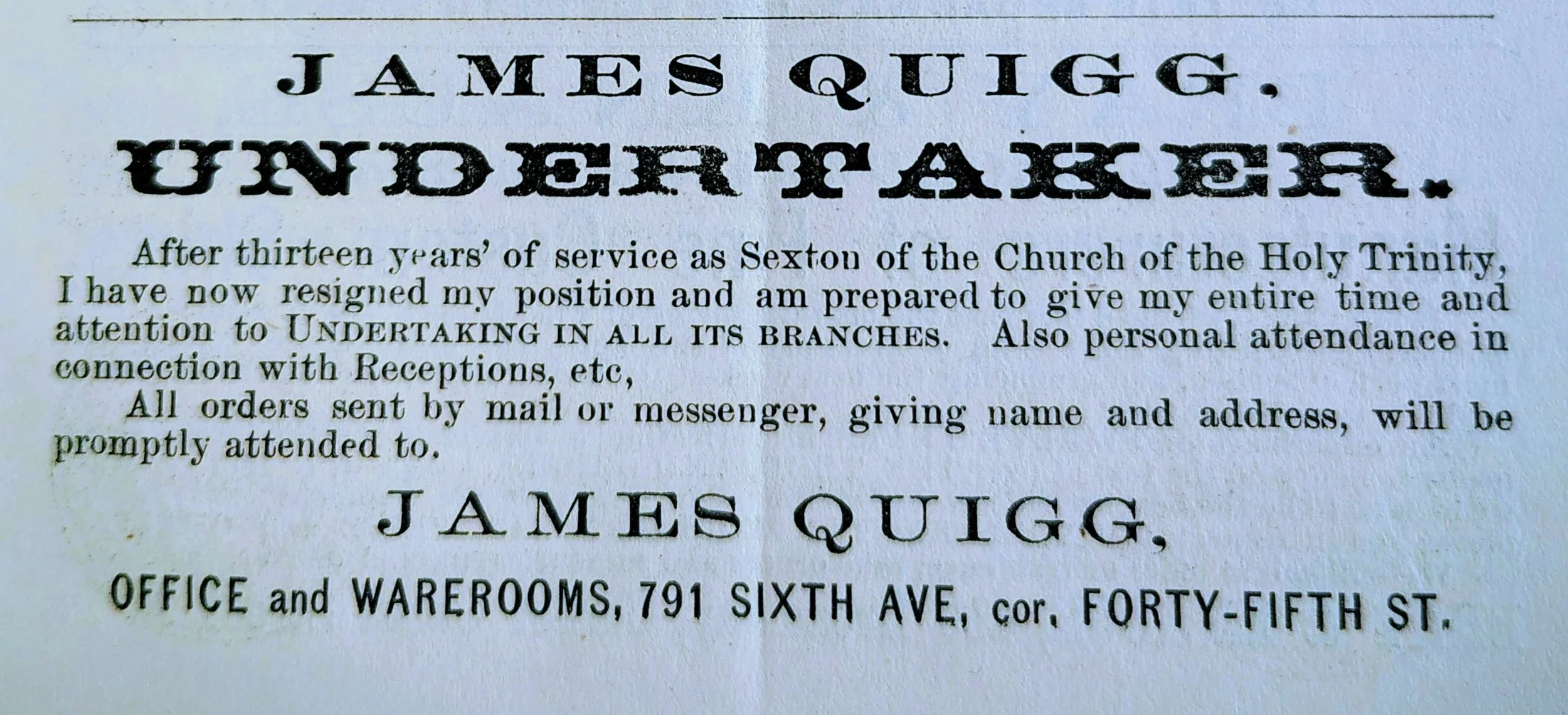
Fig 2: “Undertaking in all its branches” Quigg’s resignation advertisement in the People’s Pulpit. Helen Lane, Photograph, of Quigg, James. “Advertisement.” The People’s Pulpit: A Weekly Publication Containing Sermons by Stephen H. Tyng, Jr (New York), April 4, 1879.
By 1875, however, he had set his sights on another star, the revivalist powerhouse Dwight L. Moody. That November, Tyng pinched Moody and his musical partner, Sankey, from their popular Brooklyn engagement and brought them to Manhattan for an all-day revival at his church, advertising it on a large billboard at Grand Central Station. Thousands came, and when Moody launched his three-month 1876 Hippodrome run, Tyng had played such a role in planning it that he led nearly all the overflow services. [8]
That summer Tyng pitched what appears to have been Manhattan's first revival tent, the Gospel Tent, on 34th Street and 6th Avenue. It drew both record crowds and misfortune: destroyed by windstorm in its first year and by fire in its second. Undeterred, in 1878 he debuted the Gospel Garden, an enclosed space done up like a beer garden with fountains, potted trees, and canvas fans overhead. [9]
Said to have a "peppery and aggressive nature," Tyng’s strategy for success was to continue to flirt with controversy, to associate with religious celebrities outside the Episcopal Church, and to be so productive as to be above reproach. [10] His clerical pedigree gave him freedom other ministers could not claim. Throughout the 1870s he tested the boundaries of Episcopalian convention and taste: holding freeform prayer meetings, ending pew rentals for select services, hosting female preachers, hiring a woman physician, and welcoming worshipers across the color line. [11] He also regularly produced more confirmation candidates than other parishes for the bishop to bless every year. [12]
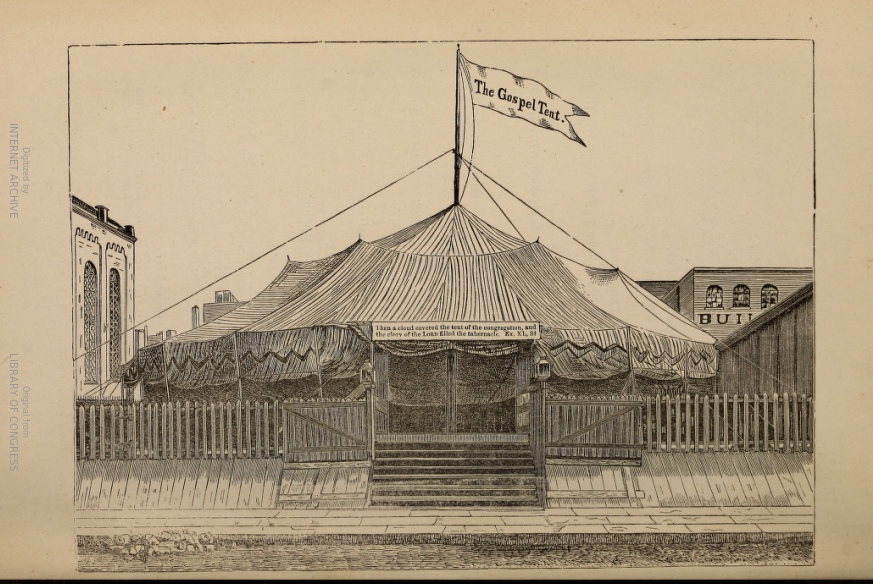
Fig. 3: Tyng’s Gospel Tent. Artist unknown, The Gospel Tent, in Mucklow, William B. Under Canvas; or, Tent Worship in Summer Months. Embracing Contributions of Eminent Clergymen, of All Denominations; and Much General and Valuable Information on the Gospel Tent, a Means for Summer Worship and Revival. Atlantic Publishing and Engraving Company, 1876. https://catalog.hathitrust.org/Record/005909363.
His heterodoxies were tolerated from a broad-church perspective, but Tyng's premillennialism was another matter. His combined commitment to social outreach and his conviction that Christ's approaching return would be "personal and visible" made him unusual. Most premillennialists found social reform secondary and most Episcopalians were skeptical of imminent-return prophecies altogether. [13]
Tyng's near dispensationalism did nothing to improve his relationship with diocesan leadership. When a reporter asked whether the bishop had any interest in a large premillennialist conference he organized and hosted, Tyng was initially coy, but when pressed answered: "I called on him and told him that I never did anything without his knowledge [ . . .] and if he felt an interest in it or cared to be present, we would be rejoiced to have him." Asked what the bishop said, Tyng replied, "Well, he thought that the utmost he could do would be to ignore it." Some 6,000 people attended. [14]
Quigg Ascendant
James Quigg’s own strategy for success was to make himself indispensable to Dr. Tyng and prove that he was capable of more than lighting a furnace or locking up a church at night. It is quite possible he found inspiration in Isaac H. Brown, the famed sexton of Grace Church, who some said was more important to a successful society wedding than a Charles Worth dress. [15]
Early newspaper mentions of Mr. Quigg reveal his being the contact for Holy Trinity’s lectures and concerts, and show him helping an unidentified gentleman, probably Tyng Jr., sublet a Summit, NJ vacation home. Somewhere along the line, James Quigg became worthy of mention in his own right, quoted in news stories on high-profile funerals, credited for the flowers at a society wedding, and even voluntarily weighing-in on a spate of deaths by pastry cream. [16]
Surviving documentation paints a portrait of considerable social ambition. His marriage to Eleanor took place at Trinity Church, Wall Street, an elevated choice for someone who worked, at the time, as a cobbler and volunteer sexton in Connecticut. [17] The 1860 census listed his personal property at $600, by the 1870 census that estate had doubled, and by 1873 he was able to purchase more than twelve acres from an old Yankee family in Westport. [18] The trajectory of his life, on paper at least, was in steady ascent.
The Reckless Reverend Philogynist
While Tyng Jr. was preparing the world for Christ’s return, his own world was falling to pieces, and it too would be “personal and visible.” He remained a prominent religious figure, but by the late 1870s his star was dimming, his church was deeply in debt, and his health and behavior were becoming increasingly unpredictable. Tyng had been pushing for an Episcopal church that was "free of caste” and which spoke the language of the people, but the New York press, once enamored with his youthful bravado, had turned predatory and began to frame him as a member of the moralizing elite.
Most of 1877 had been spent fundraising so aggressively that it drew complaints from the public. People who came just to hear him preach found themselves harangued for donations. [19] In the end, however, the money-raising efforts were successful. In fact, the Pastoral Aid Society of the Church of the Holy Trinity was considered so critical to the well-being of the people of New York City that leading philanthropists united to ensure it had a guaranteed annual income. [20]
Debt was not Tyng’s only worry. Several swindling schemes in 1877 targeted himself and his father. In the spring, a woman posing as the impoverished daughter of a Scottish minister swindled the elder Tyng incrementally out of $600. [21] Brooklyn Eagle editors were so eager to get the story to press, they did not bother to check which Stephen Tyng had been victimized. Assuming it was the younger, they published a story filled with sexual innuendo, framing the swindle as an easy seduction, labelling Tyng Jr. the “reverend philogynist.” The swindler reportedly was “emboldened probably by the manifest receptivity of Dr. Tyng's ‘organ of belief’” to ask for more than her initial request of aid and he had emptied the contents of his pants at her feet. [22] What actual behaviors of Tyng Jr.’s made the womanizing label believable can only be surmised.
Later, in a sermon taken from Proverbs 27:10, Tyng sounded like a man betrayed. He characterized gossips, especially men who gossip, as vile and excoriated those who use friendship for personal gain. “It is impossible for me to stigmatize this evil as it deserves, in the temperate language which becomes this holy place.” The sermon, published under the title Faces and Masks: A Plea for Fidelity in Friendship, encourages the discreet rebuke of the sins of friends. [23] The tone in places reads paranoid; his distress is clear.
The year 1878 provided a brief respite, but trouble returned in 1879 for both Mr. Quigg and Rev. Tyng. On April 16, Eleanor Quigg died after a lingering illness, the very month that James Quigg’s departure announcement appeared in the People’s Pulpit. [24] In May, Tyng was struck with pleurisy so severe he could not stand, followed months later by primitive surgery to drain his lungs. He was a shadow of his former self, leading only two full-length services between October and December. Prolonged periods of convalescence in Switzerland and Summit, NJ left his congregation seeking temporary leadership. [25]
Despite not being able to sustain a sermon for much of 1879-80, Tyng was fervently writing, and his opinions were increasingly provocative. His spring 1880 article in The Independent, lambasted the state of the Episcopal Church, comparing it to the Anglican Church in the era of “fox-hunting parsons, pleasure-loving lords, and depraved commonality.” In the fall, he wrote a sermon proclaiming his belief in the miracles occurring at Lourdes, surprising many Protestants. This was followed by one which stoked fears of godless and Catholic immigrant hordes, while dealing backhanded praise for the Paulist Fathers and assimilated Catholics’ embrace of intellectualism. [26]
Then seemingly out of the blue, Harper’s published a copiously cited essay called Life-Assurance Does Assure, which has all the hallmarks of sponsored content. [27] Shortly thereafter, alienated by a church which disdained his evangelism and too depleted to lead, Tyng announced his resignation. He was trading in saving souls for a high-paying position running Equitable Assurance’s new Paris office. The official word was "nervous prostration" due to "overwork." [28] In his farewell sermon he thundered: "God curse and blast this Church if it ever swerves from the principles on which it was founded. Rich and poor, black and white, met there alike . . . and those who did not like it went elsewhere." [29]
It would come to light that Tyng had been speculating in stocks and owed upward of $5,000 to his former Gospel Tent treasurer. He was being sued for non-payment; according to some newspapers the court documents were filed the day he sailed for France. [30] The New York Times listed him boarding The Scythia on May 18th with his sons but apparently not his wife and the Liverpool Mercury confirms their arrival. On the same voyage was a recently widowed, wealthy parishioner; a woman about whom adultery stories soon would spread; a woman who long had often gone by her own initials, A. A. Edgar, rejecting the customary given name suppression of married women. She traveled with her 9-year-old daughter. [31] Two weeks later, however, the New York Times announced Rev. Tyng Jr.’s departure on The Bothnia, with church congregants gathering to see him off. [32] Perhaps the S. H. Tyng on the first voyage was “Mrs.” S. H. Tyng. The omissions in both the Times and the Mercury of the gendered honorific may have made tongues wag, especially if whispers of infidelity were already circulating.
Upon arrival, A. A. Edgar (Adriana Augusta) and daughter were booked into the same hotel as the Tyngs, including Fanny. Both families found residences in adjacent Parisian arrondissements. [33] An affair between two people at this level of society, this openly, would have been highly unusual. Adriana Edgar either knew her actions to be irreproachable or she ignored the social consequences, following her heart. It is worth considering the possibility that a highly independent woman with an unusually close relationship to the Tyngs was the target of a smear campaign. On the other hand, it is also worth considering that there was some truth to the rumors. In any case, both women and their children would depart France by the fall of 1882, leaving the reverend on his own. [34] When the scandal broke, in 1883, Adriana Edgar withdrew from public life; her years of work for the Pastoral Aid Society ended. [35]
Tyng’s Paris position, however, was almost certainly arranged through moneyed connections. Mrs Edgar, appears to have had the most direct association with Equitable’s Alexander family, and was possibly behind the exit strategy. [32] Exactly what Tyng’s vestry knew in advance remains a mystery, as church records are closed and may have been damaged. Tyng's doctor, his lawyer, and the man suing him had all been active congregants and a replacement rector was even present Tyng’s last Sunday. A core group were likely aware of the details. [33]
Had similar offences been committed by James Quigg, their exposure would have been ruinous. He had achieved real success as the sexton of Holy Trinity. Without substantial capital or connections, however, his business failure left him powerless and perhaps crushing him with shame. [34] He sold his Connecticut property at a $3000 loss after Eleanor’s death but was still nearly bankrupt when he died shortly before the panic of 1884. Although James and his daughters had remained deeply involved in the church life of Holy Trinity after he resigned, their proximity to fame and wealth offered little protection once tragedy struck. [35]
Tyng’s Paris position, however, was almost certainly arranged through moneyed connections. Mrs. Edgar appears to have had the most direct association with Equitable’s Alexander family, and was possibly behind the exit strategy. [36] Exactly what Tyng’s vestry knew in advance remains a mystery, as church records are closed and may have been damaged. Tyng's doctor, his lawyer, and the man suing him had all been active congregants and a replacement rector was even present at Tyng’s last Sunday. A core group were likely aware of the details. [37]
Had similar offences been committed by James Quigg, their exposure would have been ruinous. He had achieved real success as the sexton of Holy Trinity. Without substantial capital or connections, however, his business failure left him powerless and perhaps crushed him with shame. [38] He sold his Connecticut property at a $3000 loss after Eleanor’s death but was still nearly bankrupt when he died shortly before the panic of 1884. Although James and his daughters had remained deeply involved in the church life of Holy Trinity after he resigned, their proximity to fame and wealth offered little protection once tragedy struck. [39]
After several failed attempts to return Tyng made Paris his home, eventually becoming founding president of the American Chamber of Commerce. The energy he once devoted to helping Gotham’s poor was now channeled into ensuring lucrative trade between the United States and France – a country, ironically, with a reputation for being both godless and Catholic. [40] It seemed to many, in the words of a memoirist, “a very sad abandonment.” [41]
Holy Trinity was never the same: outreach programs shrank, successive rectors moved the parish toward practices most contemporary Episcopalians would recognize as standard — processionals, a cross and candles on the altar, communion wafers instead of bread — and the central preaching pulpit was removed. Tyng impotently protested the changes from Paris by letter. In 1896, the land deemed more valuable than the building, the church on Madison and 42nd was demolished. [42] That being said, the Social Gospel, for which he paved the way, took root. Bishop Henry Codman Potter (Horatio Potter’s nephew) of Grace Church was a case in point, as was gospel tent alumnus, Rev. Rainsford at St. George. Potter was, in fact, among the first to seriously examine inequitable distribution of wealth as a source of systemic poverty, in his pastoral letter of 1886. [43]
When his father died at 85, Tyng Jr. could not make it to the funeral, which was officiated by Bishop Henry Potter, the “Aristocratic” Rev. Dix of Trinity, and Rev. Rainsford, bringing high and low church together. A little more than a decade later, Tyng Jr. died at 59 alone at his residence on the rue de la Chaussée-d'Antin; his funeral was held, fittingly, at the Church of the Holy Trinity in Paris and was attended by many American and British dignitaries residing in Paris. His eldest son and daughter-in-law were the only family present. [44]
Reflection
There are only a handful of newspaper articles that place Dr. Tyng and Mr. Quigg in the same place at the same time. One, from The New York Herald subtitled The Sexton, The Sermon, and the Singers, is written in that arch tone so effectively achieved by many 19th century journalists.
Covering the first Sunday of Lent, 1870, it begins like the opening scene of a movie. We see the picturesque beauty of the original church, the rainbow dappled light filtering through the windows, liveried handsome cabs pulling up to the doors, and female choristers stealing glances of themselves in the organist’s mirror. We are shown James Quigg, ushering in a manner fit for the “porcelain court of Pekin.” He is moving with practiced grace among New Yorkers of a “highly respectable order.” He is on his way up in the world. There are more “young and beautiful ladies” present, reports the writer, than one might typically find in church on Sunday, drawn by the chance to set their eyes on the earnest, young Reverend Tyng and his “sandy side-whiskers.” One can almost imagine the halo effect he has. In his sermon, taken from Luke XV. 19 “And am no more worthy to be called thy son; make me as one of thy hired servants,” the “reverend gentleman proceeded to inculcate beautiful lessons of humility,” states the reporter. Tyng is described skillfully paralleling the Parable of the Prodigal Son with the tale of Lucifer being cast out of heaven, contrasting the path of repentance over that of unyielding pride. [45]
These two men, one the scion of a clerical dynasty, the other an immigrant remaking himself in America, offer an interesting contrast. Tyng Jr. preaches humility and servitude as a chosen stance, doing so from a position of privilege. For Quigg servitude is less a choice than a condition of life. Quigg’s “grace of manner” reveals a man whose pride is his capital, his main investment, and his future, or so he imagines.
One cannot help but wonder if Stephen Tyng reflects on this sermon when he is toasting princes and magnates at Paris banquets decades later. Which path has he followed? Is he the prodigal son, repentant and humbled, giving up his pastoral career for the good of the church? Is he the proud, defiant “son of the morning” who fled to save his own skin, regardless of the wreckage he leaves behind?
Helen Lane has made New York her home since arriving 1989 with $200 in her pocket and the promise of a couch to sleep on. After spending most of the 1990s working in the book publishing industry, she found her true calling as a research librarian. At the Fashion Institute of Technology, where she has worked since 2009, Helen specializes in instructional design, emerging technologies, and information literacy instruction. She is married to artist and elevator inspector David Frye. They live in Ridgewood, Queens and have a daughter in college. Helen has many more tales to tell about the exploits of Dr. Tyng Jr. and Mr. James Quigg and has begun work on a book inspired by their lives. She holds a BA in English Literature from Earlham College, an MLIS from Pratt Institute, and a Master’s in Learning and Emerging Technologies from SUNY Empire State University.
[1] Junius Henri Browne, The Great Metropolis; a Mirror of New York. (American publishing company; H. H. Bancroft & co., etc., etc., 1869), https://catalog.hathitrust.org/Record/009569487; Anthony of Padua, The Tyng Family in America. (Marist Press, 1956), https://catalog.hathitrust.org/Record/005773089.
[2] “Religious Councils,” New-York Tribune (New York, New York), May 20, 1874; “The Reformed Episcopal Church,” New York Daily Herald (New York, New York), May 20, 1874;“Thrall, Cheney, The Tyngs, and The Press,” Brooklyn Eagle (Brooklyn, New York), September 7, 1871; “Episcopal Church Scapegoats,” New York Daily Herald (New York, New York), July 16, 1871.
[3] Rev Andrew Cameron, The Family Treasury of Sunday Reading (1877), 25–26; Cuyler Reynolds, Genealogical and Family History of Southern New York and the Hudson River Valley (Lewis Historical Publishing Company, 1914), 829–30; Alphonso David Rockwell, Rambling Recollections: An Autobiography (P. B. Hoeber, 1920), 285.
[4] “Dr. Tyng’s New Church,” The New York Times (New York, New York), April 18, 1874; Nathan Silver, Lost New York, with Internet Archive ([Boston] : Houghton Mifflin Company, 1967), http://archive.org/details/lostnewyork0000silv_x8y8.
[5] Charles Rockland Tyng and N. Y. ). St. George’s Church (New York, Record of the Life and Work of the Rev. Stephen Higginson Tyng and History of St. George’s Church, New York, to the Close of His Rectorship (E.P. Dutton & Company, 1890), https://catalog.hathitrust.org/Record/008438193.
[6] “BYMCA 13th Anniversary Meeting at Plymouth Church,” The Brooklyn Union (Brooklyn, New York), May 22, 1867; “The Temperance Cause,” The Brooklyn Union (Brooklyn, New York), May 6, 1868; “The Gospel for the Masses: Address by H. W. Beecher,” New - York Tribune (1866-1899) (New York, N.Y., France), March 8, 1871; “ADDRESS OF REV. STEPHEN H. TYNG, JR., Of the Church of the Holy Trinity, New York.,” Sailors’ Magazine & Seamen’s Friend 42, no. 6 (1870): 164–66, 54900315; “Anniversary Meeting of the Working Women’s Protective Union,” The New York Times (New York, New York), April 4, 1871; N. Y. ). House of the Evangelists (New York, Annual Report, with State Library of Pennsylvania (S.W. Green, printer, n.d.), accessed October 19, 2025, http://archive.org/details/annualreport00hous_1.
[7] “Rev . H. W. Beecher on Pulpits in General and His Own in Particular,” Brooklyn Eagle (Brooklyn, New York), January 6, 1868.
[8] “Moody and Sankey,” New York Daily Herald (New York, New York), March 15, 1876; “Seeing Moody and Sankey,” New York Herald (New York, New York), March 8, 1876.
[9] “The Gospel Tent,” New-York Tribune (New York, New York), June 12, 1876; “A Destructive Cyclone,” New-York Tribune (New York, New York), September 18, 1876; “Destruction of the Gospel Tent,” The New York Times (New York, New York), September 4, 1877; “Dr. Stephen Tyng Jr. Gospel Garden,” The New York Times (New York, New York), July 28, 1878.
[10] Rockwell, Rambling Recollections, 218.
[11] Church of the Holy Trinity (New York, N.Y.), ed., Annual Report of the Pastoral Aid Society of the Church of the Holy Trinity, New York, Annual Thirteenth (Pastoral Aid Society, 1879); “Sayings and Doings,” Harper’s Bazaar (New York, United States), July 15, 1876; “Teachings in the Pulpit: Dr. Tyng, Jr., Preaches His Farewell Sermon. Dedication of a Church. Church Festival for Children. Mr. Beecher to New Members.,” New York Times (New York, N.Y., United States), May 2, 1881; “An Episcopal in a Congregational Church,” Brooklyn Eagle (Brooklyn, New York), January 28, 1870.
[12] Episcopal Church, “Journal of the ... Annual Convention, Diocese of New York.,” New York Journal of Convention (New York (State)), Journal, 1785, v.; Diocese of ..., ed., Journal of the ... Annual Convention, Diocese of ... 91st-93rd 1874-1876., no. 148 (n.d.), accessed January 25, 2026, https://babel.hathitrust.org/cgi/pt?id=wu.89072971211&seq=148&q1=tyng+jr.
[13] David Komline, “Stephen Tyng Jr., Millenarian Reformer,” Anglican and Episcopal History 88, no. 1 (2019): 30–47; STEPHEN H. TYNG, “Christ’s Coming: Is It Personal and Visible?: An Address Before the Prophetic Conference in the New York, October 30th.,” The Independent ... Devoted to the Consideration of Politics, Social and Economic Tendencies, History, Literature, and the Arts (1848-1921) (New York, United States), November 7, 1878.
[14] “The Second Adventist: Arrangements for the Conference,” New York Daily Herald (New York, New York), October 27, 1878.
[15] Marian Campbell Gouverneur, As I Remember: Recollections of American Society During the Nineteenth Century (D. Appleton, 1911).
[16] “Church of the Holy Trinity Grand Concert,” New York Daily Herald (New York, New York), November 10, 1874; “Board in the Country,” New York Daily Herald (New York, New York), August 7, 1868; “The Body of Nathaniel C. Bishop Exhumed,” The New York Times (New York, New York), April 12, 1874; “Mysterious Murder: Still Searching for Mrs. Hull’s Assassins,” The New York Times (New York, New York), June 14, 1879; “Eight More Deaths: The Sufferings of Two Families from Eating Poisoned Pastry.,” New York Daily Herald (New York, New York), November 26, 1879.
[17] Quigg, James et al., “Marriage Records Detail,” Trinity Church Registers, May 19, 1853, https://registers.trinitywallstreet.org/registers/display_detail.php?id=9787&sacr=marriage; MacKenzie, Jr, Rev. Kenneth, Parish Directory of the Memorial Church of the Holy Trinity, Westport Ct (with History) (Memorial Church of the Holy Trinity, 1901), 21.
[18] “James Quiggs,” in 1860 United States Federal Census [29] (National Archives and Records Administration, Records of the Bureau of the Census), Ancestry.com, https://www.ancestry.com/search/collections/7667/records/14742255; “James Quigg,” in 1870 United States Federal Census [New York Ward 19 District 1, New York, New York] (National Archives and Records Administration, 1870), Ancestry.com, https://www.ancestry.com/search/collections/7163/records/33443308; “Abraham Sherwood and Mary Sherwood to James Quigg, Warranty Deed,” in Land Records, Book 11 (Town Clerk’s Office, 1873), https://recordhub.cottsystems.com/WestportCT/Search/Records/Details?IndexId=12641273.
[19] “Dr. Tyng’s Fund,” New-York Tribune (New York, New York), January 12, 1878; “Letters from the People,” New-York Tribune (New York, New York), December 27, 1877.
[20] Michael Bourgeois, All Things Human: Henry Codman Potter and the Social Gospel in the Episcopal Church (University of Illinois Press, 2010).
[21] “A Career Which Should Be Stopped,” The New York Times (New York, New York), August 23, 1877; “Mary M’Dermott: Some Further Information Regarding That Accomplished Swindler,” The Brooklyn Daily Times (Brooklyn, New York), August 23, 1877.
[22] “Cant as a Stock in Trade,” Brooklyn Eagle (Brooklyn, New York), August 25, 1877.
[23] Stephen H. Tyng, Jr., “Faces and Masks: A Plea for Fidelity in Friendship,” The People’s Pulpit: A Weekly Publication Containing Sermons by Stephen H. Tyng, Jr (New York), December 1877.
[24] “Eleanor Quigg Death Notice.,” The New York Times (New York, New York), April 19, 1879.
[25] “The Rev. Dr. Tyng’s Illness,” The New York Times (New York, New York), June 8, 1879; “Christmas at Church,” New-York Tribune (New York, New York), December 26, 1879; “Services at The Holy Trinity,” New-York Tribune (New York, New York), December 26, 1879; “The Illness of Tyng Junior,” New-York Tribune (New York, New York), June 7, 1879; “Opening the Gospel Tent,” New-York Tribune (New York, New York), June 16, 1879; “Dr. Tyng’s Illness,” Buffalo Post (Buffalo, New York), June 9, 1879; “Returns for Brief Sermon,” New York Daily Herald (New York, New York), October 6, 1879.
[26] Stephen H. Tyng Jr., “An Historical Comparison,” The Independent, March 3, 1880, http://archive.org/details/sim_independent_1880-03-25_32_1634; “Lourdes and Tyng,” The New York Times (New York, New York), November 23, 1880; “The Flood of Immigration.” The Montclair Times (Montclair, New Jersey), February 26, 1881.
[27] “Life-Assurance Does Assure, by Stephen H. (Stephen Higginson) Tyng,” Harper’s Magazine, April 1881, accessed October 30, 2025, https://harpers.org/archive/1881/04/life-assurance-does-assure/.
[28] Church of the Holy Trinity (New York, N.Y.), ed., Annual Report of the Pastoral Aid Society of the Church of the Holy Trinity, New York for 1880, Annual no. 15th (Pastoral Aid Society, 1881); “The Rev. Dr. Tyng’s Resignation: His Reasons for Retiring from the Church of the Holy Trinity.,” New York Times (New York, N.Y., United States), April 7, 1881.
[29] “Teachings in the Pulpit: Dr. Tyng, Jr., Preaches His Farewell Sermon. Dedication of a Church. Church Festival for Children. Mr. Beecher to New Members.,” New York Times (New York, N.Y., United States), May 2, 1881.
[30] “Young Dr. Tyng’s Ventures,” New York Herald (New York, New York), August 8, 1882; “Tyng Jr. Suit,” Brooklyn Eagle (Brooklyn, New York), August 11, 1882; “Tyng Scandal,” Brooklyn Eagle (Brooklyn, New York), August 10, 1882; “The Gospel Tent,” New-York Tribune (New York, New York), June 12, 1876.
[31] “Passengers Sailed,” The New York Times (New York, New York), May 18, 1881.
[32] “Outgoing Steam-Ships,” The New York Times (New York, New York), June 2, 1881.
[33] “English and Americans Registered Yesterday in Paris,” Galignani’s Messenger, July 21, 1881, https://gallica.bnf.fr/ark:/12148/bpt6k68506863.“ Piano Lessons by Mme. Hedvige de Mejan,” The American register for Paris and the continent (Paris), April 15, 1882, https://gallica.bnf.fr/ark:/12148/bpt6k23914661.
[34] “Mrs. S. H. Tyng Jun. will sail,” The Parisian, September 29, 1882, https://gallica.bnf.fr/ark:/12148/bpt6k68010347.
[35] Church of the Holy Trinity (New York, N.Y.), Annual Report of the Pastoral Aid Society of the Church of the Holy Trinity, New York.
[36] “Married,” New-York Tribune (New York, New York), May 26, 1855; Princeton University, General Catalogue of Princeton University, 1746-1906. (The University, 1908), https://catalog.hathitrust.org/Record/009790678; Equitable Life Assurance Society of the United States., The Equitable Life Assurance Society, 92 Broadway, New-York: Hon. Wm. C. Alexander, President. Henry B. Hyde, Vice-President. George W. Phillips, Actuary. Edmund C. Fisher, Secretary. (Equitable Life Assurance Society, 1861), https://catalog.hathitrust.org/Record/102674432.
[37] Church of the Holy Trinity (New York, N.Y.), Annual Report of the Pastoral Aid Society of the Church of the Holy Trinity, New York; New York Times, “Teachings in the Pulpit.”; Gentile, Rosa. “Email Message from St. James.” November 10, 2025; Lindsley, James Elliott. “Email Message from Author.” January 11, 2026.
[38] United States Bureau of the Census, Historical Statistics of the United States, Colonial Times to 1970 (U.S. Department of Commerce, Bureau of the Census, 1975); “THE ELITE DIRECTORY.,” in Elite Private Address & Carriage Directory & Ladies’ Visiting & Shopping Guide for New York City (New York: Phillips, Andrade & Co., 1877), 103687895, https://research.ebsco.com/linkprocessor/plink?id=a0a96842-e96f-3115-b4e1-77e3b8ba56ab.
[39] Church of the Holy Trinity (New York, N.Y.), Annual Report of the Pastoral Aid Society of the Church of the Holy Trinity, New York.
[40] Nancy L. Green, The Other Americans in Paris : Businessmen, Countesses, Wayward Youth, 1880 - 1941, with Internet Archive (Chicago ; London : The University of Chicago Press, 2014), http://archive.org/details/otheramericansin0000gree; Katharine de Forest, “Our Paris Letter,” Harper’s Bazaar (New York, United States), July 27, 1895; “The American register for Paris and the continent ["puis" for Europe ; register and Anglo-American news ; and Anglo-colonial world],” Gallica, June 23, 1883, https://gallica.bnf.fr/ark:/12148/bpt6k2391528p.
[41] David Alphonso Rockwell, Rambling Recollections: An Autobiography (P. B. Hoeber, 1920), 285.
[42] James Elliott Lindsley, A History of Saint James Church in the City of New of York, 1810-1960, with Princeton Theological Seminary Library (New York : St. James Church, 1960), http://archive.org/details/historyofsaintja00lind_0; “Holy Trinity Reopened,” The New York Times (New York, New York), February 15, 1892; “To Tear Down a Church,” New-York Tribune (New York, New York), February 8, 1896.
[43] Bourgeois, Michael. All Things Human: Henry Codman Potter and the Social Gospel in the Episcopal Church. University of Illinois Press, 2010.
[44] “Dr. Stephen H. Tyng Buried,” New-York Tribune (New York, New York), September 9, 1885; Death of Dr. Tyng,” The New York Herald (European Edition), November 18, 1898, International Herald Tribune Historical Archive, 1887-2013; “Funeral of Dr. Tyng,” The New York Herald (European Edition), November 24, 1898, International Herald Tribune Historical Archive 1887-2013;The New York Herald (European Edition), “Death of Dr. Tyng”; The New York Herald (European Edition), “Funeral of Dr. Tyng.”
[45] New York Daily Herald, “Church of the Holy Trinity,” March 7, 1870.