
Reputation and Ruin in Young Dr. Tyng's New York, Part I: The Body in the Basement
By Helen Lane
For the amateur genealogist, what starts as a search for personal identity can become the rediscovery of public notoriety. And when it does, the distance between guarded family secrets and the exposure of the truth is soon measured headline by headline.
Searching 19th-century newspaper archives for information on a certain James Quigg yielded a horrific and sensational story, one that was picked up by papers from Maine to California. The headlines were blunt and graphic: “SEXTON QUIGG CUTS HIS THROAT” AND “KILLED HIMSELF UNDER GUARD.” The articles chronicled the man’s final days in February of 1884, covering his initial, pathetic attempted suicide by drinking oxalic acid, his placement under the watch of Officer Michael Flynn (whom he charmed into neglecting his duties) and his determined final act with a carving knife. He bled out behind locked doors on the flagstone floor of the basement of number 204 E 48th Street, having cut his throat nearly ear to ear. [1]
Yet, as shocking as the manner of his death was, Mr. Quigg's suicide attempt and eventual success attained national headline status mainly due to his former employment, for it was only when the “50-year-old Irish laborer” mentioned briefly in the New York Times was correctly identified by the New York Tribune as the "Former Sexton of Young Dr. Tyng’s Church" that the story took on any life. [2] After this discovery many journalists saw the opportunity to stoke the scandal and gossip surrounding a famous evangelical minister, the church that he built, and the secrets he was supposedly hiding. [3]
Stephen H. Tyng Jr., was a man whose name had been in the press nearly every day the decade preceding; a preacher whose fame might have eclipsed that of Henry Ward Beecher under better circumstances; a person who, today, is a mere Gilded Age footnote, of interest mainly to chroniclers of the Episcopal church or evangelism in the United States. [4]
From the beginning of Tyng's remarkable career as rector of the Church of the Holy Trinity, certain newspapers seemed to have had it out for him, particularly the Brooklyn Eagle, which desperately needed a fact-checker, and the New York Herald, with its penchant for sensationalism. Other papers simply found him newsworthy. He had the same qualities that make for celebrity headlines today: he was rebellious, outspoken, “conspicuously virtuous,” arrogant, a nepo-baby, and incredibly accomplished. Furthermore, unlike Henry Ward Beecher, whom Mark Twain described as homely as a singed cat, Tyng Jr. had youthful good looks and style, secure enough in his masculinity to sport Piccadilly weepers and the latest in menswear. [5]
The suicide incident briefly brought back stories which had first surfaced when Tyng Jr., having overcome severe illness and restored his church’s debt, shocked everyone in the Spring of 1881 by suddenly resigning and moving to Paris, where he had secured a lucrative position with an insurance company. He cited his health and nerves as his reasons. The press immediately began to suspect that there was more to the story and they would be right. [6]
Mr. Quigg, it was said, had been asked to sign a letter of secrecy before being forced to step down in1879, although his family denied it. The idea was not beyond reason. He had, after all, been directly quoted in several newspaper stories covering scandals that involved prominent parishioners of Tyng’s. As the sexton of a wealthy church in 19th century New York City, his role was part building manager, events coordinator, and sometimes undertaker, putting him behind the scenes of many “life stage” rites. [7]
When he first set foot in America in 1851, James Quigg was alone and barely eighteen years old. By 1860 he had married and the census shows the Quiggs as a family of four living in Connecticut and being from Ireland. While his siblings and his wife’s extended family continued to be recorded as Irish for decades, by 1870, the Quigg household, now residing in Manhattan, was listed as originating from Connecticut, and by 1880, from Great Britain.
This consistent erasure of origin suggests a desire to distance themselves from Irishness, to pass as something other. Perhaps their move to New York City two years after the Draft Riots informed the choice, or perhaps it was behavior learned elsewhere. James Quigg from Londonderry, a Protestant with a distinctly Irish Gaelic surname, likely understood better than most, that how one identifies and how one is perceived by others are not one and the same. How fitting, then, that the New York Times had initially identified him as a drunken, despondent Irish laborer.
The gossip trailing Reverend Tyng Jr.’s departure had compounded year by year. Rumors of mental instability, the mugging by garrote of his former assistant minister by would be blackmailers, the reporting of salacious details of a decade-long affair with a wealthy, recently widowed parishioner all made headlines in 1882 and 1883. In fact, it was only one week before Quigg’s attempted suicide that police announced they had finally given up investigating the garroting and blackmailing scheme. [8]
With Quigg’s death the stories essentially ended; the papers moved on from the sexton's suicide and its possible connection to the former reverend. In the decade that followed, malicious gossip about Tyng Jr. all but evaporated. Lacking the confessions, testimony, or legal hearings that characterized the infamous Beecher-Tilton adultery case of the 1870s, the charges would be brushed away.
Tyng would be allowed to remake his life in Paris relatively unscathed.
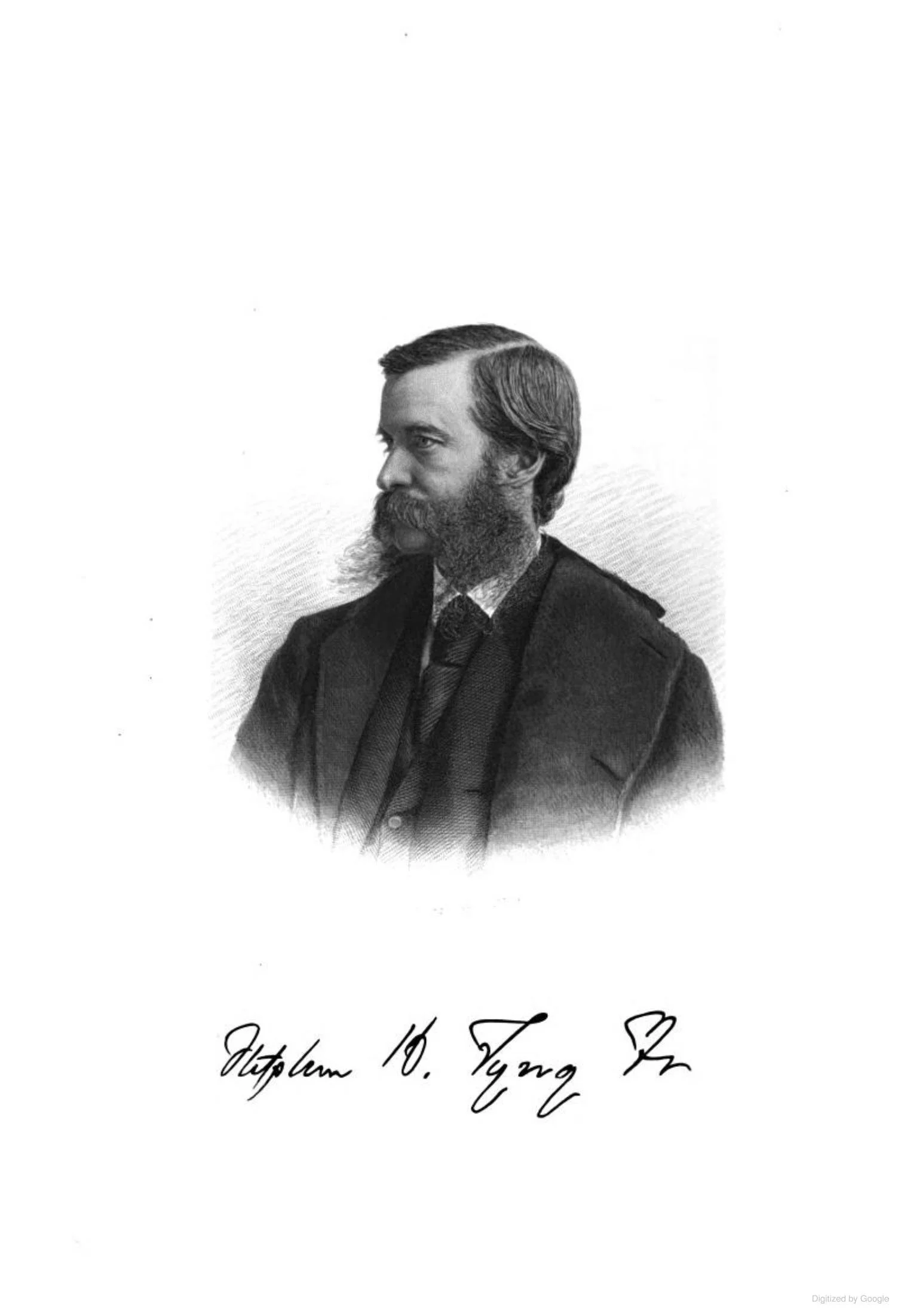
Fig. 1: Stephen H. Tyng, Jr. from The American Portrait Gallery 1880. Buttre, John Chester, Plate 71: Stephen H. Tyng, Junior in Lillian C. Buttre, The American Portrait Gallery: With Biographical Sketches of Presidents, Statesmen, Military and Naval Heroes, Clergymen, Authors, Poets, Etc., Vol 2. New York, NY, J. C. Buttre, New York, NY, J. C. Buttre, 1880.
The Father, The Son, and The Church of the Holy Trinity
Stephen H. Tyng Jr. captured national attention in the media frenzy surrounding his ecclesiastical trial in early 1868. His crime? Breaking canon law by preaching in a Methodist church in New Brunswick, NJ without the express permission of the bishop and the local Episcopal rectors, Mr. Boggs and Mr. Stubbs. And doing so in the wrong clothing. [9] Those actions in the summer of 1867 were purposefully provocative and came at a time when low-church Episcopalian ministers were pushing back against the Anglo-Catholic Oxford movement, and restrictive thinking that prevented ecumenical collaboration. [10] A contemporary later recalled “his defiant air” toward the trial. [11] The ensuing confrontation was staged to expose the stifling nature of an Episcopal Church that was losing touch with its Protestant roots. It also made him a superstar.
The son of Dr. Stephen H. Tyng, Sr., the renown pastor of St. George’s in Stuyvesant Square, the young Tyng inherited his father’s low-church evangelical leanings and legacy. He also stood in the shadow of his ill-fated, abolitionist brother, the Reverend Dudley Atkins Tyng, whose powerful anti-slavery sermon, Our Country’s Troubles, had gotten him into hot water with his Philadelphia church in 1856. [12]
Returning from the Virginia Theological Seminary at the outbreak of war, Tyng served briefly as rector of the Church of the Mediator. He received his commission as a Union Army Chaplin in June of 1863, leaving a month before the Draft Riots. It was then, that Joseph Reed, a seven-year-old Black member of his church’s Sunday school, was beaten to death by the mob in the streets. The murder of the child affected him greatly and may have produced a trauma-inform drive and religiosity that distinguished him from this father. [13] When Tyng Jr. returned from serving, he was made the first rector of The Church of the Holy Trinity on the corner of Madison & 42nd Street. By the late 1860s, he and his wife, Fanny, had two young sons. [14]
Described as a “perfect dynamo of aggressive work” the young Stephen Tyng was well-known for his tireless efforts on behalf of New York’s poor and forgotten. [15] By the time of the trial, the Church of the Holy Trinity already supported a sizable and highly engaged congregation. This included the Quigg family, who had uprooted themselves from their lives in rural Connecticut to join the charismatic young minister’s community. James Quigg was not merely an employee but an active participant in the church’s broader institutional life through the Pastoral Aid Society, an organization founded in 1866 and led by Tyng Jr. with explicitly democratic aspirations.
Early bylaws granted full committee membership to all male congregants over the age of fifteen, regardless of background or social standing, and surviving reports place James Quigg’s name, and others of obscure origin, alongside those of wealthy and well-connected parishioners such as Robert Ray and Samuel H. Hurd (Barnum’s son-in-law). Women, too, played central roles, with prominent donors underwriting the church’s missions while less socially visible members were also recognized for their labor. The youngest of the Quigg children, Sarah, would serve as both treasurer and then secretary of the Martha and Mary association in later years. [16]
The institutional nature of the Church of the Holy Trinity, its soup kitchen and medical dispensary, its aid society, its inclusion of working-class congregants alongside the wealthy, anticipated what would later be called the “Social Gospel.” Tyng Jr. was building the scaffolding of that theology in practice before it had a name; the idea that a church’s mission should go beyond saving souls to transforming the conditions of the poor. [17]
The public overwhelmingly disapproved of the charges brought against the young minister. [18] The press published articles that scorned, criticized, and even lampooned the Episcopal leadership. “It is high time that the tribe of young men were put down… They can look upon the most time-honored piece of humbug, and say without the least compunction, “Away with it!’” proclaimed an editorial in The Independent, edited at the time by Theodore Tilton. [19] Harper’s magazine made it the topic of their Easy Chair column, asking why it was that when they read of the charges they were reminded of the “shore of Galilee teacher who banned the Scribes and Pharisees and declared his kingdom to be not of this world,’ essentially comparing young Tyng to Christ himself. [20] Others observed these religious disciplinary matters with amusement and cynicism, as this poem published in the Brooklyn Eagle illustrates. [21]
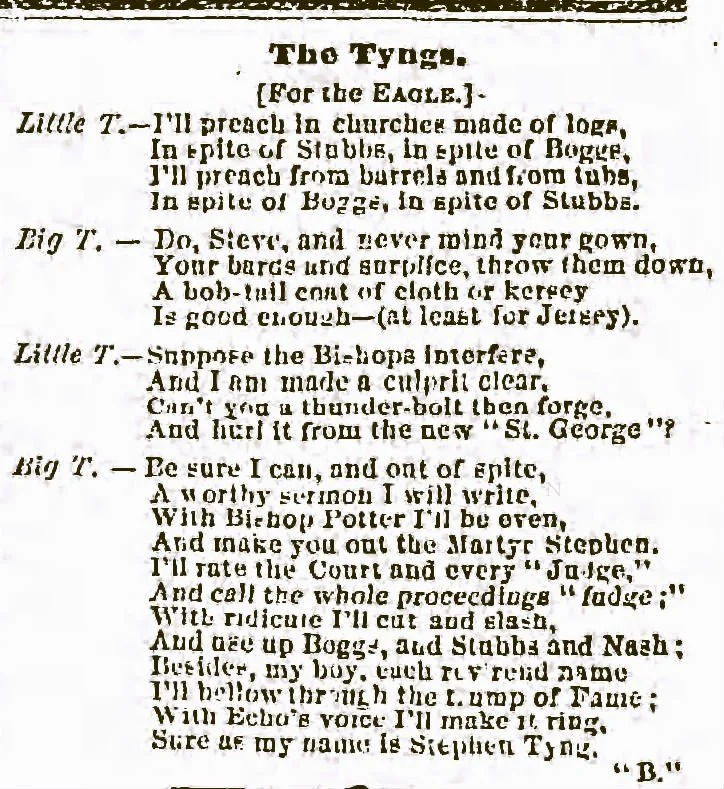
Fig 2: A poem entitled, The Tyngs, by “B” as it appeared in the Brooklyn Eagle. B. “The Tyngs.” Brooklyn Eagle (Brooklyn, New York), March 26, 1868.
In the lead-up to the trial, the Tyngs and their allies were determined to keep the protest in Protestant. Father and son were formidable when united in the cause. Tyng Sr. was a man whose “words were sentences, sentences were sermons, and sermons were volumes”; someone who could “mangle sophistries with his tongue as a wolf would a lamb.” Tyng, Jr. was said to move “with his own soul filled with kindred emotions” that could ignite in others “the inextinguishable fires of faith.”
That summer at a conference in Saratoga Springs, throngs showed up to hear the young pastor preach; his pointed scriptural message, Luke 9:60, "Let the dead bury the dead." Back in New York, he gave sermons equating freedom of the pulpit to freedom of the press and warning against "Romish" centralized control. Low church allies published mock charges against Rev. Dix of Trinity Church and against St. Alban's in general. [22]
Behold the Man
Boughs of Christmas holly and pine still decorated the cozy sanctuary of St. Peter’s in Chelsea as the trial began on January 10, 1868, but a two-hour wait for a missing judge was putting nearly everyone on edge. The young Tyng, however, appeared unbothered, yawning, and playing nonchalantly with his walking cane. Once the trial was finally underway, Mr. Stubbs personally begged Tyng to plead to the charges so to avoid further “unpleasantness,” but ignoring his entreaties, Tyng’s counsel insisted on a public trial, one that would allow them to cross-examine witnesses. [23]
The court reconvened on February 10, once again at St. Peter’s. On each of the five days that it lasted, the church lecture room was packed with spectators elbowing and pushing each other for a better view and “ill-behaved ladies” vocalizing their support for their beloved martyr. [24] The prosecution focused on the technical violations of the 12th Canon as well as Tyng’s failure to wear a surplice, and the defense framed the trial as overreach, questioning how a canon rooted in British civil law could be brought to bear in the United States. [25] The Brooklyn Eagle, mocked the prosecution’s obsession with ecclesiastical vestments, comparing it to the question of whether “Rev. Tyng believes in and plays croquet.” [26] The technical violation of church law, however, was undeniable, leading to a guilty verdict.
The final scene played out on March 14 at the Church of the Transfiguration, a congregation known for its Anglo-Catholic proclivities. This time the crowd was flanked by police in case Tyng’s supporters got out of line. The church had once served as a haven for those seeking safety from the Draft Riots. This was perhaps a pointed message to the accused, that Low Church practitioners did not hold a monopoly on empathy and altruism. [27]
Bishop Horatio Potter’s admonition amounted to little more than a verbose and patronizing public shaming. No sooner had the bishop finished than the distinguished, elder Tyng rose and delivered a formal protest with the rousing voice of a seasoned preacher. Deploying ritual as a weapon to silence him, Bishop Potter and his clergy dropped to their knees in recited prayer while the church organ drowned out the elder Tyng’s voice. The event ended in a noisy stalemate, leaving the two factions more divided than ever. [28]
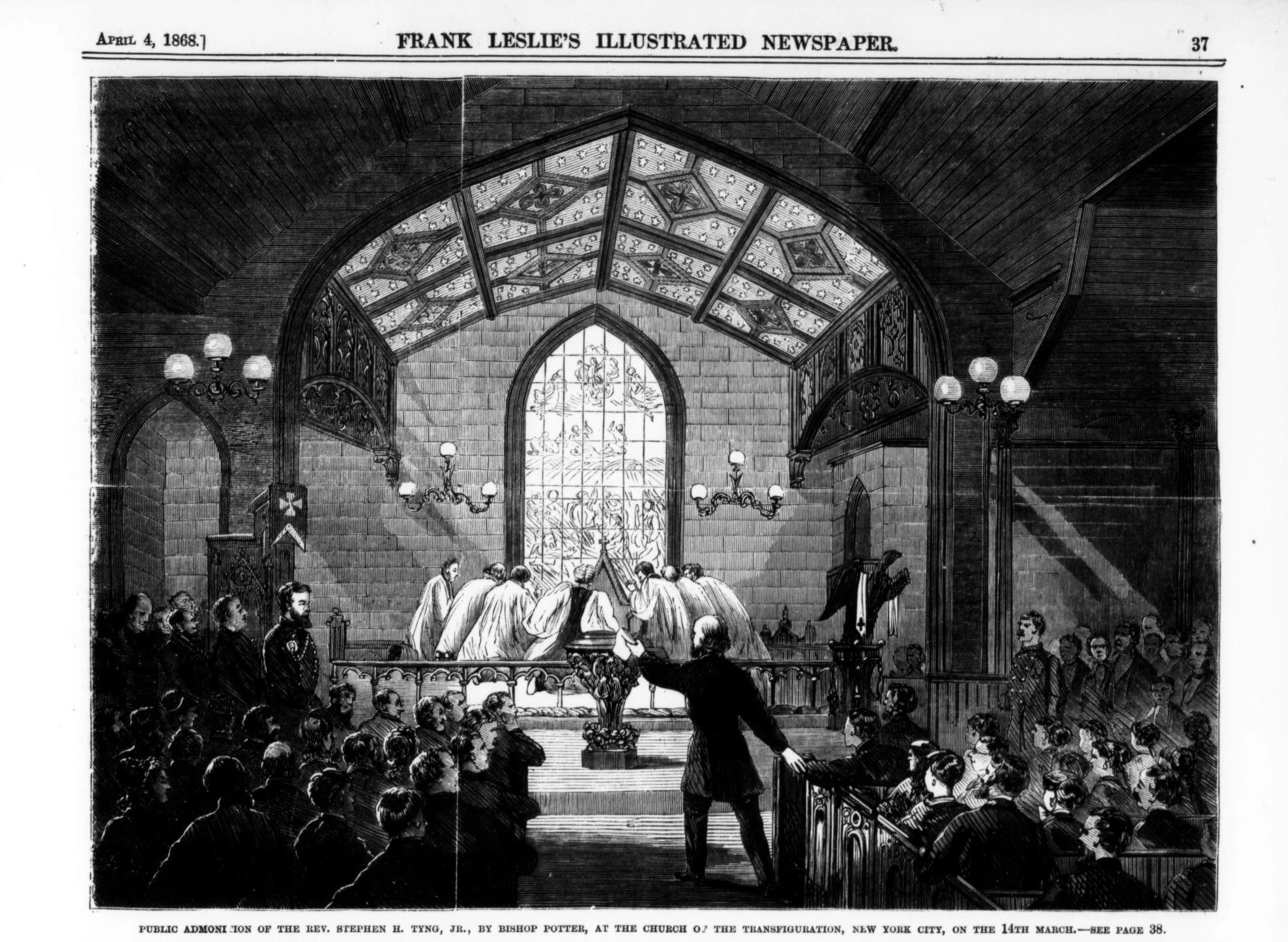
Fig. 3: Illustration in Frank Leslie’s Illustrated depicted Rev. S.H. Tyng Sr. delivering his protest. Frank Leslie’s Illustrated Newspaper 1868-04-04: Vol 26 Iss 653. With Internet Archive. Out-of-copyright, 1868, http://archive.org/details/sim_leslies-weekly_1868-04-04_26_653.
The spectacle did immense good for Tyng’s fame as well as for his congregation and missions. The Church of the Holy Trinity and Pastoral Aid Society saw explosive growth in 1868 and the years that followed. The bishop had chided Tyng Jr, saying that his talk of unrestricted “liberty of preaching” were fine sounding words for empty-headed people, but that he risked making himself the center of attention to the detriment of the message itself. [29] Tyng ignored this warning and in the decade that followed became involved in every imaginable, popular Christian trend, keeping his name in the headlines consistently and often drawing fire. Mr. James Quigg, whatever his own reasons were, was by Tyng’s side until near the decade’s end.
Tyng Jr.’s career would map the transformation of Protestant reform from racial justice and women's rights to Comstock-era moralism and ugly anti-Catholic sentiment. It was a trajectory that was rooted in the conviction (held by many like-minded reformers of the era) that Protestantism represented the principles of individual consciousness and moral self-discipline required for a healthy democracy. Ultimately, however, Tyng’s career would not be sustainable for reasons both known and unknown. When the end came, it would not be pretty.
Helen Lane has made New York her home since arriving 1989 with $200 in her pocket and the promise of a couch to sleep on. After spending most of the 1990s working in the book publishing industry, she found her true calling as a research librarian. At the Fashion Institute of Technology, where she has worked since 2009, Helen specializes in instructional design, emerging technologies, and information literacy instruction. She is married to artist and elevator inspector David Frye. They live in Ridgewood, Queens and have a daughter in college. Helen has many more tales to tell about the exploits of Dr. Tyng Jr. and Mr. James Quigg and has begun work on a book inspired by their lives. She holds a BA in English Literature from Earlham College, an MLIS from Pratt Institute, and a Master’s in Learning and Emerging Technologies from SUNY Empire State University.
[1] “Sexton Quigg Cuts His Throat,” The New York Times (New York, New York), February 15, 1884; “Killed Himself Under Guard.,” The Times Record (Brunswick, Maine), February 16, 1884.
[2] “Two Attempts at Suicide,” The New York Times (New York, New York), February 11, 1884; “Killed Himself under Guard: The Former Sexton of Young Dr. Tyng’s Church Succeeds This Time,” New York Herald (New York, New York), February 15, 1884.
[3] “Despondent Sexton: Attempted Suicide Growing Out of a Church Scandal,” San Francisco Chronicle (San Francisco, California), February 11, 1884; “A Clerical Scandal,” San Francisco Chronicle (San Francisco, California), February 4, 1884.
[4] David Komline, “Stephen Tyng Jr., Millenarian Reformer,” Anglican and Episcopal History 88, no. 1 (2019): 30–47; Allen C. Guelzo, For the Union of Evangelical Christendom : The Irony of the Reformed Episcopalians, with Internet Archive (University Park, Pa. : Pennsylvania State University Press, 1994), http://archive.org/details/forunionofevange0000guel; James Elliott Lindsley, This Planted Vine: A Narrative History of the Episcopal Diocese of New York, 1st ed (Harper & Row, 1984).
[5] Debby Applegate, The Most Famous Man in America: The Biography of Henry Ward Beecher, First edition (Doubleday, 2006), http://catdir.loc.gov/catdir/enhancements/fy0659/2005054842-s.html.
[6] “The Rev. Dr. Tyng’s Resignation: His Reasons for Retiring from the Church of the Holy Trinity.,” New York Times (New York, N.Y., United States), April 7, 1881.
[7] “The Body of Nathaniel C. Bishop Exhumed,” The New York Times (New York, New York), April 12, 1874; “Mysterious Murder: Still Searching for Mrs. Hull’s Assassins,” The New York Times (New York, New York), June 14, 1879.
[8] “Rev Tyng’s Disgrace,” Daily Sentinel (Rome, New York), February 4, 1884; “Rev Bache Case,” Brooklyn Eagle (Brooklyn, New York), December 12, 1883; “Mr. Bache’s Misfortune,” The New York Times (New York, New York), December 10, 1883; “Mr. Bache in the Pulpit,” The New York Times (New York, New York), December 24, 1883; “The Case of Rev. Dr. Bache,” The Sun (1837-) (Baltimore, Md., United States), December 11, 1883; “Mr. Bache’s Misfortune Possibly the Victim of a Blackmailing Scheme.: A Man Who Wanted to Sell Some Alleged Letters of Dr. Tyng--a Policeman’s Memory of a Scene up Town.,” New York Times (New York, N.Y., United States), December 10, 1883; San Francisco Chronicle, “A Clerical Scandal.”
[9] “Topics of To-Day,” Brooklyn Eagle (Brooklyn, New York), July 27, 1867; “Local Intelligencer. The Case of Rev. Stephen H. Tyng Jr.,” The New York Times (New York, New York), July 30, 1867.
[10] Lindsley, This Planted Vine; Guelzo, For the Union of Evangelical Christendom.
[11] Alphonso David Rockwell, Rambling Recollections: An Autobiography (P. B. Hoeber, 1920).
[12] Anthony of Padua, The Tyng Family in America. (Marist Press, 1956), https://catalog.hathitrust.org/Record/005773089; Russell E. Francis, “The Religious Revival of 1858 in Philadelphia,” The Pennsylvania Magazine of History and Biography 70, no. 1 (1946): 52–77.
[13] Suffering from the Late Riots in the City of New York. Committee of Merchants for the Relief of Colored People and Vincent Colyer, Report of the Committee of Merchants for the Relief of Colored People, Suffering from the Late Riots in the City of New York (G. A. Whitehorne, printer, 1863), 20, Making of America., https://catalog.hathitrust.org/Record/001873892.
[14] “NYC Marriage & Death Notices 1857-1868,” New York Society Library, The New York Society Library, 2026, https://www.nysoclib.org/nyc-marriage-death-notices-1857-1868; “Death of Dr. Tyng,” The New York Herald (European Edition), November 18, 1898, International Herald Tribune Historical Archive, 1887-2013.
[15] Rockwell, Rambling Recollections.
[16] Church of the Holy Trinity (New York, N.Y.), ed., Annual Report of the Pastoral Aid Society of the Church of the Holy Trinity, New York for 1867, Annual Second (Pastoral Aid Society, 1868); Church of the Holy Trinity (New York, N.Y.), ed., Annual Report of the Pastoral Aid Society of the Church of the Holy Trinity, New York, Annual Thirteenth (Pastoral Aid Society, 1879); Church of the Holy Trinity (New York, N.Y.), ed., Annual Report of the Pastoral Aid Society of the Church of the Holy Trinity, New York for 1880, Annual no. 15th (Pastoral Aid Society, 1881).
[17] Komline, “Stephen Tyng Jr., Millenarian Reformer,” 33.
[18] “The Case of the Rev Mr. Tyng "From Hatred, Malice and All Uncharitableness Good Lord Deliver Us,” New York Daily Herald (New York, New York), July 28, 1867.
[19] “The Atrocious Crime of Being a Young Man,” The Independent (New York, New York), August 8, 1867.
[20] “Editor’s Easy Chair,” Harper’s Magazine, n.d., accessed December 9, 2025, https://harpers.org/archive/1868/04/editors-easy-chair-1964/.
[21] B, “The Tyngs,” Brooklyn Eagle (Brooklyn, New York), March 26, 1868.
[22] J. Alexander Patten, Lives of the Clergy of New York and Brooklyn: Embracing Two Hundred Biographies of Eminent Living Men in All Denominations. Also, the History of Each Sect and Congregation. (Atlantic Publishing Company, 1874), 585–86, https://catalog.hathitrust.org/Record/005922034.; The Brooklyn Union (Brooklyn, New York). “Affairs in Saratoga.” August 27, 1867.
[23] “The Protestant Episcopal Church,” New York Daily Herald (New York, New York), January 11, 1868; “Local Intelligence: Church Discipline,” The New York Times (New York, New York), January 11, 1868.
[24] “The Tyng Trial: Second Day’s Proceedings,” Brooklyn Eagle (Brooklyn, New York), February 12, 1868; “The Trial of Dr. Tyng,” Buffalo Courier (Buffalo, New York), February 21, 1868.
[25] Stephen H. Tyng and Episcopal Church, Trial of the Rev. Stephen H. Tyng, Jr. (J.A. Gray & Green, printers, 1868), https://catalog.hathitrust.org/Record/006800829.
[26] “Tyng’s Trial: Boggs, Stubbs and Co. Vs S. H. Tyng, Jr.,” Brooklyn Eagle (Brooklyn, New York), February 11, 1868.
[27] David W. Dunlap, From Abyssinian to Zion : A Guide to Manhattan’s Houses of Worship, with Internet Archive (New York : Columbia University Press, 2004), 131; “The Tyng Case,” The New York Times (New York, New York), March 15, 1868.
[28] Lindsley, This Planted Vine; Frank Leslie’s Illustrated Newspaper 1868-04-04: Vol 26 Iss 653, with Internet Archive (Out-of-copyright, 1868), http://archive.org/details/sim_leslies-weekly_1868-04-04_26_653; The New York Times, “The Tyng Case”; Tyng and Episcopal Church, Trial of the Rev. Stephen H. Tyng, Jr., 299–309.
[29] Tyng and Episcopal Church, Trial of the Rev. Stephen H. Tyng, Jr., 307–8.