

Gotham

The Black Eagle of Harlem: An Interview with Billy Tooma
Today on the blog, editor Kelly Morgan talks to Billy Tooma, writer and producer of the 2017 documentary, The Black Eagle of Harlem. The film examines the life of Hubert Julian, an immigrant aviator living in Harlem during the 1920s.
Read More
(Podcast) Discovering Ancient Greece and Rome in the Modern City
Today on Gotham, Beth Harpaz, editor of CUNY SUM, interviews Elizabeth Macaulay-Lewis about Classical New York: Discovering Greece and Rome in Gotham. The new volume, co-edited with Matthew McGowan, explores how and why New York City became a showcase for the art and architectural styles of ancient Greece and Rome — from the public spaces at Rockefeller Center to the Gould Memorial Library at Bronx Community College.
Listen to their interview here.
Read More
One Hundred Years of Equity Strikes and Labor Solidarity
By Caroline Propersi-Grossman
In August 1919, following months of stalled negotiations, the New York City section of Actors’ Equity Association (Equity) called a strike against The Producing Managers Association, a trade group composed of theater owners and producers including the Shubert, Ziegfield, and Belasco theater owners. Equity’s demands were modest. The strike called for a standardized eight-show work week with additional compensation for extra matinee performances and higher wages for chorus performers. The Producing Managers Association responded by refusing to recognize Equity, filing injunctions against individual actors, and occasionally attempting to open negotiations with the actors’ union on a theater-by-theater basis.
Read More
Ephemeral Reminders of the Good Government Movement
By Sandra Roff and Sarah Rappo
For an archivist, opening a box from an unexpected archival collection can reveal strange and often wonderful items that can shed light on persons, places or events. Much of what is found between the pages of reports, tucked into scrapbooks, or loosely scattered in cartons can prove to be unexpected treasures for researchers. Under the umbrella term ephemera, the value of these archival finds has been chronicled in assorted journal articles and in the publications of the Ephemera Society.
Read More
Art's Great Good Place? Warhol's Silver Factory and Its Legacy
By Jeffrey Patrick Colgan
Andy Warhol is a famous artist. With his platinum blonde wig, cosmetic surgery, and cool gaze resting atop impossibly high cheekbones, his visage alone is known by almost every American. So too his art, with its repetition, immediacy, bold splotches of non-gradated color, and mass-culture subject matter. For many outside of the art world he alone represents 20th Century visual art. Within the art world, and the adjacent fields of art history and the philosophy of art, the biography and artistic output of Warhol—endlessly examined and discussed as it is—primarily repeats the same few narratives.
—
Andy Warhol—From A to B and Back Again, Whitney Museum of American Art
November 12th, 2018 - March 31st, 2019

In his most recent book, Clarence Taylor, dean of the history of the civil rights movement in New York, looks at black resistance to police brutality in the city, and institutional efforts to hold the NYPD accountable, since the late 1930s and '40s.
Listen to this interview here.
Read More
Walking Harlem: An Interview with Karen Taborn
Today on the blog, Kate Papacosma talks to Karen Taborn about the process of developing her book, Walking Harlem: The Ultimate Guide to the Cultural Capital of Black America.
Read More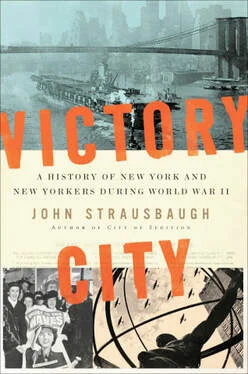
John Strausbaugh's Victory City: A History of New York and New Yorkers During World War II
Reviewed by Steven H. Jaffe
In recent years writers and historians have turned their attention to New York City’s experience in World War II. Contributions to the field have included Lorraine B. Diehl’s Over Here! New York City During World War II (2010), Richard Goldstein’s Helluva Town: The Story of New York City During World War II (2010), my own New York at War: Four Centuries of Combat, Fear, and Intrigue in Gotham (2012), and Kenneth T. Jackson’s WWII & NYC(2012), the latter accompanying an exhibition of the same name at the New-York Historical Society. Other scholars have tackled specific aspects of the story, including the crucial military role of the city’s port (over 3 million GIs and 63 million tons of materiel departed from the harbor’s piers to the North African and European fronts), and the volatile political, ethnic, religious, and economic tensions that vexed relations between New York’s Jewish, German, Irish, Italian, and African-American communities before and during the war.
Read MoreThe Defiant: An Interview with Dawson Barrett
By Nick Juravich
Today, I’m talking to Dawson Barrett about his new book, The Defiant: Protest Movements in Post-Liberal America, out now from New York University Press. The book has been getting some excellent coverage in the academic blogosphere recently; you can read an excerpt from the prologue over at Tropics of Meta, and a thoughtful interview that Dawson did with fellow UW-Milwaukee alum Joe Walzer for Labor Online. These two pieces, read together, are a great introduction to stakes, ideas, and arguments in The Defiant. Rather than recap them here at Gotham, we recommend checking them out.
Read More