
Policing the Future in interwar New York City
By Dalen Wakeley-Smith
As Europe erupted in war in 1914, a very different battle was fought on the streets of New York City. Fortune tellers, dreaded soothsayers who supposedly conned thousands of New Yorkers out of their money, had overrun the city. Such anxieties had even led to the state law against “those pretending to tell the future” by 1900.
But such laws did not contain the anxiety over the identity of the fortune tellers. Worst amongst them were the “Gypsy fortune tellers,” Romani women whom other Americans believed had a primordial connection to the occult which gave them special powers of duplicity. In fact, New Yorkers were convinced that the problem of the “Gypsy fortune teller” had become so bad that the New York Police Department (NYPD) was forced to develop a new strategy to deal with the them. The crackdown on telling the future would come to include the use of discretionary policing, enlisting women into law enforcement roles, and punitive measures doled out by magistrate courts. Ironically, through this campaign against predicting the future, the NYPD would itself become a modern police force.
Progressive-era authorities regarded fortune telling as a kind of fraud. New York law classified fortune tellers as “disorderly persons” by the late 19th century. Even though fortune telling was illegal, the allure of securing an authentic purveyor of magical knowledge swayed many would-be customers to seek out their Romani neighbors. Romani people, often classified as “Gypsies”, are a diverse ethnic community hailing from across Europe whose ancestors entered the United States throughout the nineteenth century. Cast as timeless wanderers, child thieves, and magical con artists by Europeans, anti-Romani racism and state sanctioned acts of violence was the norm in Europe for most of the modern period. By the close of the 19th century, New York City was home to thousands of Romani people who had left Europe and other locales seeking stability. Still, economic opportunities were often limited; alternatively characterized as “careless wanderers” and racially “undesirables,” Romani communities often found it difficult to make ends meet. [1]
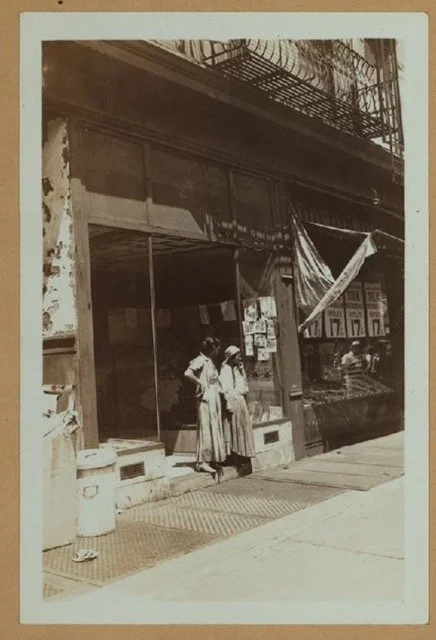
“Street scenes — Gypsy Fortune Tellers — [Queens],” circa 1934, Irma and Paul Milstein Division of United States History, Local History and Genealogy, The New York Public Library. https://digitalcollections.nypl.org/items/779e9a30-c562-012f-1e40-58d385a7bc34
Yet by the 1910s, Romani women had learned that their association with mysticism could be exploited for gainful employment. Romani women in New York realized that exaggerated clothing and jewelry was enough to mark them as “Gypsies”; simply spending time in public view garnered attention. While some of these women advertised their future sight from front stoops or street-front parlors, others were more clandestine. Aware of the illegality of fortune telling, some women rented several locations throughout the city and filled them with secondhand spiritual items such as books, charts, and other items in an attempt to hide their main source of income.
It did not take long before the NYPD came to profile American Romani women as the only true fortune tellers. The man who would lead the NYPD against them was police commissioner Arthur Woods. In 1914, Woods organized a special squad to surveil and arrest fortune tellers caught plying their trade. At first, Woods’s task force was largely successful. Police officers swept across city streets, stoops, and stairwells, arresting people who offered to reveal the future for a price.
Woods’s strategy seemed to be working to put an end to such schemes. Moreover, the anti-fortune telling unit played a major role in supplementing the department’s finances with fortune tellers’ forfeited bail bonds. In 1915, Woods proudly reported that “the amount of $6,100 in bonds {…} was forfeited and collected, demonstrating the close attention being given these offenders {fortune tellers}, who inflict a great amount of misery upon their dupes, rob them of their money and in some cases of their minds.” [2]
But the task force was soon overburdened. As the war in Europe expanded, police units were assigned to guard docks and other sensitive infrastructure fearing German sabotage. When America joined the war in 1917 and military enlistments increased, the manpower of the NYPD was further reduced. That year, the number of fortune tellers arrested in the city dropped to a mere seventy-five. [3] In 1917, Woods sought to reinforce his anti-fortune telling task force with another new innovation: policewomen.
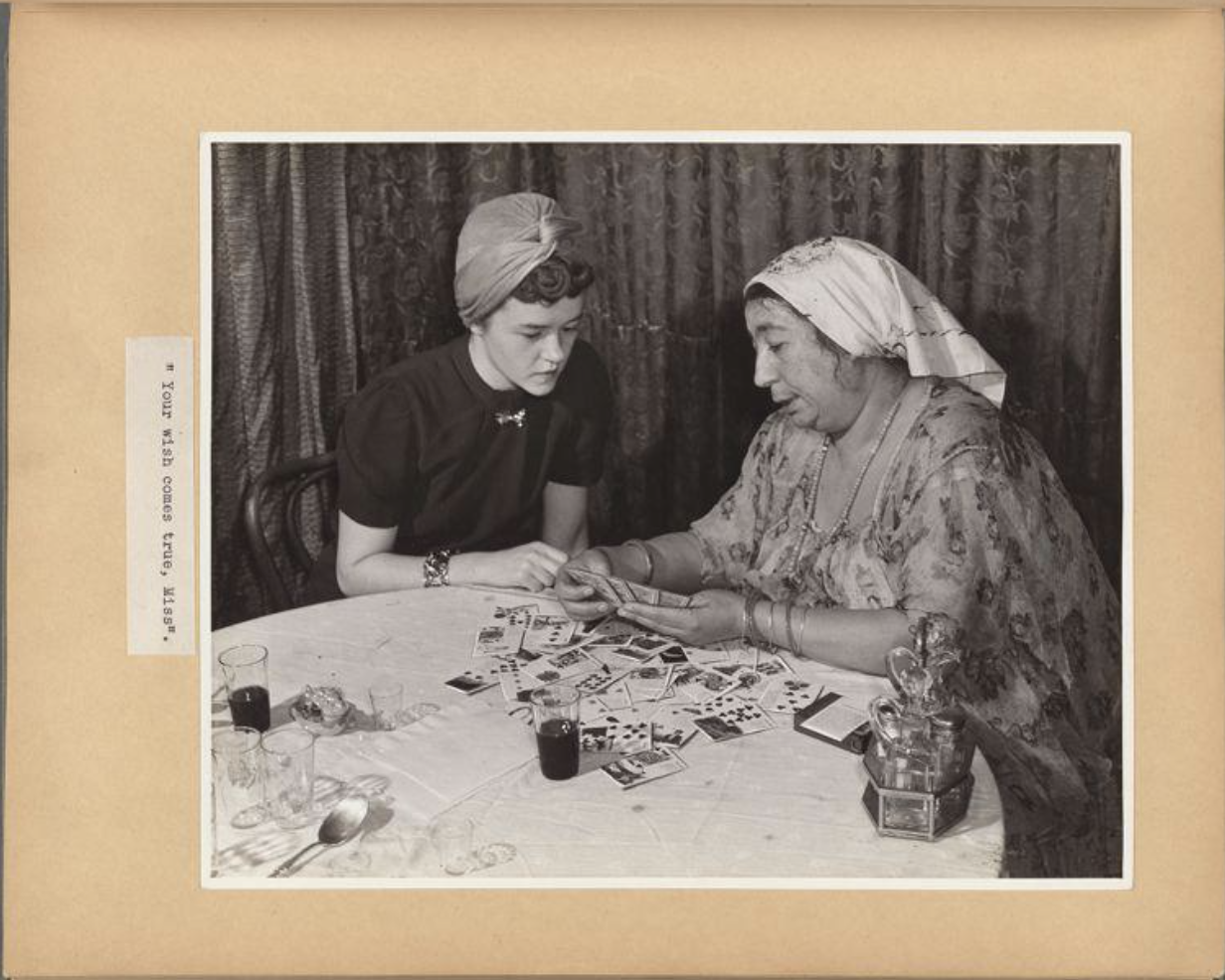
“Your wish comes true, miss,” American Romani fortune teller and client circa 1938, The Miriam and Ira D. Wallach Division of Art, Prints and Photographs: Photography Collection, The New York Public Library. https://digitalcollections.nypl.org/items/b4c25ca0-d94b-0135-7cdb-047c3803af55
Newly elected Mayor John Hylan took Woods’s effort one step further. Hylan created the position of Fifth Deputy Police Commissioner and appointed the head of the Welfare Bureau Ellen O’Grady to the role. [4] Previously, policewomen under the Welfare Bureau were tasked with investigating “conditions relating to white slavery, crime and offenses affecting women and girls, social welfare, and protection of juveniles.” [5] In this fashion, newly minted policewomen acted more like social workers than as agents of law enforcement like their male counterparts.
Woods’s recruitment of women and Hylan’s reorganization of their units to combat fortune telling broadened the scope of the policewoman’s role in the NYPD. Still charged with focusing on juvenile and women offenders, now New York’s policewomen were expected to police fortune tellers as well. By 1925 New Yorker’s policewomen, now stationed throughout the city, were tasked with explicitly seeking out “Gypsy fortune tellers.”
But how did policewomen identify and arrest “Gypsy fortune tellers”?
An intriguing example comes from November 2nd, 1927, when Mary Adams and Lina Nicholas were charged with fortune telling and sentenced to serve five days in the correctional house by Magistrate Judge Glatzmayer. [6] Both Adams and Nicholas were caught by policewomen Mary Sullivan when they individually told her fortunes as she went about her duties as an undercover customer. Sullivan was told first by Adams that she would have five years of bad luck, and her husband was being deceitful (Sullivan was a widow) before handing over $1. For $10 more, Adams declared that Sullivan’s fortunes would change for the better, but Sullivan arrested her immediately after her new pronouncement. Later that day, Sullivan posed as a fortune seeker for Lina Nicholas whereby she produced $2 and was told that she would remarry. Evidently, the good news meant little to Sullivan, as she promptly arrested Nicholas. [7]
Policewomen like Sullivan could be quite efficient. (Sullivan herself rose through the ranks as one of the most steadfast supporters of policing “Gypsy fortune tellers”). Over the next several years the number of fortune tellers arrested increased to a high of 181 in 1928. [8] In 1929, the Penal Code was amended to include the provision under code 899 subsection 3 defining a fortune teller as “persons pretending to tell fortunes, or where lost or stolen goods may be found; but this subdivision shall not be construed to interfere with the belief, practices, or usages of an incorporated ecclesiastical governing body or duly licensed teachers or ministers thereof acting in good faith and without personal fee.” [9] With the amendment, the NYPD ensured that Romani fortune tellers who charged a fee would be prosecuted under the subdivision.
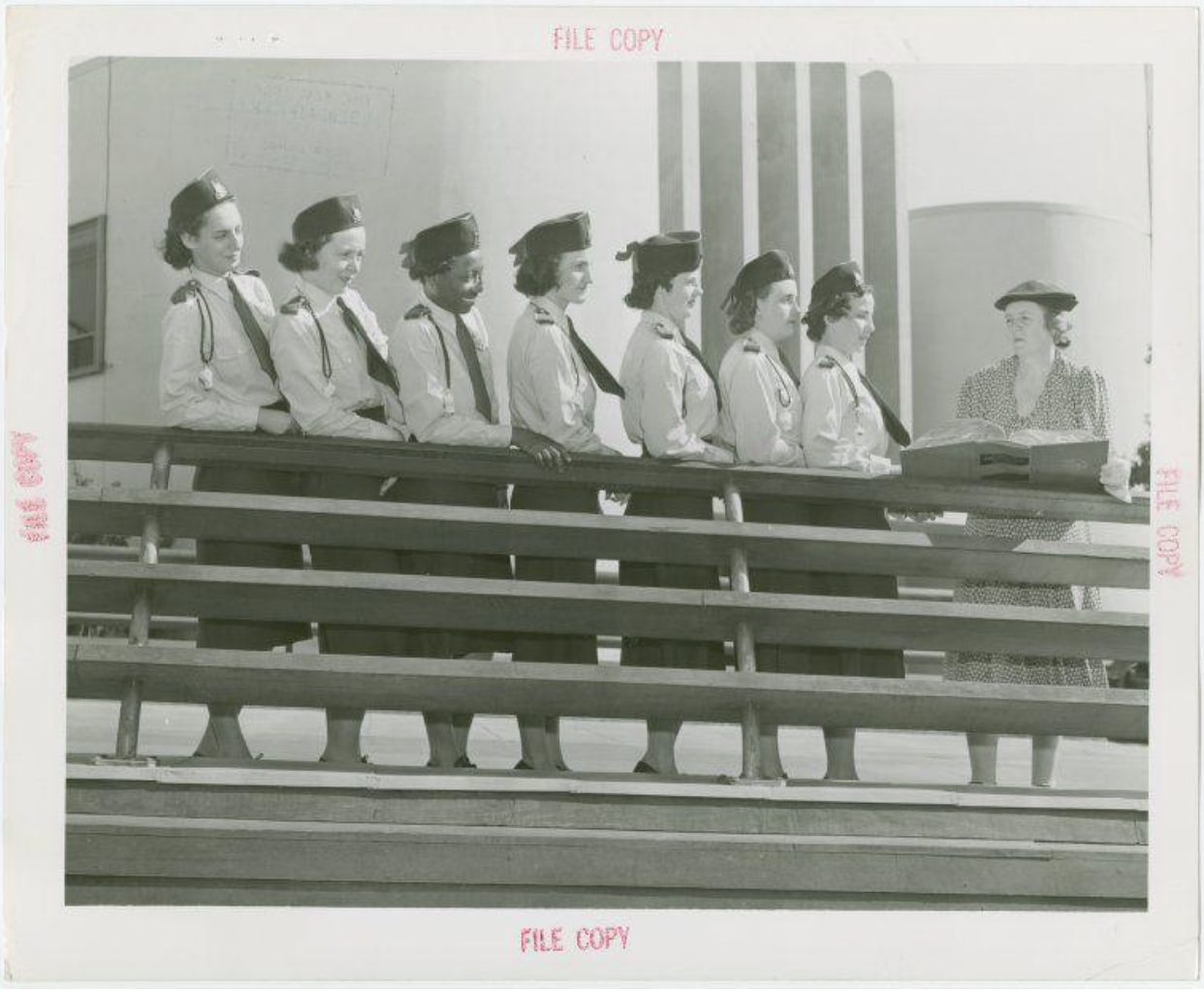
Henrietta Addition and Policewomen at the World’s Fair, circa 1939. Manuscripts and Archives Division, The New York Public Library. "New York World's Fair - Employees - Police - Henrietta Additon and Policewomen," https://digitalcollections.nypl.org/items/f6de7a90-c548-012f-e92f-58d385a7bc34.
By 1931 the NYPD policewomen had their hands full with fortune tellers. Scores of American Romani women were arrested and arraigned before the magistrate courts throughout the city. A New York Times article from 1931 entitled, “Forecasters of the Future who Flourish in New York,” makes it clear that section 899 of the penal code did not have widespread effect but instead “the only fortune-telling interpreted to be contrary to law is palmistry and phrenology, practically a monopoly in the hands of the gypsies.” [10] The Times reporter, Rebecca Hourwich, stated that, “lowest on the scale of the fortune tellers are the gypsies. Pending the results of a city-wide investigation of all manner of fortune tellers, the police appear to be most active in their raids on them.” [11] Hourwich stated she was referred to “Mrs. Mary Sullivan, head of the policewomen, because ‘it’s something for the policewomen to handle — almost all customers, and fortune tellers being women.”
The conflict between the NYPD and American Romani only escalated in the early 1930s. The Crime Prevention Bureau under Henrietta Addition campaigned to rid the city of “Gypsy fortune tellers” once and for all. Even the infamous 1931 Seabury investigations, which led to the downfall of Mayor Walker and many high-ranking judicial appointees, involved cases of fortune tellers being wrongfully accused of low-level crimes and being charged spurious amounts of money in potential bribes. The key magistrate court judge accused of corruption Albert Vitale was himself first accused of misconduct in 1930 involving a case of a Romani fortune teller which led to the 1931 Seabury investigations. [13] Even as corruption scandals rocked the mayor’s office and magistrate courts, the NYPD continued to focus on catching fortune tellers. According to the NYPD annual report for 1931, 255 people were arrested as fortune tellers, more than a 150% increase from the previous two years. [14]
As the depression continued to ravage New York City American Romani fortune tellers were utilized as a scapegoat for long simmering social ills. Represented as disorderly women who conned respectable Americans out of their money, the NYPD’s policewomen continued to track, surveil, and arrest them at a much higher rate than in the 1910s and 1920s. The campaign against the future tellers continued into the La Guardia era but reached its peak during the interwar years as the NYPD utilized discretionary policing, special task forces, corrupt magistrate courts, and policewomen as disciplinarians fighting the future. The policing of American Romani women throughout the interwar years highlights the entangled history of little known American anti-Roma discrimination and the emergence of a police force empowered to track, surveil, and arrest American citizens based on upon scant evidence with limited oversight. Such innovations allowed the NYPD to expand their discretionary policing power over many other communities of color with limited pushback and lead to the rise in police violence and social tensions which we still grapple with today. Likewise, American Roma are still overly policed, discriminated against in housing, education, and the workforce, and often feel like second class citizens as was highlighted in the recent Harvard University research which showed over 58% of Romani respondents were racially profiled by police. [15]
Dr. Dalen Wakeley-Smith is an assistant professor of history at Washington University in Saint Louis and the author of the forthcoming book Gypsy Madness: American Roma & New York City from the University of Illinois Press.
[1] Dalen C. B. Wakeley-Smith, “‘The One Primitive People Who Contact with Civilization Has Failed to Exterminate’: New York and ‘Gypsy’ Madness in the 1920s,” Journal of American Ethnic History 43, no. 1 (2023): 40–72.
[2] Police Department City of New York, “Annual Report,” Annual Report for the Years 1913-1916 (New York), 198, https://catalog.hathitrust.org/Record/011159781.
[3] Police Department City of New York, “Annual Report,” Statistical Report (New York, N.Y.), 1918, 65, https://catalog.hathitrust.org/Record/008686695.
[4] Police Department City of New York, “Annual Report,” 1918, 42; Dorothy Moses Schulz, “A Precinct of Their Own: The New York City Women’s Precinct, 1921–1923,” New York History (Cooperstown) 85, no. 1 (2004): 41.
[5] Police Department City of New York, “Annual Report,” Statistical Report (New York, N.Y.), 1919, 159, https://catalog.hathitrust.org/Record/008686695.
[6] “Two Fortune Tellers Fined: Gypsy Told Widowed Policewoman Husband Was Deceitful,” New York Herald Tribune (1926-1962) (New York, N.Y.), November 3, 1927.
[7] New York Herald Tribune (1926-1962), “Two Fortune Tellers Fined.”
[8] Police Department City of New York, Annual Report, (New York.), 1929, Municipal Archive of New York City.
[9] New York, The Penal Law of the State of New York Providing for the Punishment of Crime: Chapter 40 of the Consolidated Laws Passed in 1909, with 1929 Amendments (Eagle Library Publications, 1929), 381.
[10] Rebecca Hourwich, “Forecasters of the Future Who Flourish in New York: In Spite of Police Opposition, Fortune-Telling by the Stars, by Numerology or by Palm-Reading Is a Thriving Business How the Law Is Evaded. Fees of Astrologers. The Horoscope Chart. Victims of Thievery. Work of the ‘Mediums.,’” Special Features, New York Times (New York, N.Y., United States), 1931.
[11] Hourwich, “Forecasters of the Future Who Flourish in New York.”
[12] “Gypsies Haled to Court: Two Held in Miss Additon’s Drive to End Fortune Telling.,” New York Times (New York, N.Y., United States), 1931.
[13] “Missing Records Back in Vitale Case: Papers Naming Fortune Teller Mysteriously Returned to Morrisania Court. They Clear Magistrate1 Show That No Charge of Petit Larceny Was Made Against Accused Woman.,” New York Times (New York, N.Y., United States), 1930; “McAdoo Assails Vitale Failure To Hold Gypsy: Says Magistrate Knew She Admitted. ‘Swindle,’ but Had Police Alter Charge Sends Facts to Bar Inquiry Cites Arresting Officer in Case for Action by Whalen,” New York Herald Tribune (1926-1962) (New York, N.Y., France), January 12, 1930; “Bar Examines Vitale 3 Hours; Mc Adoo Seeks Lost Records: Magistrate Heard Secretly on Whalen’s Charge of Unethical Conduct: New Inquiry Is Begun Two Theft Cases He Dismissed Reopened Arrest of Rothstein Friend Is Ordered; Court Notes on Gypsy Sought; Hearing Resumes on Monday,” New York Herald Tribune (1926-1962) (New York, N.Y., France), January 9, 1930; Absolves Vitale of Visit to Gunman: Whalen Asserts Inquiry Shows Magistrate Did Not Meet Diamond at Night Club. Bar to Get Gypsy Case: McAdoo Forwards Papers, Saying Vitale Knew Woman Was Swindler and That He Did Not Clear Him. Misinterpreted, He Says. Criticizes the Examination., (New York, N.Y., United States), 1930.
[14] Police Department City of New York, Annual Report, (New York.), 1932, 136–74, Municipal Archive of New York City.
[15] Margareta Matache et al., FXB Center for Health and Human Rights: Romani Realities in the United States: Breaking the Silence, Challenging the Stereotypes A Study from the François-Xavier Bagnoud Center for Health and Human Rights at Harvard University and Voice of Roma, November 2020, 74.