Remembering Michael Sorkin
A tribute to the giant architectural critic, taken on Thursday by COVID-19.
Read More
A tribute to the giant architectural critic, taken on Thursday by COVID-19.
Read MoreBy Nick Juravich
I started with the Harlem Education History Project (HEHP) in the fall of 2013 as a newly minted doctoral candidate. Fresh from my exams and starting my dissertation research, I had the unique opportunity to participate in both sides of the emerging project, which today appear on the home page as the book and the digital collection. Despite the embryonic nature of my own project, co-directors Ansley T. Erickson and Ernest Morrell invited me to contribute to the inaugural scholarly workshop that served as their first step toward the edited volume. That same fall, I signed up to audit “Digital Harlem Research Collaborative” (DHRC), Erickson’s first HEHP course, a deep, yearlong dive into the worlds of digital, public, and Harlem history.
By Marta Gutman
Faced with intransigent bureaucracy, struggling schools, deteriorating buildings, and entrenched racial segregation, parents in Harlem demanded direct control over the core functions of public education in the 1950s and 1960s. One new building became a flashpoint in the battle for community control—Intermediate School (IS) 201, the infamous windowless school that abuts the Park Avenue railroad viaduct two blocks north of East 125th Street, straddling Central Harlem and East Harlem. White architects and politicians, including the mayor, John Lindsay, rallied to defend “Harlem’s besieged masterpiece,” but parents in Harlem disagreed.[1] The location and the architecture, which many of them opposed, stood as a constant reminder of their unmet demands, from exclusion in policy making to broken promises of integration.
Read MoreBy Jonna Perrillo
Chapter 5 of Educating Harlem examines Langston Hughes’s production of the often-overlooked The First Book of Negroes as a vantage point into how the author transformed ideas, images, and business practices that he developed as a young Harlem Renaissance writer to educate children during the Cold War. Moreover, thinking about the book’s readership provides a view into the politics of the books Harlem and New York City children otherwise were reading in 1950s classrooms. Hughes’s political critiques in The First Book of Negroes dated to some of his most seminal works as a writer in the Harlem Renaissance. Throughout his life and career, Hughes remained committed to the same questions that thrived at the heart of the Renaissance, including: What constitutes black culture and art? What are the responsibilities of the black artist to himself and his or her community? Can cultivating a black readership serve as a pathway to community advancement? And what is the role of a black aesthetic—and the black diaspora—within a larger U.S. culture? Now, he translated these questions into a genre for the people he saw as the most vulnerable and most in need of nuanced and humane accounts of black experience and accomplishment: children.
Read MoreInterviewed by Dominique Jean-Louis
This week on Gotham we hear from the Harlem Education History Project (HEHP), a multi-platform program at Columbia University that includes a digital collection, exhibits, and the recently published Educating Harlem: A Century of Schooling and Resistance in a Black Community, as well as many other resources for teaching the history of education. Today, Dominique Jean-Louis interviews the Project’s co-director, Ansley T. Erickson, co-editor of the book.
Read MoreBy Vaughn Scribner
The Tavern on the Green restaurant is an icon of New York City. Nestled in the seemingly-rustic, yet carefully-planned confines of Central Park, the building began life in 1870 as a shelter for the park’s grazing sheep.[1] In 1934, park officials transformed the building into a restaurant. Since then, various families bought into the business, and made renovations like a dance floor, glass-enclosed Crystal Room, and a new patio.[2] Beyond offering a diverse array of cocktails, main courses, and appetizers, however, much of the restaurant’s enduring popularity owes itself to setting: the Tavern on the Green is a carefully-crafted combination of urban and rural life; a “hybrid” space where customers feel like they’re escaping the gray, crowded confines of the city, but still have access to the entertainment and sociability for which New York City is famed.[3] But the Tavern on the Green does not just represent fantasy, or a New York that “never was.” On the contrary, the Tavern on the Green harkens back to the second half of the eighteenth-century, when New York City’s residents fostered an urban culture predicated upon a thriving network of taverns and green spaces which offered residents the hospitalities of city life within a bucolic, relaxing, and intentionally-constructed “natural” environment.
Read MoreBy Anna Duensing
In July 1963, the New York branch of the Congress of Racial Equality (CORE) organized demonstrations in the Bronx to protest hiring discrimination at White Castle hamburger stands. An “undercurrent of racism” existed throughout the North, stressed James Farmer, National Director of CORE.
Read MoreReviewed by Emily Brooks
Black and Hispanic or Latino youth are dramatically overrepresented in the city’s detention facilities. In addition to their overrepresentation in youth detention, black teens are also far more likely than whites to experience police brutality or harassment. Some of the widely-publicized examples include, mostly recently, a horde of NYPD drawing their guns and violently arresting an unarmed black teen on a crowded subway car, and officers filmed punching black teenagers in the face while supposedly breaking up a fight. From cell phone footage and Facebook posts to records produced by youth detention facilities and scholarly research in various disciplines, a substantial body of material attests to the over-criminalization and under-protection of youth of color, particularly black youth, in contemporary NYC. For anyone looking to understand the historical roots of our contemporary regime of racialized youth criminalization, Carl Suddler’s Presumed Criminal: Black Youth and the Justice System in Postwar New York will be essential reading.
Read MoreBy Bruce Twickler
In October of 1783, just six weeks before the British evacuated New York, the Commander-in Chief-of the British forces, Sir Guy Carleton, commissioned a panel of three British officers to investigate the disastrous fire that devastated the city seven years earlier. Shortly after midnight on September 21, 1776, fire had erupted in lower Manhattan. By daybreak it had consumed five hundred buildings – including schools, churches, warehouses and homes – and caused more destruction than all the previous colonial fires in New York combined.
Read MoreBy Sarah Miller-Davenport
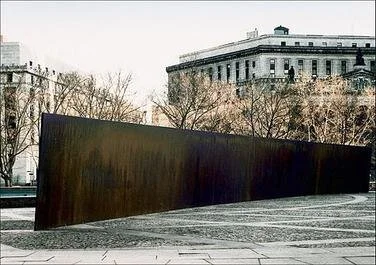
When Richard Serra’s Tilted Arc was installed in Federal Plaza in Lower Manhattan’s Foley Square in 1981, it was meant to be a pioneering work of public art that would expose New York’s masses to post-minimalist sculpture. Tilted Arc would indeed become one of the most legendary sculptures in 20th century history—but not for its artistic merit.
Read More