

The Gateway to the Nation: The New York Custom House
By Alexander Wood
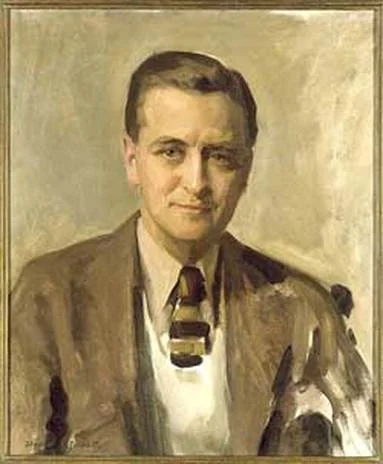
The reign of Beaux-Arts architecture reshaped the landscape of the city at the turn of the century with grand public buildings that projected a new found sense of national power. The architects who embraced this style emphasized classicism, monumentality, and embellishment in their work, and were skilled at adapting historical precedents for modern building types. Following this mission to create civic symbols, Cass Gilbert conceived the custom house as a gateway to the nation. From its triumphal arched entry, and honorific statuary, to the heraldic imagery on its facade, it was expressly designed to evoke a passageway into a walled city. The allusion to a gate reflected a desire to proclaim the identity of the nation to the world, but it also suggested a point of controlled access through a border. It thus offered a suggestive precedent for the headquarters of the most important district of the federal customs service, which served as the guardian of the nation’s chief port of entry.
Read More
The Medium and the Message: Sara Blair's How the Other Half Looks
Reviewed by Aaron Shkuda
Visitors to Seward Park on Manhattan’s Lower East Side from July 2018 through July 2019 can view “Mom-and-Pops of the L.E.S.,” a project by the photographers James and Karla Murray. The installation is a trompe l'oeil storefront, a cube containing four large-format prints of the couple’s photographs of the vanishing businesses of the Lower East Side. These include a delicatessen modeled on the façade of the still-extant Katz’s, but meant to stand in for any of the shuttered Jewish delis across the city. This project, with its mix of Lower East Side iconography, nostalgia for a lost immigrant New York, and the complicated, multiply-mediated encounters it inspires, is an appropriate companion to Sara Blair’s powerful and compelling new book, How the Other Half Looks: The Lower East Side and the Afterlives of Images.
Read More
“People of the City”: Children in the City
By Robert A. Slayton
The Ashcan artists viewed the people of the city from a unique perspective. Unlike the elites, they did not consider these individuals their biological inferiors. Yet they also differed from the reformers, in that they rejected the notion that the people who lived in dense city neighborhoods were inherently subjects of pity. Instead, Henri, Sloan, Myers, and the others painted children and women and men, each from these individuals' own, unique perspective, rather than imposing a worldview on them. By so doing, in their paintings and drawings, they gave working-class individuals agency, showing how these people adapted to the world around them in a myriad of ways, ways that often enabled them to attain a measure of control over some parts of their lives.
Copyright © 2017 SUNY Press. Excerpted from Beauty in the City: The Ashcan School with the author's permission. All rights reserved.
Read More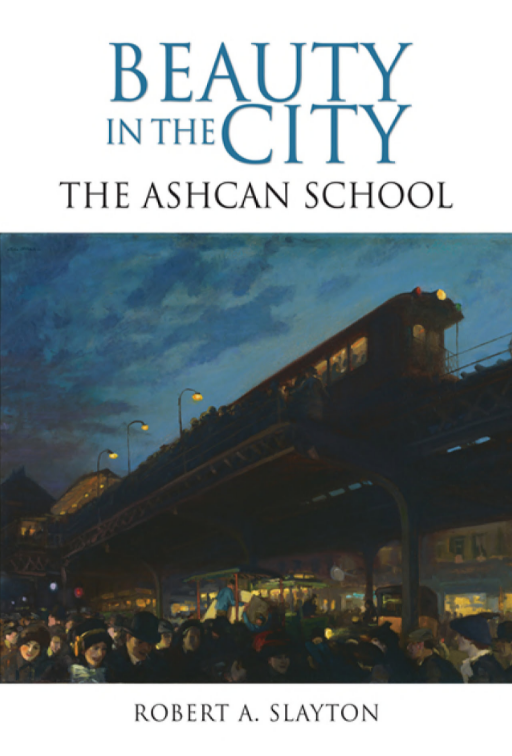
"Vision From An Ashcan": A Radical Exploration of New Subjects
By Robert A. Slayton
The Ashcan school represented a challenge to its era. In a fundamental reinterpretation of art’s appropriate subject matter, it threw down a gauntlet, of canvas and paint, to the art world both of the right and of the left. It did not see the city through the narrow peephole of the elites, instead introducing new landscapes, new characters. But these perspectives were also different from what the reformers saw. This new approach painted the rest of the city, with beauty, endowing urban and working-class individuals of all ages and genders with agency and will. In so doing, the Ashcan artists created one of the great American art forms.
Copyright © 2017 SUNY Press. Excerpted from Beauty in the City: The Ashcan School with the author's permission. All rights reserved.
Read More
"Out of ashes comes beauty": An interview with Jeffrey C. Stewart
Today on Gotham, Peter-Christian Aigner speaks with Jeffrey C. Stewart about his new book, The New Negro: The Life of Alain Locke, the most comprehensive biography on the "father of the Harlem Renaissance."
Read More
Women after Suffrage: An Interview with Elisabeth Israels Perry
Today on the blog, editor Katie Uva sits down with Elisabeth Israels Perry to talk about her research process and her insights as she prepares her new book, After the Vote: Feminist Politics in La Guardia's New York (Oxford University Press, forthcoming 2019).
Read More
Amy Werbel's Lust on Trial: Censorship and the Rise of American Obscenity in the Age of Anthony Comstock
Reviewed by Marcela Micucci
Anthony Comstock was a household name in nineteenth-century America, so much so that his last name became synonymous with a movement and set of laws that sought to censor obscenity and eradicate vice. Historian Amy Werbel explores this anti-obscenity movement — and its champion — in her provocative and cutting-edge work, Lust on Trial: Censorship and the Rise of American Obscenity in the Age of Anthony Comstock (2018).
Read More
"To harness the forces of nature to the service of mankind”: An interview with Richard Munson
Today on Gotham, Peter-Christian Aigner speaks with Richard Munson, director of the Environmental Defense Fund’s clean-energy efforts in the Midwest and the author of several books, about his new work, Tesla: Inventor of the Modern.
Read More
Where Suffrage Took Flight: Staten Island and the Woman Suffrage Movement
By Gabriella Leone
On May 20, 1913, nationally renowned suffragist, Rosalie Gardiner Jones, made a spectacular debut in Staten Island, where she became the first suffrage activist to fly for the cause. To achieve this feat, she met her pilot Harry Bingham Brown, one of Staten Island’s resident pilots, at the Grant City train station and boarded his plane. The New York Times reported, “Gen. Rosalie did not show a sign of fear as she took her seat in the biplane, seized a steel rod, the only thing to hold to, with her left hand, had her skirts tied down with a little piece of blue string, and, with a bunch of leaflets in her right hand, nodded a smiling good-bye to the crowd below.” Decorated with 'Votes for Women' banners, the plane arrived at its destination, roughly two miles away on the island’s eastern shore, in fifteen minutes. It landed at the Flying Carnival of the Staten Island Aeronautical Society in a flurry of yellow leaflets, which Jones had been scattering along the way.
Read More