Tell Her Story: An Interview with LaShawn Harris
Interviewed By Emily Brooks
LaShawn Harris’s Tell Her Story: Eleanor Bumpurs & The Police Killing that Galvanized New York City explores the life and killing of Eleanor Bumpurs, a Black mother and grandmother who was killed by a white police officer while being evicted from her Bronx apartment in 1984. Harris recovers Eleanor’s “full personhood, (xii)” placing the attack on the grandmother within her own larger story of life, family, and community. Tell Her Story also considers “what histories of New York City did Eleanor’s killing expose, and what did this American crime story reveal about 1980s urban life and society? (xii)” In the following interview Harris answers questions about the book and her research from historian Emily Brooks.
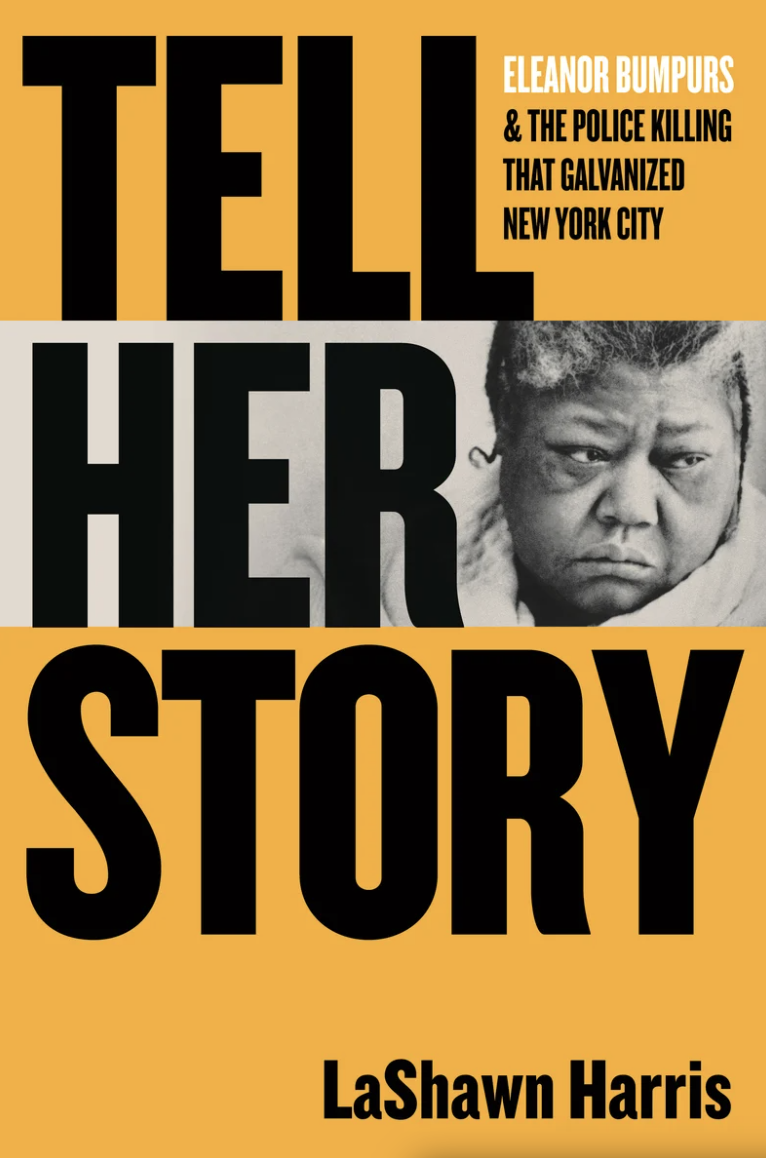
Tell Her Story: Eleanor Bumpurs & The Police Killing That Galvanized New York City
By LaShawn Harris
Beacon Press
August 2025, 352 pp.
EB: My first question is about the organization of the book and the sources. It reads like a biography that moves through Eleanor’s life and then the circumstances of her death and the activism and court cases that followed. I found this organization very effective in two significant ways. Firstly, you do such a thoughtful job of humanizing Eleanor and presenting her as a person who was embedded in her family and community and who lived a full life, even though much of what the public knew about Eleanor centered on her death. I think your organization also allows your readers to fully grasp the accretion of indignities and violence that Eleanor and her family endured from various public agencies who failed them many times even before her killing. I imagine that it is quite challenging to write a biography of someone who is not famous because of the limitations of the sources, but I think your book shows us how incredibly valuable it can be. Can you tell us a bit about if it was always your plan to organize the book in this way and what challenges you encountered in trying to recover Eleanor’s life and story?
LH: When I started the research for this project, I intended on writing this story in three parts. The first part focuses on Eleanor's less familiar life prior to her killing on October 29, 1984. The second part centers on the social and legal justice campaign launched on her behalf; a citywide campaign that represented an early iteration of what legal scholar Kimberle Crenshaw and the African American Policy Forum would call the #SayHerName campaign in 2014. And the last part of the book surveys the legal journey toward holding the NYPD accountable for Eleanor’s death. The organization of the book is inspired by the writings and films of contemporary journalists, political activists, filmmakers, and family members that lost loved ones to police and civilian violence. Some of these texts include Brenda Stevenson’s 2013 book, The Contested Murder of Latasha Harlins: Justice, Gender, and The Origins of the LA Riots, Ryan Coogler’s 2013 film, Fruitvale Station, Sybrina Fulton and Tracy Martin’s 2017 book, Rest in Power: The Enduring Life of Trayvon Martin, journalist Matt Tabbi’s 2017 book, I Can’t Breathe: A Killing on Bay Street, and Robert Samuels and Toluse Olorunnipa’s 2022 book, His Name is George Floyd: One’s Life and The Struggle for Racial Justice. These works offer audiences windows into the unfamiliar lives of Latasha Harlins, Oscar Grant, Trayvon Martin, Eric Garner, and George Floyd. They humanize victims and survivors. And they refute police, fraternal unions, elected officials, and ordinary citizens’ scathing narratives about victims of police and state violence.
The major challenge was conducting oral interviews. Oral history became valuable for unearthing episodes from Eleanor’s life. Between 2017 and 2023, I had the opportunity of interviewing several former New York officials, journalists, political activists, cultural producers, Sedgwick Houses tenants, a former Bronx Supreme Court assistant prosecutor, and Eleanor’s second oldest daughter. Mary Bumpurs was the only Bumpurs family member interviewed for this book. Other family members were not interested in talking to me. They elected privacy over disseminating stories about Eleanor and themselves and their feelings about losing their kin to police violence. Embracing an ethos of care toward Eleanor and her family, I respected the Bumpurs family’s feelings and privacy, refusing to inundate them with interview requests and valuing the confidentiality often denied to historically targeted and surveilled populations. Not having the opportunity to interview some of Eleanor’s relatives was disappointing. No doubt, their memories would have presented nuanced perspectives on how different Bumpurs family members coped with police violence and public attacks.
EB: You engage with such a wide variety of sources to creatively recover and sometimes imagine parts of Eleanor’s experiences. Did you have any favorite unexpected sources that helped you in the research process?
LH: My favorite source was Mary Bumpurs. Mary was generous with her time, granting me numerous phone and in-person conversations. Her memories about family love and loss and her participation in citywide protests for her mother were critical to my research and writing process. Mary was the first family member to learn about her mother’s killing; she became the media spokesperson for her family; and she led a social justice movement for her mother. Mary shared with me stories about her mother that did not figure into 1980s interviews with journalists and those narratives not housed in archival collections. Her memories about her family’s history filled in many historical gaps, contextualized my archival materials, and provided a fuller yet curated picture of her mother.
EB: I was very struck by your personal connection to the story and by your discussion of the particular ways that police violence and anti-blackness can impact children and their experience of urban life. What were some of the ways that youth sought to respond to the attack?
LH: Children have long been witnesses to and victims of police brutality. Their minds and bodies bore the memories and scars of, as James Baldwin put it, “the thunder and fire of the billy club, the paralyzing shock of spittle in the face,” and “what it is to find oneself blinded, on one’s hands and knees, at the bottom of the flight of steps down which one has just been hurled.”
As many historians have already documented, children were vital to the struggle against police and state violence. And in 1984, New York City children and teenagers continued in this tradition, participating in citywide protests against the killing of Eleanor Bumpurs. Like New York cultural artists, political activists, and politicians like Spike Lee, Black United Front founder Herbert Daughtry, and David Dinkins, Bronx children marched on city streets; they wore on their clothes “Justice for Eleanor Bumpurs” buttons; and they created poems and films for Eleanor.
A few days after Eleanor’s killing, the Bronx Media Collective, consisting of ten to twelve students from the South Bronx’s Regional High School, veteran teacher and journalist Dennis Bernstein, and writer-filmmaker Chela “Connie” Blitt, wrote, directed, and filmed “Eleanor Bumpurs: 12-Gauge Eviction.” Under one hour long, the well-researched film is one of a few investigative and student produced documentaries on the Bumpurs killing. Personal and geographical connections to the University Heights area inspired students to cover one of the Bronx’s worst cases of police brutality. Some students resided in Sedgwick Houses. Some had occasionally spotted Eleanor in the neighborhood. And some students had the unfortunate experience of witnessing the commotion that Eleanor’s shooting caused in the neighborhood.
Featuring a creative blend of 1980s Hip-Hop music, cartoon drawings, role playing and narration, and poems and speeches from Bronx activists and prominent Black Power activists such as Malcolm X, the film puts a human face on community suffering and rage. On Bronx streets, in bodegas, at neighborhood meetings and protest rallies, students, equipped with cameras, microphones, and writing materials, spent countless hours interviewing public housing tenants, Eleanor’s relatives and friends, and local store merchants, religious and political leaders. A creative work about collective pain and outrage, “Eleanor Bumpurs: 12-Gauge Eviction” garnered much media attention. Student filmmakers were featured guests on radio broadcast programs such as the liberal leaning WBAI and profiled in New York’s popular Newsday publication. “Eleanor Bumpurs: 12-Gauge Eviction” even premiered at several 1980s and 1990s New York City film festivals including Harlem Week’s film festival.
EB: In recovering Eleanor’s experience, you show us how her killing can be traced to negligence, underfunding, racism, and violence at multiple city agencies including NYCHA, HRA, Department of Mental Health, Mental Retardation and Alcoholism Services, and the NYPD. Although all of these agencies played a role, it was ultimately the NYPD officer who shot Eleanor. In the aftermath of her killing, however, we see that Mayor Koch and other city officials back officer Stephen Sullivan and that it is the social workers at HRA who end up facing public penalties. These internal conflicts between different branches of city power were really interesting to me. How do you see the power of the NYPD playing out in this story in terms of city politics?
LH: The Bumpurs case clearly shows how elected officials sanctioned the NYPD’s power and authority. This is evidenced in the city’s official report on the Bumpurs case, which was released in November1984. Compiled by Mayor Edward Koch’s aide Victor Botnick, the report, entitled “The Eleanor Bumpurs Case,” covered the actions of the city agencies involved in Eleanor’s eviction. Botnick concluded that the deadly eviction was a “byproduct of a series of mistakes, lapses, and failure in communication, and other circumstances that combined unpredictably to precipitate the tragedy.” The Koch administration blamed the Human Resources Administration and the Bumpurs family for Eleanor’s eviction and death.
The Koch administration absolved the NYPD of any wrongdoing and backed officer Stephen Sullivan’s decision to shoot Eleanor. Mayor Koch made clear to the public that “Mrs. Bumpurs had died not, it appears because of brutality but became of something much more complex. Her death was a byproduct of “a chain of mistakes that came together in the worst possible way, with the worst possible circumstances.” The NYPD’s first Black Commissioner Benjamin Ward also supported Sullivan. He articulated that Sullivan “carried out procedures in place. He violated no rules but followed faulty procedures. The killing of Mrs. Eleanor Bumpurs was justified by procedure.” Koch did not recommend disciplinary action for Sullivan or any other officer involved in Eleanor’s eviction. Nor did city officials recommend that the NYPD amend its policy regarding persons living with mental disabilities. But Ward, facing mounting public pressure from those demanding police accountability, revised the NYPD’s “faulty” policies for handling persons experiencing mental health breakdowns.
Mayor Koch appreciated the NYPD’s incremental changes. His public defense of Sullivan and the NYPD was not surprising. Mayor Koch was pro-police. He believed that police “are doing everything that we could ask of them. They would do even more if we made more resources available to them.” Patrolmen’s Benevolent Association (PBA) union president Philip Caruso praised Koch for his support of the police. “No one, no mayor in recent history, has been more supportive of police supporters. No one has been more aggressive in terms of law enforcement on all the issues.” While tasking officers with fighting city crime and arresting nonviolent citizens deemed disorderly, Koch provided little oversight over the NYPD. He ignored citizens’ citizens’ complaints of police misconduct and brutality; all documented in the 1983 Congressional hearings on urban policing and later in the 1994 Mollen Commission report.
EB: I appreciated how transparent you are in the book about how Eleanor’s family members had different perspectives on you writing about her life, and that some chose not to participate in the project. The relationship between historians and their subjects is always a complex one, perhaps particularly for scholars who write about people who did not choose to live public lives and especially if we are writing about vulnerable or violent moments. Can you tell us a bit about how you think about the role of the scholar/historian in telling challenging personal stories and placing them in historical context?
LH: The Eleanor Bumpurs story is one of those hard histories. Parts of her story include scenes of personal disappointments, economic struggles, maternal loss, and ultimately state violence. As I was writing the book, I continuously told myself that it was my responsibility to tell this complicated story with nuance and compassion and care. Presenting a nuanced perspective on Eleanor’s life and killing created space for me to offer a full biography, to tell broader stories about 1980s New York City, and to shed light on late-twentieth-century Black women’s socioeconomic and political lives. Moreover, telling hard histories presents the opportunity to draw important lessons and insights from the past and place contemporary moments within historical context.
EB: Even with your admirable commitment to resisting telling Eleanor’s life as a story of only strife and hardship, this is such a sad story. There were so many times when I exclaimed in horror out loud at the really shocking violations of her humanity and dignity and that of her family and her neighbors. How did you deal with living with the heaviness of her story?
LH: I focused on and wrote about Eleanor’s many loves. She was a loving and protective mother who loved to dance and cook. The care and cultural work of cooking was therapeutic for her. While listening to one of her favorite mid-twentieth-century radio programs such as Columbia Broadcasting System and National Broadcasting Company’s Mr. & Mrs. North and soap opera Stella Dallas or humming or singing one of her favorite gospel songs, “Nearer, My God to Thee,” she fried fish and chicken, baked peach cobbler and apple pies, and prepared non-processed desserts and fresh vegetables. For Eleanor, preparing southern dishes relieved the stresses of poverty and parenthood and perhaps were sweet reminders of her life back in North Carolina. Writing about Eleanor’s many pleasures was intentional. I wanted to show that Eleanor was more than a police shooting victim and newspaper headline. Centering these moments in Eleanor’s life also encourages the public to go beyond individuals’ brutal and deathly encounters with police. Eleanor’s life entailed moments of individual and family happiness and joy; and these moments, like for many Black women of her generation, were radical acts of self-care and critical to confronting personal challenges and white patriarchal structures and hierarchies.
EB: I’m a New Yorker so I love a New York City story, but there were a lot of ways that this also struck me as a broader story about the failures of the nation in terms of Civil Rights. In the book, you discuss how the contraction of social services under the Reagan administration affected Eleanor’s life and the lives of her neighbors. How do you see connections to contemporary politics today?
LH: Of course, there are many connections. In recent years (and months), the public has witnessed reduced federal funding to food, health and social safety net programs that are lifelines for millions of Americans. Federal disinvestment from social safety net programs results in everyday harms and indignities for working-class persons and financially strapped families. It pushes many deeper into poverty. It puts many at risk for experiencing housing and food insecurities and denies access to medical care. And the contraction of social services, which amounts to government abandonment, puts underserved communities at risk for encountering the police and other carceral forces -- experiencing incarceration and excessive and deathly force.
EB: I am writing these questions from the Bronx. In New York City we elected a new mayor whose positions promise a number of changes in City Hall. And yet, this morning I was reading an article about the head of the Civilian Complaint Review Board resigning because of ongoing attacks from the president of the Police Benevolent Association and nationally the political climate poses many challenges to advocates of racial justice and opponents of police violence. What are your perspectives on justice for victims of police violence today?
LH: The public testimonies of family activists inform my perspective on justice for victims and survivors of police and state violence. At protest rallies and in public writings and media interviews, families are clear about what justice looks like for victims of brutality. They call for activists, elected officials, and community members to: eradicate excessive and deadly force police policies, provide trauma informed care for survivors, reframe ideas about public safety, limit police encounters with vulnerable populations, invest in social services (housing, healthcare, and employment) for vulnerable and marginalized communities, pursue legal accountability for victims, and uplift victims’ stories about state violence. Ultimately, justice, for many, is about establishing community-based systems that protects all citizens’ rights and respects the humanity of all people.
LaShawn Harris is an Associate Professor of History at Michigan State University. She is the author of the award winning book, Sex Worker, Psychics, and Numbers Runners: Black Women in New York City's Underground Economy (UIP, 2016) and Tell Her Story: Eleanor Bumpurs & The Police Killing that Galvanized New York City (Beacon Press, 2025).
Emily Brooks is a historian and the author of Gotham's War within a War: Policing and the Birth of Law-and-Order Liberalism in World War II-Era New York City (UNC, 2023). Her work has been published in the Journal of Urban History, the Washington Post, and City & State NY, among other places, and she is a curriculum writer at the New York Public Library.