
Unfriendly to Liberty: An Interview with Christopher F. Minty
Interviewed By Dillon L. Streifeneder
In Unfriendly to Liberty, Christopher F. Minty explores the origins of loyalism in New York City between 1768 and 1776, and revises our understanding of the coming of the American Revolution.
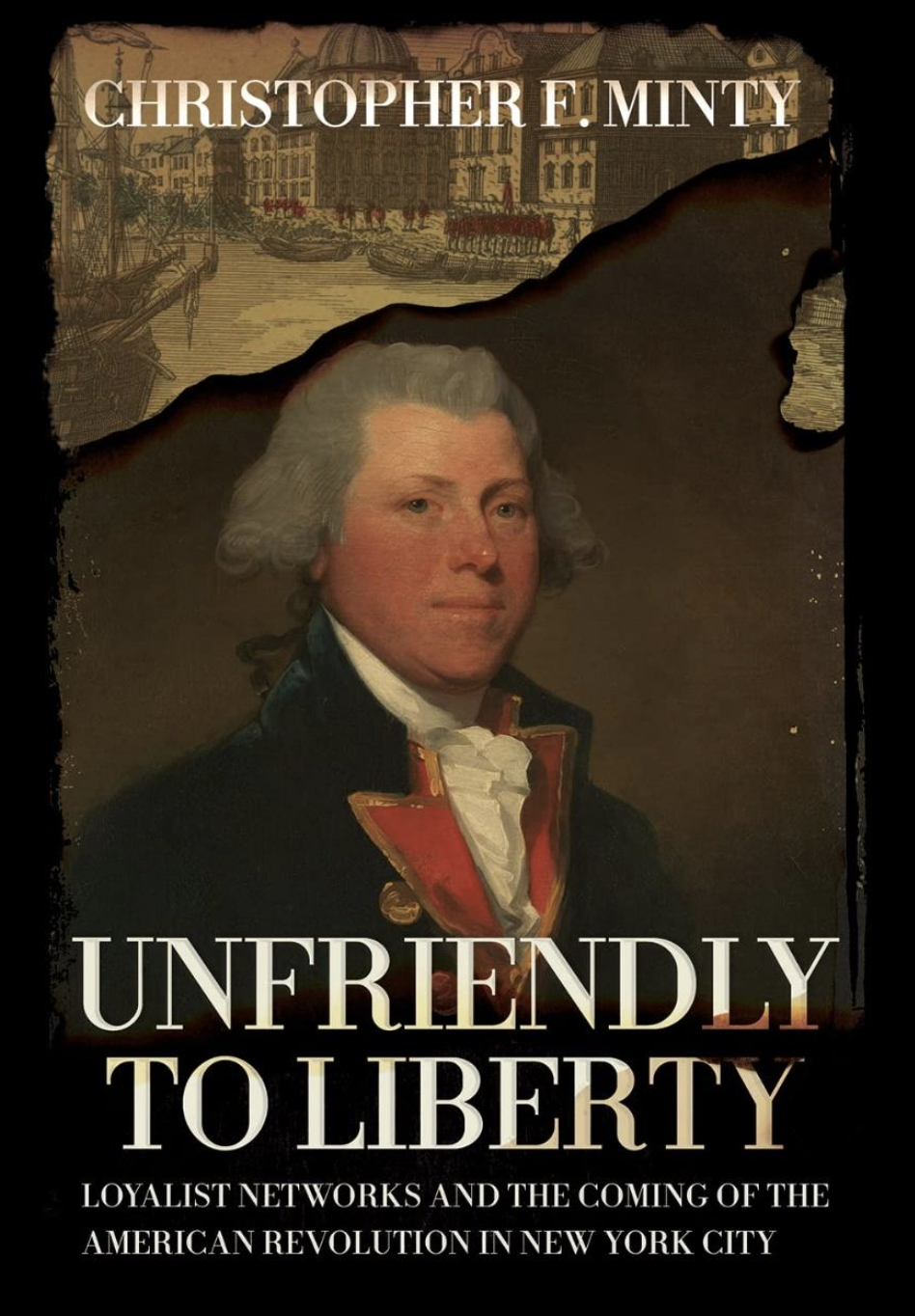
Unfriendly to Liberty: Loyalist Networks and the Coming of the American Revolution in New York City
by Christopher Minty
Cornell University Press
May 2023, 318 pp.
DS: Your book is based on an extensive body of primary sources. Finding sources related to New York’s Loyalists, however, can be a serious challenge. What types of sources did you use for your research and where might others interested in New York’s Loyalists look for doing research?
CM: Working on Loyalists means accepting, fairly early on, that their history survives in fragments. Their papers were rarely gathered together in one place, and often ended up far from New York—scattered across imperial repositories, private collections, and the bureaucratic record of displacement. The research process becomes one of tracking people across that uneven terrain, following traces wherever they appear.
Those traces take many forms. I drew on poll lists, tavern accounts, associational records, and, above all, the Loyalist Claims Commission papers in London, where individuals described—in often striking detail—the losses they sustained after the war. For those starting out, the New-York Historical Society (now The New York Historical) and the New York Public Library offer strong foundations. If New York Historical’s library ever reopens, that would be a great place to do further work. Beyond that, the work widens geographically. London, Ann Arbor, New Brunswick, and Nova Scotia, in particular, hold key pieces of the story, as well as smaller archives like the Royal Bank of Scotland’s archives in Edinburgh. The Loyalist archive reflects the experience: dispersed, layered, and best approached with patience.
DS: Unfriendly to Liberty opens with the Assembly elections of 1768 and 1769. You see these elections as an important inflection point that substantially altered New York’s political culture. Could you explain what New York’s politics and political culture looked like before 1768?
CM: Before 1768, New York’s political life moved within a relatively stable framework. A small number of families—the Livingstons, the DeLanceys—exercised sustained influence through landholding, commerce, and long-standing local authority. Their position rested on relationships that had developed over decades.
Elections occurred, though they rarely generated prolonged or intensive competition. Voters were not organized into enduring blocs, and candidates did not engage in continuous public campaigning. The elections of 1768 and 1769 unsettled that arrangement. Politics became more visible, more active, and more open to disruption. That shift proved lasting.
DS: You identify the “DeLanceys” as being instrumental in upending the established political order. Who were they, and why did you focus on them? Were they unique? Or did similar groups exist in other colonies?
CM: The DeLanceys stood at the center of New York’s political and commercial elite. Their importance lies in how they operated within that position. They organized, expanded, and adapted in ways that reshaped the city’s political landscape during a moment of change.
Their reach extended well beyond a narrow circle. Through commercial ties, religious affiliation, and shared participation in civic life, they connected individuals across different social settings. One finds them in formal institutions and in the everyday spaces where relationships were formed and reinforced. Similar developments were underway elsewhere in British North America, yet in New York the DeLanceys drew those threads together with particular effectiveness.
DL: What tactics did the DeLanceys use, and how did their campaigns in 1768/69 change New York City politics?
CM: They approached elections as sustained efforts requiring coordination and presence. Print played a central role—essays, notices, and arguments circulating through the city. At the same time, they invested in personal contact, appearing in taverns and other shared spaces where political discussion unfolded.
Their campaigns also reflected the city’s diversity. Appeals reached different linguistic and cultural communities, acknowledging the composition of New York itself. Over time, these practices altered expectations. Political engagement broadened, competition intensified, and outcomes came to feel contingent rather than assumed.
DS: One of your central concepts is “political economy” – that being the relationship between political institutions and economic systems, to include the way that states and governments ordered the economy and operated within the marketplace. What did the DeLanceyite vision for New York look like?
CM: My work here has been heavily influenced by Steve Pincus, Amy Watson, Justin du Rivage, and others. When I read their work, I saw similarities to mid-eighteenth-century New York City, and pursued it in some depth. Doing so, I think, helped me better understand the dynamics of Manhattan politics. The DeLanceyites, for example, worked with a clear sense that political authority and economic life were intertwined. They sought to secure New York’s position as a leading commercial center within the empire, while maintaining sufficient autonomy to protect local interests.
Led by James DeLancey Jr. (not the Westchester DeLancey of the same name), the DeLanceyites advanced this through institutional development. The Chamber of Commerce and the Marine Society provided structures through which merchants and maritime actors could coordinate their efforts. These organizations shaped policy, reinforced shared priorities, and helped define the city’s trajectory. Their program combined resistance to particular imperial measures with an ongoing investment in commercial expansion and stability.
DS: How did that vision interact with the wider imperial crisis?
CM: The position they occupied grew increasingly difficult to sustain. Their commitments tied them to the empire, while their political stance led them to resist parliamentary taxation and intervention. In the mid- to late 1760s, they played an active role in organizing opposition, including support for nonimportation and working with the Sons of Liberty.
As tensions escalated, the ground shifted. British authorities pressed their claims, while local critics moved toward more radical conclusions. The space available for adjustment narrowed, and the balance the DeLanceys had maintained became harder to hold.
DS: You emphasize the problem of teleology. How did the DeLanceyites’ earlier opposition to British policy complicate later Loyalism?
CM: Their earlier actions complicate any straightforward reading of Loyalism. During the late 1760s, they stood at the forefront of resistance to parliamentary taxation, organizing collective responses and asserting colonial rights in familiar terms. These people, who mostly became Loyalists, led the fight against Parliament’s reorientation of the British Empire. They worked alongside would-be revolutionaries like Isaac Low, John Lamb, and John Holt. But come the mid-1770s, they went in another direction.
Difficulties emerged in the context of governance. The controversy surrounding the Quartering Act in 1769, particularly their effort to link it to essential fiscal legislation, generated a strong reaction. Their decision reflected practical concerns about maintaining the colony’s finances. Opponents interpreted it differently, and that divergence shaped subsequent developments, altering perceptions and narrowing political options.
DS: While partisan alignment with the DeLanceys did not guarantee future loyalism, your book shows how frequent social engagement did help create a sort of “loyalist consciousness.” How did you recreate Loyalist networks from incomplete sources?
CM: The work unfolded gradually, through the accumulation of small pieces of evidence. Names reappeared across different records—tavern lists, election returns, associational memberships—and those repetitions began to form patterns.
Connections became visible over time. Individuals shared spaces, relationships, and experiences that linked them across contexts. By the early 1770s, these overlapping ties coalesced into recognizable networks. Loyalism emerged within that web of association, developing along lines already established in the preceding decade.
DS: The DeLanceys were crucial in ushering in a new era of politics to New York, but they did not hold a monopoly on their methods. Offering a different vision for New York’s place within the British Empire, you show how a competing group led by Alexander McDougall emerged amid the imperial crisis. How did the “McDougallite” vision differ, and did they outmaneuver the DeLanceys?
CM: Alexander McDougall is, I think, one of the most underappreciated and understudied figures in the American Revolution—and not just because he’s Scottish. He and his allies advanced a more confrontational approach to imperial authority. Their arguments pressed beyond reform toward a more direct challenge to the structures of empire. They proved highly effective in mobilizing support. Techniques associated with the late 1760s—print, association, public engagement—were employed with greater intensity and fewer constraints. The DeLanceys, operating within government and maintaining ties to an imperial framework under strain, moved more cautiously. Over time, that difference shaped the balance of influence. McDougall was eventually able to mobilize support and form relationships, even alliances, with prominent figures from other colonies, including John Adams and Samuel Adams.
DS: Why should 21st century New Yorkers should care about Loyalists? What is their legacy?
CM: Loyalists bring the Revolution back into focus as a lived experience shaped by uncertainty and competing commitments. They were woven into the fabric of New York’s political and economic life, participating in developments that defined the period.
Their influence extended into the structures that endured. Patterns of association, habits of organization, and the expansion of political engagement continued beyond the moment of rupture. Recovering their history brings those elements into view and underscores the range of possibilities that existed before outcomes hardened into certainty.
Christopher F. Minty is an editor at the Center for Digital Editing at the University of Virginia. He previously served as the assistant editor of the Adams Papers Editorial Project, and the managing editor of the John Dickinson Writings Project. He earned his PhD from the University of Stirling, UK and has made multiple contributions to Gotham: A Blog for Scholars of New York City History.
Dillon L. Streifeneder is Assistant Professor of History at the United States Naval Academy, Annapolis, MD and Associate Editor for Gotham: A Blog for Scholars of New York City. He is currently writing a book on state formation in New York spanning the colonial period through the American Revolution.