Masthead_Gloucester_Kearn.jpg
Posts in Gender & Sexuality
Ruinous, Bleak and a Bitter Sense of Freedom

Ruinous, Bleak and a Bitter Sense of Freedom

By Jeffrey Escoffier

Photography, at least before the digital era, has a special relationship to history. Unlike other visual images, photographs are ‘traces’ of what they portray— they are the direct result of light reflected from objects in front of the camera onto a chemical emulsion. The photographic trace is recorded at a moment of time and then stored for future viewing; it is, thus, automatically an historical representation. According to cultural critic Siegfried Kracauer, the historical significance of photographs rests on their capacity to record things normally unnoticed at the time.

Read More
A Vital Force: Immigrant Garment Workers and Suffrage

A Vital Force: Immigrant Garment Workers and Suffrage

By Karen Pastorello

At a New York City suffrage parade in the fall of 1912, Wage Earner’s Suffrage League vice-president Leonora O’Reilly led a delegation of working women toward Union Square toting a sign that read “We Want the Vote for Fire Protection.” Other women marching held signs depicting the “Asch Building Fire” that had ripped through the Triangle Shirtwaist Company the previous year.[1] The industrial tragedy shook the city and exposed the plight of urban immigrant workers to the rest of the world for the first time in history. For activists already engaged in working to better the lives of industrial workers, women labor activists’ reaction to the tragedy directly linked the possibility of improving working women’s lives to the vote. Women in the United States felt powerless in the workplace and the broader world around them. They did not have the right to influence legislation that would affect their daily lives. They did not have the right to vote. Suffrage would give working-class women another weapon to fight against the harsh conditions of their labor.

Read More
The Epistolarians

The Epistolarians

By Margaret A. Brucia

The nearly 300 letters were a jumbled heap— out of their envelopes, out of order, out of my field of expertise. But the moment I bargained for them that spring morning in the confusion of a Roman flea market, the academic focus of my life underwent a seismic shift, from the ancient Mediterranean world to New York City in the Gilded Age. Julia Gardiner Gayley’s letters, it turned out, were more than just interesting primary source material from the first three decades of the twentieth century, they were a passageway into the intimate lives of two strong, confident, articulate, independent-minded women. And they told a story worthy of Henry James or Edith Wharton, from the beginning of Mary’s Grand Tour of Italy in 1902 to her mother’s death in New York in 1937.

Read More
The Fight for Suffrage in New York State

The Fight for Suffrage in New York State

Reviewed by Marcela Micucci

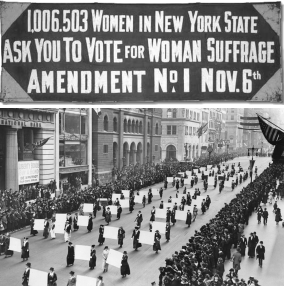
November 6th marked 100 years of women’s suffrage in New York. While celebrations of the landmark event have echoed across the state this past year, perhaps the greatest commemoration to the centennial year has been historians’ reignited interest in New York suffragists and their struggle to win the vote. Leading the charge in this cadre of works are Johanna Neuman’s Gilded Suffragists and Susan Goodier and Karen Pastorello’s Women Will Vote.

Read More