
Review: Martin V. Melosi's Fresh Kills: A History of Consuming and Discarding in New York City
Reviewed by Simone M. Müller
Fresh Kills Landfill was a human-made structure whose scale was gigantic in every conceivable dimension. With some 400 staff on site, holding twenty different job titles, the facility covered an area of about 3,000 acres, 2200 of which were available for fill. At the peak of its operation, in the late 1980s, Fresh Kills received about 29,000 tons of New York City’s municipal solid waste on a daily basis. Until its closure in 2001, Fresh Kills functioned as the world’s largest landfill in the heart of one of the world’s megacities.
Read More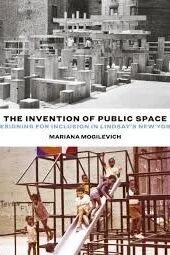
The Invention of Public Space: An Interview with Mariana Mogilevich
Interviewed by Katie Uva
Today on the blog, editor Katie Uva speaks to Mariana Mogilevich about her recent book, The Invention of Public Space: Designing for Inclusion in Lindsay’s New York. Mogilevich discusses the 1960s and 1970s as a uniquely inventive time in the city for defining and conceptualizing the use of public space. At a time when New York was dealing with deindustrialization, economic decline, and suburbanization, the Lindsay Administration made a conscious effort to develop inviting public space and support public interaction in city spaces, an attempt to lift up the city’s density and shared space as an asset rather than a liability.
Read MoreThe Sustainability Myth: An Interview with Melissa Checker
Interviewed by Katie Uva
Today on the blog, Gotham editor Katie Uva speaks to Melissa Checker about her recent book, The Sustainability Myth: Environmental Gentrification and the Politics of Justice. In it, Checker examines and critiques current frameworks of sustainability in New York, where sustainability and economic development are often seen as goals that are mutually supporting. Checker argues that this belief leads to gentrification, deepens economic inequality, and even winds up worsening environmental conditions in some parts of the city.
Read MoreActivist Philanthropy, Indeed
Reviewed by Jeffrey A. Kroessler
Have you recently trekked to a farmers’ market for fresh produce? In this lockdown year, do you miss attending concerts at Carnegie Hall? A Broadway show? Have you enjoyed roaming through the romantic landscape of Central Park, or wandered the streets of the city’s historic districts? Do you go out of your way to experience the inspiring urban spaces of Grand Central Terminal? Are you invigorated when you head west to the Hudson River Park and marvel at the river’s recovery?
Read MoreNew Amsterdam and Old New York: Remnants of Netherlandic Architecture in Late-17th Century New York City
By Jeroen van den Hurk
On the afternoon of Monday, June 7, 1697, Dr. Benjamin Bullivant set out from Boston on a trip down the East Coast that would take him all the way down to New Castle, Delaware, and back. The exact reason for his travel is unknown, but he carried with him various letters of introduction for dignitaries he would meet along the way. He also kept a travel diary in which he recorded notes on the built environment he saw in New York City, some of which he considered old and some of which he labeled new.
Read More
Reassessing American “Ruin”
Reviewed by Pedro A. Regalado
During the 1970s and 1980s, the South Bronx was the epicenter of American “ruin.” In the popular imagination, flames engulfed acres of developed cityscape; poverty and violence mingled with the remains of abandoned buildings; and a crack epidemic degenerated entire neighborhoods.
Read MoreA History of New York in 27 Buildings: The 400-Year Untold Story of an American Metropolis
Sam Roberts Interviewed by David O. Monda
David O. Monda, guest host of CUNY's Gotham Center for New York City History, speaks with longtime New York Times reporter Sam Roberts, host of CUNY-TV's The New York Times Close Up, about his new book — A History of New York in 27 Buildings: The 400-Year Untold Story of an American Metropolis.
Read MoreEngineering America: The Life and Times of John A. Roebling
Richard Haw, interviewed by Beth Harpaz
The beloved Brooklyn Bridge was one of the most daring feats of 19th Century engineering. The man who designed it was equally daring and a paradox of personality: An oddball who engineered a structure that was a marvel of stability at a time when suspension bridges routinely fell down. Richard Haw, a professor in the Interdisciplinary Studies Program at John Jay College of Criminal Justice, has written two previous books about the Brooklyn Bridge. The focus of his latest – after 13 years of research – is the man behind the bridge. Engineering America: The Life and Times of John A. Roebling tells one of the most fascinating American immigrant stories. Haw talks about it with Beth Harpaz, editor of CUNY SUM.
Read MorePublic Works: Reflecting on 15 Years of Project Excellence for New York City
Reviewed by Fran Leadon
“Public Works: Reflecting on 15 Years of Project Excellence for New York City,” on view at the AIA Center for Architecture, on LaGuardia Place, (before the Center closed for COVID-19) is a tiny exhibition about a big idea. In 1996, during Rudy Giuliani’s first term as mayor, the city created the Department of Design and Construction (DDC) in order to unify construction programs that had previously been scattered through the Transportation, Environmental Protection, and General Services departments. In 2004, under Mayor Michael Bloomberg, the DDC started a program called “Project Excellence” (also, confusingly, referred to as “Design and Construction Excellence.”)
Read More